Beyond Angkor Wat: Hidden Temples Worth Your Next Big Trip

There is a particular kind of quiet you find inside an ancient sacred space. It is not just the absence of noise. It is something heavier, more deliberate. The feeling that you are standing somewhere that humans have been returning to for centuries, not for entertainment, but because something about the place genuinely calls to them.
I first started noticing that feeling during my time teaching English in Thailand, when I would wander into village temples early in the morning before the heat built up. Monks in saffron robes moved through the courtyards. Incense drifted across worn stone floors. Nobody was performing anything for anyone. That quiet hit differently than any crowded landmark I had ever visited, and it changed what I look for when I travel.
The problem is that most travel content about “spiritual destinations” takes you straight to Angkor Wat, Bali, or Machu Picchu. These are genuinely extraordinary places, and I am not going to pretend otherwise. But the moment you arrive at a site where six tour buses are already parked and someone is selling selfie sticks at the gate, something in the experience shifts. You are no longer discovering; you are queuing.
So this guide is for a different kind of trip. It is for readers who want to go a little deeper, a little further, and come home with something they actually feel, not just photographs they have already seen everywhere else. As National Geographic reported in a piece on Cambodian temple alternatives, some of the most historically significant sacred sites on the planet remain genuinely undercrowded, simply because nobody told enough people about them.
These are those places.
Before You Go: The Basics of Visiting Sacred Sites Well
I want to lead with this because it matters more than any destination list. A sacred site is not an open-air museum. In most cases, it is an active place of worship, or it was one for so long that the cultural weight is still completely present. How you show up is part of the experience.
Here is what that looks like practically:
Cover your shoulders and knees. This applies almost universally, across Buddhist temples, Hindu shrines, Christian cave churches, and Shinto sites. Bring a lightweight scarf or sarong in your day bag; you will use it constantly. At many sites you will not be allowed in without it, and at others you will simply feel the eyes of local worshippers if you ignore the norm.
Take your shoes off without being asked. Watch where locals place theirs and follow. At some Thai and Cambodian sites, shoes come off at the outer entrance. At others, at the inner sanctuary. When in doubt, watch and mirror.
Move quietly, speak softly, and put your phone down sometimes. I know this sounds obvious, but it is easy to slip into documentation mode at a photogenic place. Let yourself actually be somewhere. The best moments at spiritual sites usually happen when you stop filming.
Hire a local guide when one is offered. At almost every site on this list, a local guide for $10 to $15 dramatically changes what you understand and feel. They know which carvings tell which stories, which structures were damaged by war and which by neglect, and often they are connected to the living religious community around the site. That context is irreplaceable.
Now, to the destinations.
Sambor Prei Kuk, Cambodia: The Forest Kingdom Before Angkor
Most travelers who visit Cambodia set their sights on Angkor and never make it to Kampong Thom Province. That is a significant loss, because Sambor Prei Kuk is a UNESCO World Heritage Site that predates Angkor by several centuries and sits in a jungle so unhurried it feels like a different country entirely.
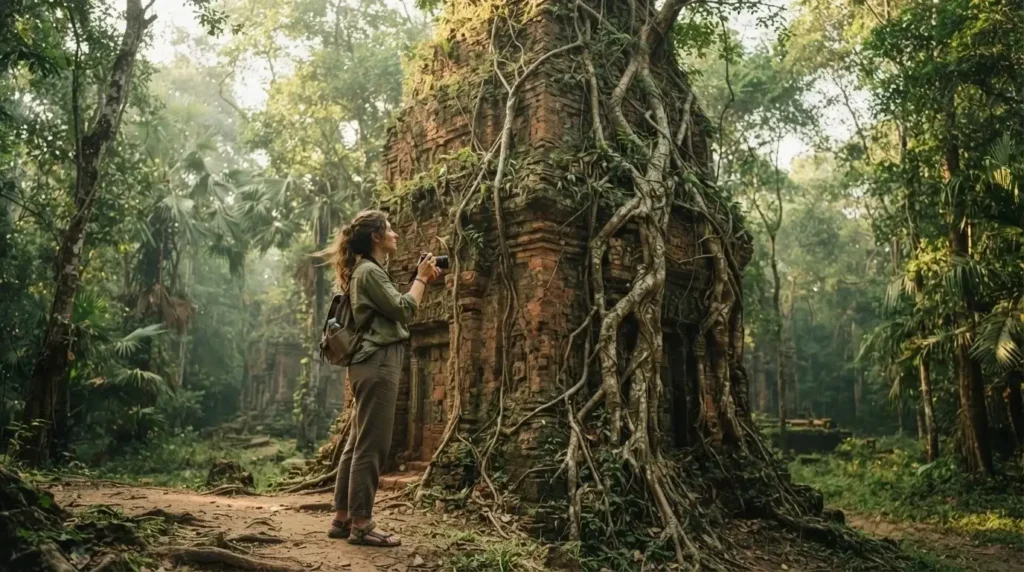
The complex contains over 100 brick temples from the 6th to 8th centuries, built during the pre-Angkorian Chenla Empire. Ten of the temples are octagonal, a design found nowhere else in Southeast Asia. Tree roots curl around crumbling towers the way they do at Ta Prohm in Siem Reap, but here you are not sharing the moment with a hundred other cameras. On a typical weekday morning, from what solo travelers consistently report, you may have entire temple groups to yourself for stretches of thirty minutes or more.
Getting there from Siem Reap takes about four hours by bus or shared taxi. From Phnom Penh, roughly two and a half hours. Kampong Thom town is the base; guesthouses there are simple but comfortable and very affordable. The entry fee is $10 USD for foreign visitors. Hire a local guide at the site for around $10 more. In two to three hours, a guide will take you through the three main temple groups (North, Central, and South) and point out the carved flying palaces and decorative roundels that distinguishing the site’s unique artistic vocabulary.
The best time to visit is early morning, when the light filters through the trees and the air is still cool. Go before 9 AM if you can. Bring water, sunscreen, and decent walking shoes. The ground between temple clusters is uneven and paths can be soft after rain.
What makes Sambor Prei Kuk spiritually affecting is precisely its silence. The jungle has reclaimed so much of it. You walk among towers wrapped in roots, feeling the way time actually works, which is slowly, and without your permission.
My Son Sanctuary, Vietnam: The Cham Civilization’s Sacred Valley
About 45 kilometers from Hoi An, tucked between jungle hills in Quang Nam Province, is a complex of Hindu temples that most travelers speed past on their way between Da Nang and Hoi An. My Son Sanctuary was the religious and political capital of the Cham Kingdom from roughly the 4th to the 13th centuries, and while the Vietnam War caused significant destruction, what remains is deeply moving.
My Son is a UNESCO World Heritage Site, preserving evidence of a civilization that blended local Cham culture with Hindu traditions from India in ways that produced some of the most distinctive temple architecture in Southeast Asia. The brick towers are reddish-orange, adorned with intricate carvings of deities, dancers, and elephants. The main complex is set in a natural valley surrounded by mountains on all sides. Even on a busier day, the geography creates a sense of enclosure and seclusion that is hard to shake.
Entry is 150,000 VND for foreign adults (around $6 USD), and the site is open daily from 6:00 AM to 6:00 PM. Traditional Cham dance performances are held four times a day: at 9:15 AM, 10:45 AM, 2:00 PM, and 3:30 PM. If you have the flexibility, the 9:15 AM showing works well because you can arrive at opening, catch the performance, and then explore the full complex before the midday heat builds.
The most practical tip solo travelers give consistently: hire the site’s own audio guide or a local guide. The Cham civilization left no written language that could be fully decoded until recently, and without context the carvings look impressive but remain abstract. A guide turns the site into a story.
From Hoi An, you can take an organized day trip (most guesthouses and hotels arrange these for roughly $10-15 including transport), rent a motorbike if you are comfortable with Vietnamese roads, or take a taxi or grab directly. The journey is about 45 minutes each way.
Fushimi Inari Taisha, Kyoto: Go Past Where Everyone Stops
I want to include Fushimi Inari here not because it is unknown (it is one of the most photographed shrines in Japan), but because 90 percent of visitors never experience it the way it is actually meant to be experienced, and that distinction is worth making.
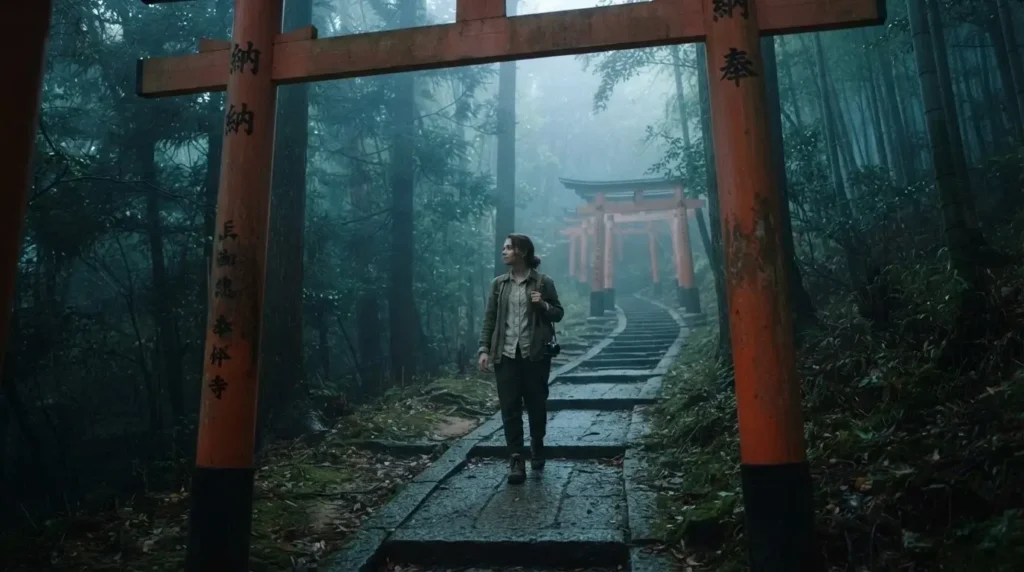
The famous tunnel of thousands of vermillion torii gates is genuinely stunning. But most visitors photograph the iconic lower section near the entrance and leave. They never walk the full mountain circuit. They never reach the quieter upper trails where the gates thin out, the forest closes in, and the atmosphere shifts from a scenic attraction to something more genuinely contemplative.
The official Fushimi Inari Taisha shrine website notes that the shrine was established in 711 AD and serves as the head of approximately 30,000 Inari shrines across Japan. Entry is free. The shrine is open 24 hours a day, 365 days a year. The full hiking circuit to the summit of Mount Inari and back takes two to four hours depending on your pace.
The key is this: arrive before 7 AM, or after 5 PM. The lower gates fill with tour groups throughout the day. But walk thirty minutes up the path past the Yotsutsuji intersection (about halfway) and the crowds disappear dramatically. The upper sections of the trail have small sub-shrines, stone fox guardians, and the kind of deep forest quiet that makes you understand why this mountain has been sacred for over a thousand years. Bring comfortable shoes. The path is paved but involves sustained uphill walking.
To get there from Kyoto Station, take the JR Nara Line to Inari Station (5 minutes, 150 yen). You can also walk from Fushimi Inari Station on the Keihan Line. Both put you at the shrine’s main gate within a minute of the exit.
Ellora Caves, India: Three Religions, One Hillside, Centuries of Silence
If you ask me to name a single place in the world where you can witness the meeting of Buddhism, Hinduism, and Jainism carved into the same stretch of volcanic rock over five centuries, the Ellora Caves in Maharashtra are it. And yet they remain significantly less visited than they deserve.
The Archaeological Survey of India manages the site, which contains 34 major caves carved between roughly the 6th and 12th centuries AD. Caves 1 to 12 are Buddhist. Caves 13 to 29 are Hindu, including the extraordinary Kailasa Temple (Cave 16), which is one of the largest single monolithic rock-cut structures in the world: an entire temple complex carved top-down out of a single basalt cliff. Caves 30 to 34 are Jain. Entry is 600 INR for foreign visitors and 40 INR for Indians. The site is open 6 AM to 6 PM, closed on Tuesdays.
What makes this place spiritually remarkable is not just the scale, which is staggering, but the fact that three distinct religious traditions chose the same hillside, across different centuries, without destroying what came before. That kind of coexistence is not common in human history. Walking through the caves, you feel it in the carved figures on the walls: the shift in imagery, the shift in story, the shift in what each tradition believed the divine looked like.
Ellora is located 30 km from Aurangabad, which has the nearest major airport. Day trips from Aurangabad are very straightforward, either by taxi (roughly 500-800 INR one way) or through a local guesthouse tour. Plan for at least a full day. If you have four to five hours, prioritize Cave 10 (the Visvakarma, a Buddhist cave with a stunning carved stupa), Cave 16 (the Kailasa, unmissable), Cave 21 (the Ramesvara, particularly beautiful Hindu carving), and Caves 32 to 34 from the Jain group.
Lalibela, Ethiopia: Churches That Were Carved from the Ground Up
There are a handful of places in the world where you arrive and simply cannot reconcile what you are seeing with what your brain expected. Lalibela, in the highlands of northern Ethiopia, is one of those places.
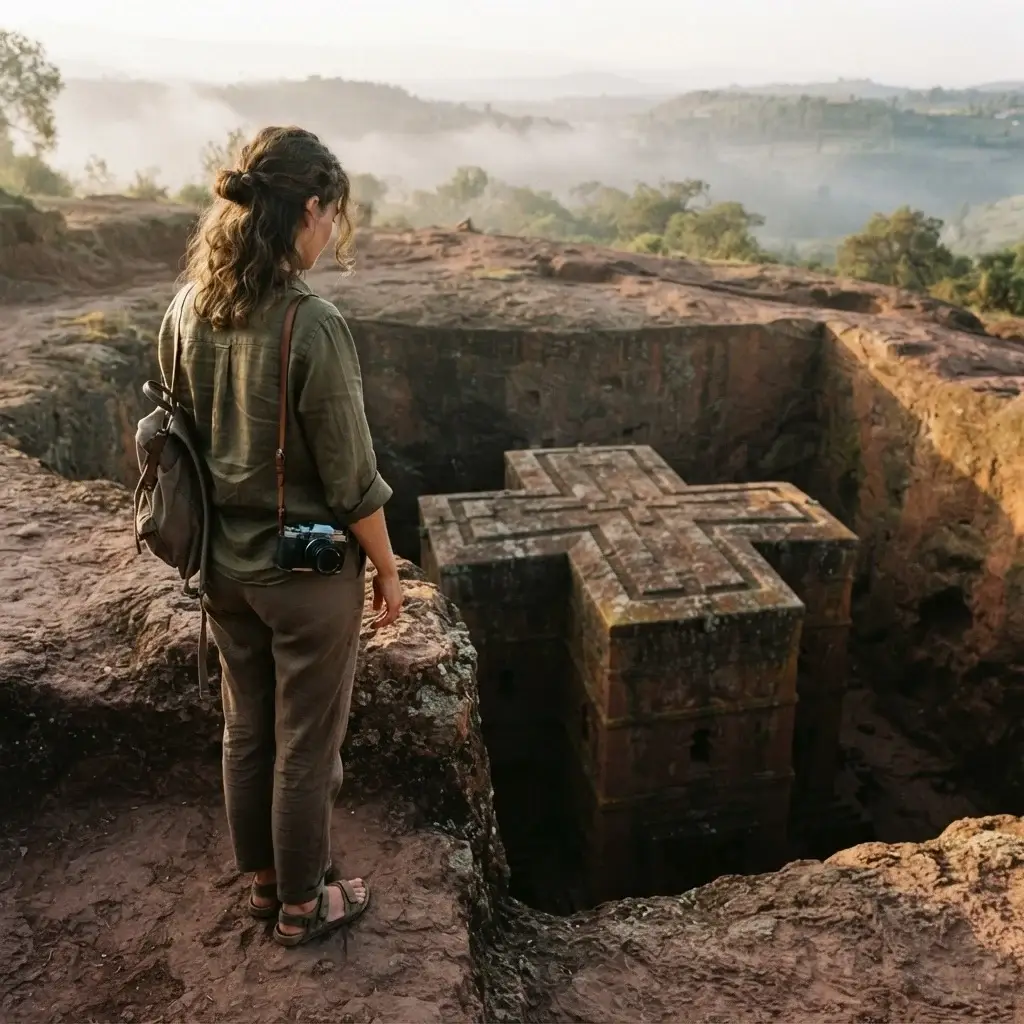
The rock-hewn churches of Lalibela are a UNESCO World Heritage Site, described by UNESCO as one of the most remarkable architectural achievements of any civilization. Eleven medieval churches were carved not into a hillside but downward through solid volcanic rock, creating structures that sit below ground level in open courtyards connected by underground tunnels and passages. King Lalibela built them in the 13th century as a “New Jerusalem,” and they remain active Ethiopian Orthodox Christian churches today.
This is a living religious site, not an archaeological park. Priests in white robes walk the tunnels. Morning services involve chanting, drums, and incense. If you arrive early enough and position yourself respectfully, you can witness worship that has continued with almost no interruption for 800 years. It is the kind of thing that stays with you, whatever your faith.
The entrance fee for the church complex is around $50 USD, valid for five days, which is worth every cent across multiple visits. An Ethiopian e-visa is available online and costs approximately $80 for a 30-day single entry. Direct flights to Lalibela run from Addis Ababa, the capital (about one hour by air). As of reports from late 2025, Lalibela has been considered safe for solo visitors flying in directly, though it is wise to check current conditions before traveling anywhere in Ethiopia, given the country’s complex regional situation.
Plan for a minimum of two full days. The church complex is divided into two main groups: the northern and the southeastern, with the famous Bete Giyorgis (Church of Saint George) slightly apart from both. Bete Giyorgis, carved in the shape of a Greek cross from above, is arguably the most photographed church in sub-Saharan Africa, and yet standing at the rim of the pit looking down at it, nothing quite prepares you for what you see.
Hire a registered guide at the entrance. They manage access to the interiors, carry the key information about each church’s history and current religious significance, and help you navigate the underground passages safely. Expect to pay around $40 for a full guide for two days.
The Thing Nobody Tells You About Visiting Sacred Places
There is a common anxiety I hear from readers before their first visit to a religious site in an unfamiliar culture. It goes something like: “I am not Buddhist/Hindu/Christian/Muslim. Is it disrespectful for me to be there?”
This is a good question asked with good intentions, and the honest answer in most cases is no, it is not disrespectful, provided you behave respectfully. The sites on this list, from Sambor Prei Kuk to Lalibela, receive visitors from across the world of all backgrounds and beliefs. The local communities that care for these places generally welcome visitors who come with curiosity and courtesy rather than performance and entitlement.
What matters is your posture when you arrive. Are you there to consume a spectacle or to genuinely learn something? Those two orientations feel different to the people who watch visitors come and go every day. Dress appropriately, move quietly, don’t photograph a ceremony in progress unless you have been clearly welcomed to do so, and ask before entering an inner sanctuary if a service is happening.
I have found, consistently through my own experience in places like Thailand and China, that the moments of genuine connection at sacred sites come not from trying to participate in something you do not fully understand, but from being genuinely, humbly present. That is available to everyone.
How to Build a Trip Around a Hidden Temple
Picking a temple is the easy part. Making the trip actually work around it is where most people get stuck. Here is a simple framework I use when planning:
Identify the nearest major city with an international airport. For Sambor Prei Kuk, that is Phnom Penh or Siem Reap. For My Son, it is Da Nang. For Ellora, it is Aurangabad via Mumbai. For Lalibela, it is Addis Ababa. For Fushimi Inari, it is Kyoto, accessible from Osaka Kansai or Tokyo.
Build two or three days around the sacred site specifically. Most of these places deserve more than a rushed half-day. The experience deepens on a second or third visit when you are no longer orienting yourself and can actually absorb.
Add a secondary cultural or natural experience nearby so the trip has rhythm. Kampong Thom near Sambor Prei Kuk has river life worth exploring. The Hoi An old town near My Son is one of the most beautifully preserved historic towns in Asia. The town of Aurangabad pairs well with a visit to Ajanta, another cave complex 100 km away. Lalibela is a starting point for broader northern Ethiopia exploration, including Gondar and the Simien Mountains.
Don’t overschedule. The reason sacred spaces work on you is because you give them time. If your itinerary has four sites in two days with transfers in between, the temple becomes just another stop. Slow down. Sit in the courtyard. Let the place do its work.
One Final Thought
I left an office job in New York, waited tables, saved money, and eventually started writing about travel because I believed that certain kinds of experiences were genuinely worth rearranging your life around. A quiet morning in an ancient stone courtyard, 6,000 miles from where you grew up, while monks chant and incense drifts and you realize you are completely, disoriently present – that is one of those experiences.
None of the places on this list are effortless to reach. That is partly why they are still worth reaching. The friction is actually part of it. The traveler who makes it to Sambor Prei Kuk or Lalibela is not the traveler who stayed home waiting for the perfect moment. They are the one who decided the moment was now, and figured the rest out on the way.
That can be you, whenever you are ready.