A Solo Traveler’s Guide to Underrated Ancient Ruins Worldwide

There is a specific kind of silence that only exists at ancient ruins.
Not the quiet of an empty room. Something older and heavier than that. The kind of silence that settles over you when you’re standing somewhere that has already outlasted every empire, every language, and every certainty humanity has ever built. And when you’re standing there alone, or close to it, that feeling is one of the most powerful things travel can hand you.
The problem is, most of the world’s famous ruins have lost that silence. Machu Picchu is extraordinary, but it is also daily home to thousands of visitors, regulated entry windows, and queues. Chichen Itza is genuinely impressive and also genuinely exhausting to experience in the middle of a tour group crowd. I understand why people go to these places. But if you’re a history lover, someone who wants to feel history rather than just photograph it, the most important ruins in the world might not be the most famous ones.
I’ve spent years thinking about what makes a destination worth traveling to, not the scale of it, not the Instagram value, but whether it changes something in you. And some of the places that have changed me, or changed the people I trust most when it comes to travel advice, were ruins I’d barely heard of before I started planning.
This guide is for travelers who want that. Real depth, real quiet, real history. With enough practical detail to actually get you there.
Before You Go Anywhere: The Mindset That Makes Ruins Come Alive
Here’s something I learned from my time working as a sightseeing guide in New York: the most important thing you can bring to any historical site is not your camera. It’s context. The tourists who stood in Times Square and absorbed nothing were the same ones who would stand in front of the Colosseum and feel nothing, because they had no frame for what they were looking at.
Before visiting any ancient site, spend thirty minutes reading. Not a travel blog. A history source. A quick overview of the civilization that built it, what they believed, why they chose that location, what ultimately ended them. That thirty minutes transforms a pile of old stones into a conversation with something human that lived and breathed centuries before you were born.
With that said, here are the ancient ruins I think every serious history lover should know about and, more importantly, how to get to them.
Göbekli Tepe, Turkey: The Site That Rewrote Human History
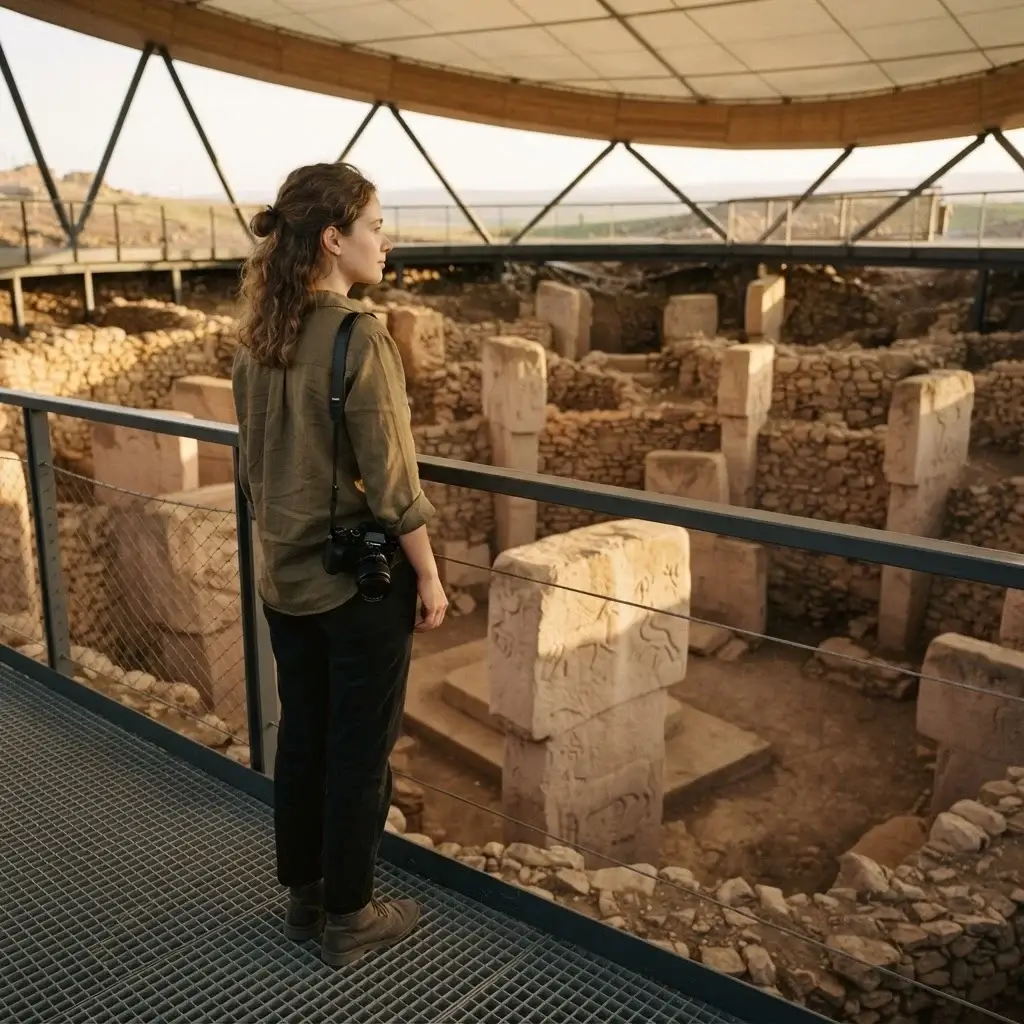
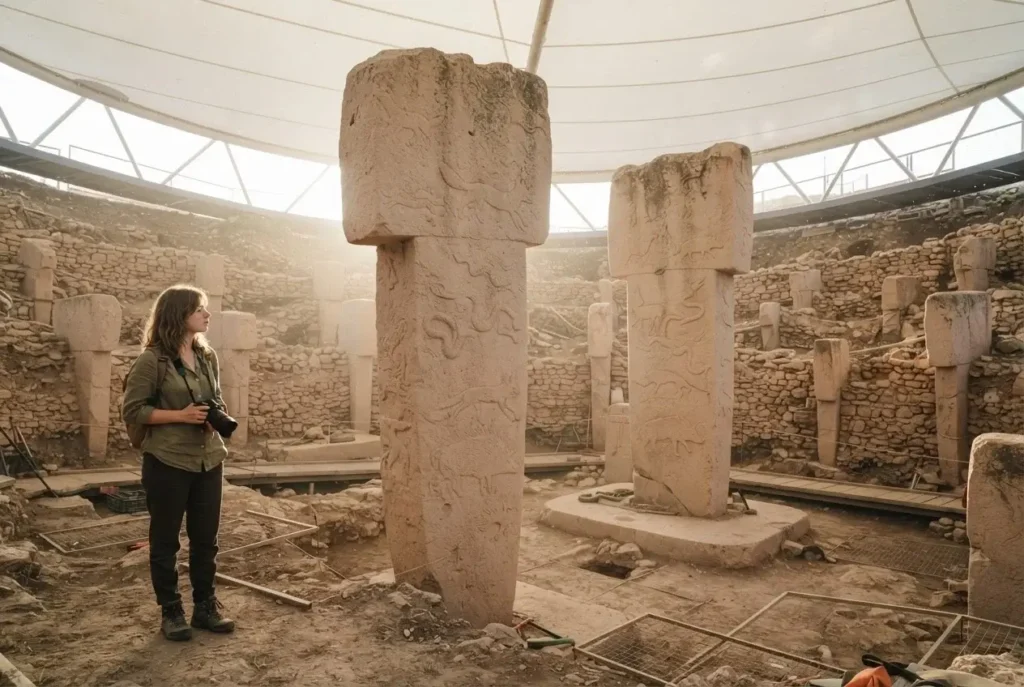
If you had to pick one ancient ruin that genuinely broke what archaeologists thought they knew about human civilization, Göbekli Tepe is it. Located about 12 kilometers northeast of the city of Şanlıurfa in southeastern Turkey, this site is widely understood to be the world’s oldest known temple complex, built around 9600 BC by communities of hunter-gatherers during the Pre-Pottery Neolithic period.
Read that again. Hunter-gatherers. Not settled farming communities. Not an organized city-state with surplus grain and a labor force. People who were still primarily mobile, who had not yet domesticated crops, somehow organized themselves to quarry, carve, and erect massive T-shaped limestone pillars up to 5.5 meters tall, decorated with intricate low-relief carvings of animals, abstract symbols, and what appear to be human forms. The site was designated a UNESCO World Heritage property in 2018, recognized explicitly as “one of the first manifestations of human-made monumental architecture” and as evidence of the creative genius of pre-agricultural societies.
What this discovery did to established archaeological thinking is enormous. For decades, scholars assumed that complex organized religion, monumental construction, and social hierarchy came after agriculture. Göbekli Tepe suggests it may have been the other way around. The act of building a sacred space may have been what drew people together long enough to eventually settle and farm. It doesn’t just change the timeline. It potentially changes the entire story.
Visiting it solo is genuinely manageable. Şanlıurfa is the base city, and the drive to the site takes about twenty minutes from the city center. Taxis are straightforward and drivers know the site well. A modern visitor center at the entrance includes bilingual exhibits, a documentary screening area, and a cafe. The excavation areas themselves are now protected under a large modern shelter, and elevated metal walkways give you clear overhead views of the circular enclosures and their carved pillars. For a full picture of opening hours, ticket prices, what to bring, and how to combine the visit with nearby sites like Karahantepe and the Şanlıurfa Archaeology Museum, the official visitor guide at gobekli-tepe.com is the most thorough and up-to-date resource available.
Plan at least two hours on site.
Spring (March through May) and autumn (September through November) are ideal seasons. Summer temperatures in southeastern Turkey regularly exceed 40 degrees Celsius, so if you go in July or August, arrive at opening time and carry more water than you think you need.
What to eat nearby: Şanlıurfa has one of the most distinctive and underrated food cultures in Turkey. Look for “cig kofte” (raw-style spiced bulgur rolls), “lahmacun” (thin flatbread with minced meat and herbs), and the city’s famous kebabs, particularly “urfa kebab,” which is milder and slightly smoky compared to its Adana counterpart. The old bazaar area near Balıklıgöl is a wonderful place to eat and wander after the ruins.
Jerash, Jordan: Rome’s Best-Preserved City Outside Italy
Most travelers who visit Jordan plan around Petra, and Petra absolutely deserves its reputation. But about 48 kilometers north of Amman, there is an ancient Roman city called Jerash (ancient Gerasa) that regularly stuns the visitors who make the detour. It is among the best-preserved examples of Roman urban planning anywhere in the world, and it receives a fraction of the attention that Petra does.
Walking into Jerash is walking into a living urban grid. You have the sweeping colonnaded Cardo Maximus, the main street lined with columns that once carried a covered walkway. You have two Roman theatres, a hippodrome, multiple temples including the Temple of Artemis whose towering columns are still standing, the Oval Plaza, public baths, and the triumphal Arch of Hadrian marking the ceremonial entrance to the city. The scale of it is disorienting. You expect a ruin. You find a city.
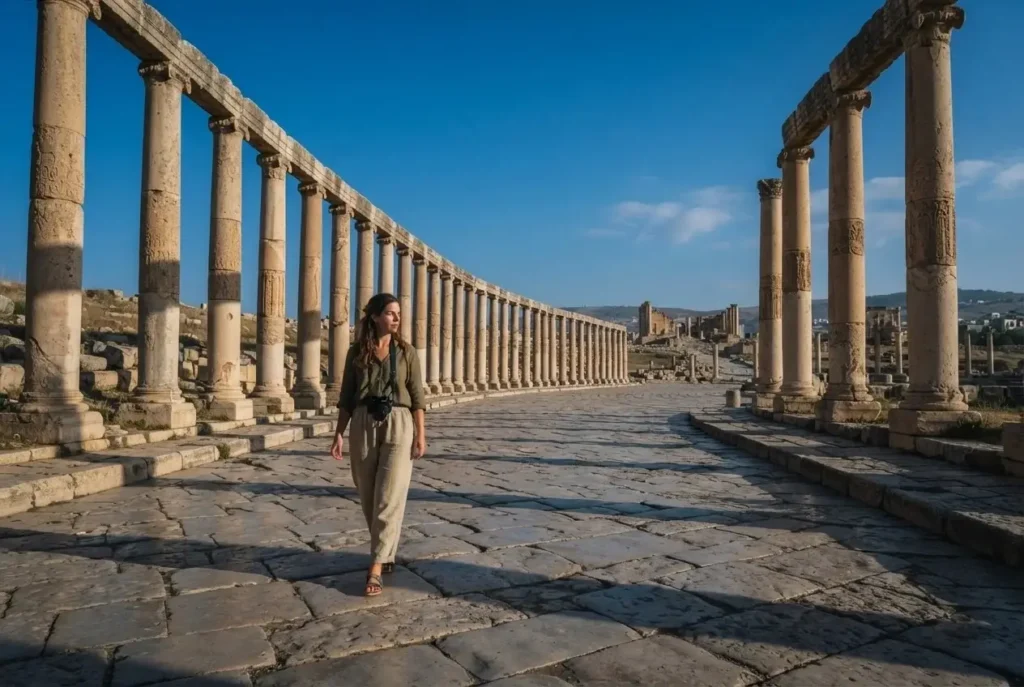
From what solo travelers consistently report, Jerash is particularly accessible and rewarding without a guide if you pick up a map at the visitor center on arrival, though hiring a local guide at the ticket counter adds genuine depth to the experience given how much history is packed into the site. The Jordan Tourism Board’s dedicated Jerash visitor information page has current opening hours: 8:00 AM to 4:00 PM in winter (November through April) and 8:00 AM to 6:30 PM in summer, with adjusted hours during Ramadan.
A practical note that many articles miss: if you are planning a multi-day Jordan trip, the Jordan Pass is worth serious consideration. It covers entry to more than 40 attractions including both Jerash and Petra, and for stays of three or more nights it also covers your tourist visa fee. For most international travelers, the math works out strongly in your favor if Jerash and Petra are both on your itinerary.
What to eat nearby: The town of Jerash itself has a handful of good local restaurants near the archaeological park entrance. Look for fresh hummus, ful medames (slow-cooked fava beans), and mansaf if you are there for lunch, a slow-cooked lamb and rice dish served with a fermented yogurt sauce called jameed. It is Jordan’s national dish and a genuinely unique eating experience.
Volubilis, Morocco: Where Rome Met Africa
Morocco does not come up in most conversations about Roman history, which is exactly why Volubilis deserves to be on every history lover’s radar. Located between the imperial cities of Fez and Meknes, on a commanding hillside at the foot of the Jebel Zerhoun mountains, Volubilis is the best-preserved Roman archaeological site in Morocco and one of the most atmospheric ancient sites I’ve come across in my research.
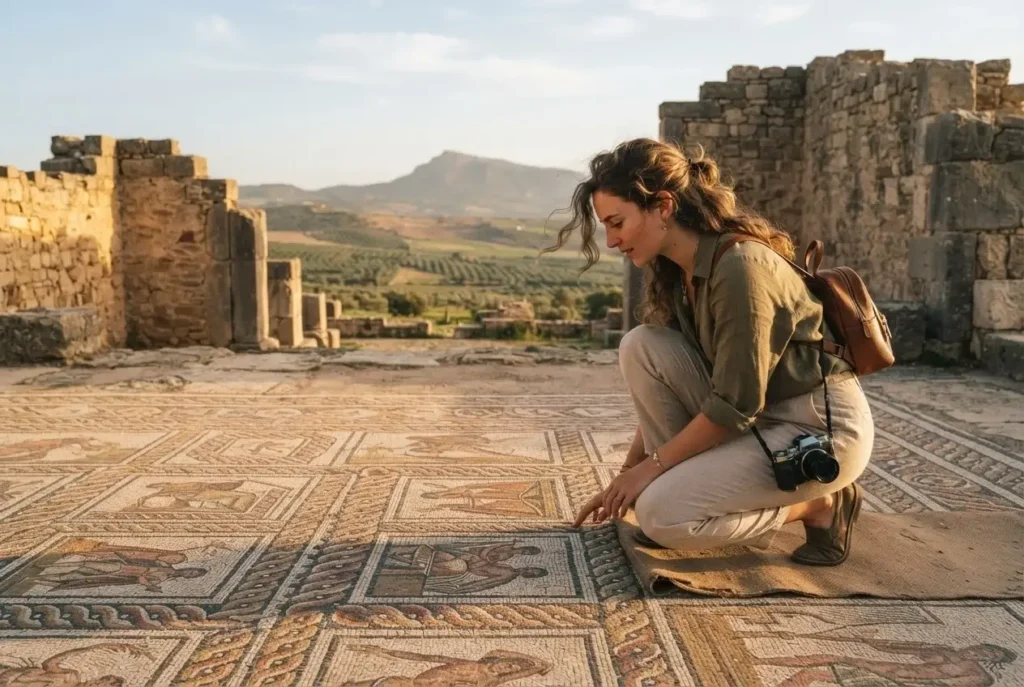
What makes it extraordinary is not just the Roman layer, though the mosaics at Volubilis are genuinely world-class, some of the best-preserved in-situ Roman mosaics anywhere in the world. It is the full spectrum of civilizations the site documents. As the UNESCO World Heritage listing for Volubilis explains, the site bears witness to Mauritanian, Punic, Roman, Christian, and early Islamic cultures across roughly ten centuries of continuous occupation. The ruins were left largely untouched for nearly a thousand years after the Islamic period, which is a significant reason they remain in such good condition.
Visiting is practical and affordable. The site is open daily from 8:30 AM until one hour before sunset. Entry is 70 MAD, which is roughly seven US dollars. It sits between Fez (about 50 kilometers to the east) and Meknes (about 30 kilometers to the south), making it a natural addition to any Moroccan itinerary built around the northern imperial cities. Most travelers rent a car for the day or hire a grand taxi from Meknes for a half-day trip, which gives you the flexibility to stop at the adjacent hilltop town of Moulay Idriss, an important site in Islamic history and well worth a brief walk.
The mosaics are the headline at Volubilis, many still in their original floor positions within the outlines of Roman homes and public buildings. Bring your best walking shoes, wear sun protection, and arrive in the morning when the light hits the colored stone beautifully and before the midday heat kicks in.
What to eat nearby: The town of Moulay Idriss, a ten-minute drive from Volubilis, has several small local cafes where you can eat a simple but excellent Moroccan lunch: harira soup, kefta brochettes (minced spiced lamb skewers), and mint tea. This is the kind of village lunch that costs almost nothing and that you’ll remember.
Timgad, Algeria: The Pompeii of Africa That Almost No One Knows About
This is the one that tends to surprise people most. In the highlands of northeastern Algeria, on the northern slopes of the Aures mountains, there is a Roman city so well planned, so symmetrically laid out, and so completely frozen in time that archaeologists and travelers who know it call it the Pompeii of Africa.
Timgad was built from scratch in AD 100 by the Emperor Trajan as a military colony for Roman veterans, designed on a perfect square grid with a central forum, theatre, library, and market. Unlike Pompeii, which was buried by catastrophe, Timgad was gradually abandoned over centuries and then slowly swallowed by Saharan sand, which preserved it remarkably well until excavations began in the 1880s. What emerged was essentially a complete Roman city plan, streets, foundations, archways, an amphitheatre, and a triumphal arch, all in the middle of the Algerian high plains. The site has been a UNESCO World Heritage property since 1982.
Algeria is a destination that requires more planning than the others on this list. Visas are required for most nationalities and should be arranged well in advance. The infrastructure for independent tourism is less developed than in Morocco or Jordan, which is precisely why the crowds are near zero. Travelers who have been consistently describe it as one of the most overwhelming and moving Roman sites they have visited, specifically because you may share it with almost no other tourists. A guided approach, either through a reputable tour operator running Algeria archaeological tours or by hiring a local guide in the city of Batna (the nearest major city), is strongly recommended both for context and for logistics.
Timgad is not the easiest destination on this list. But if ancient Rome genuinely moves you, the idea of walking the streets of a perfectly planned Roman city in the African highlands, with almost no one else around, is the kind of experience that this type of travel exists for.
What to eat nearby: Algerian food in this region leans heavily on Berber and Roman culinary traditions. Look for “chakhchoukha,” a regional dish of torn flatbread cooked in a spiced lamb and chickpea stew, and “mesfouf,” a sweet couscous made with dried fruits and nuts. The food around Batna is honest, slow-cooked, and deeply regional.
Moray, Peru: Inca Engineering That Still Confuses Experts
The Sacred Valley of the Incas near Cusco is already on many travelers’ radar, primarily because of Machu Picchu. But within the Sacred Valley, tucked into the landscape about 50 kilometers northwest of Cusco, there is an Inca site called Moray that most day-trippers to the region miss entirely.
Moray is a series of large, circular terraced depressions carved into the landscape, the largest reaching about 30 meters deep. The precise engineering involved created measurably different microclimates at each level, with temperature variations of up to 15 degrees Celsius between the top and bottom terraces. The leading theory is that this was a sophisticated agricultural research station, where the Incas experimented with growing different crops at different altitudes and temperatures. It is, by any measure, extraordinary evidence of scientific thinking in a pre-modern civilization.
From what travelers consistently report, Moray is genuinely quieter than most Sacred Valley sites. Entry is covered by the Cusco Tourist Ticket (Boleto Turístico) and visiting hours run from 8:30 AM to 5:00 PM. It pairs naturally with the nearby Maras salt mines, a series of thousands of small salt evaporation pools still actively worked by local families, making for one of the most visually dramatic half-days in the region. Most travelers combine the two on a single day trip from Cusco, either by hired taxi or as part of a small-group Sacred Valley tour.
What to eat nearby: The village of Maras itself has a few small family-run restaurants where you can eat “sopa de quinoa” (quinoa soup), “trucha a la plancha” (grilled trout from the Sacred Valley rivers), and fresh corn preparations. Eating in a village like Maras rather than a tourist restaurant in Cusco is one of those simple choices that completely changes how a destination feels.
Hierapolis, Turkey: A Roman Spa City Built Over a Miracle of Nature
Most people who visit Pamukkale in western Turkey go for the famous white travertine terraces, the natural calcium carbonate pools that look, from a distance, like a hillside covered in snow. Far fewer appreciate what is sitting directly alongside those terraces: the remarkably preserved ruins of Hierapolis, a Greco-Roman city that was built around the thermal springs for centuries and served as a significant pilgrimage and healing destination in the ancient world.
Hierapolis has a full ancient theatre still standing in impressive condition, a colonnaded street, extensive necropolises, the ruins of a large Byzantine church, and the Plutonium, a cave sacred in antiquity and believed to be an entrance to the underworld due to the toxic carbon dioxide emissions from the thermal vents. The combination of ancient city and extraordinary natural landscape makes the site genuinely unique among ancient ruins, and the combination means you can spend a full day here easily.
Entry as of 2026 is 30 euros per person, covering both the Hierapolis archaeological ruins and access to the Pamukkale travertines. The official Turkish government ticket site is muze.gov.tr. Plan to arrive early, both to beat the crowds on the terraces and to experience the ruins in morning light before the heat of the afternoon.
The site is not a secret, but most tourists spend their time on the travertine pools and give the ruins a cursory walk-through. If you go in the opposite order, start at the theatre and the colonnaded street, then work your way toward the terraces as the afternoon light shifts, you’ll have a much richer experience than the average visitor.
What to eat nearby: The modern town of Pamukkale at the base of the hill has several solid local restaurants. Look for “gozleme” (thin flatbread stuffed with cheese, spinach, or minced meat and cooked on a griddle), local olives and white cheese, and for a full meal, any restaurant serving fresh lamb dishes and mezes in the Aegean style.
The Practical Things Nobody Tells You About Ancient Ruins Travel
A few honest notes before you start booking flights:
Getting to remote ruins often takes more time than the map suggests. This is especially true for Timgad in Algeria and Göbekli Tepe in Turkey, where the surrounding region is not heavily developed for tourism and transport connections are less frequent. Build buffer days into your itinerary and don’t try to rush through multiple remote sites in a single day.
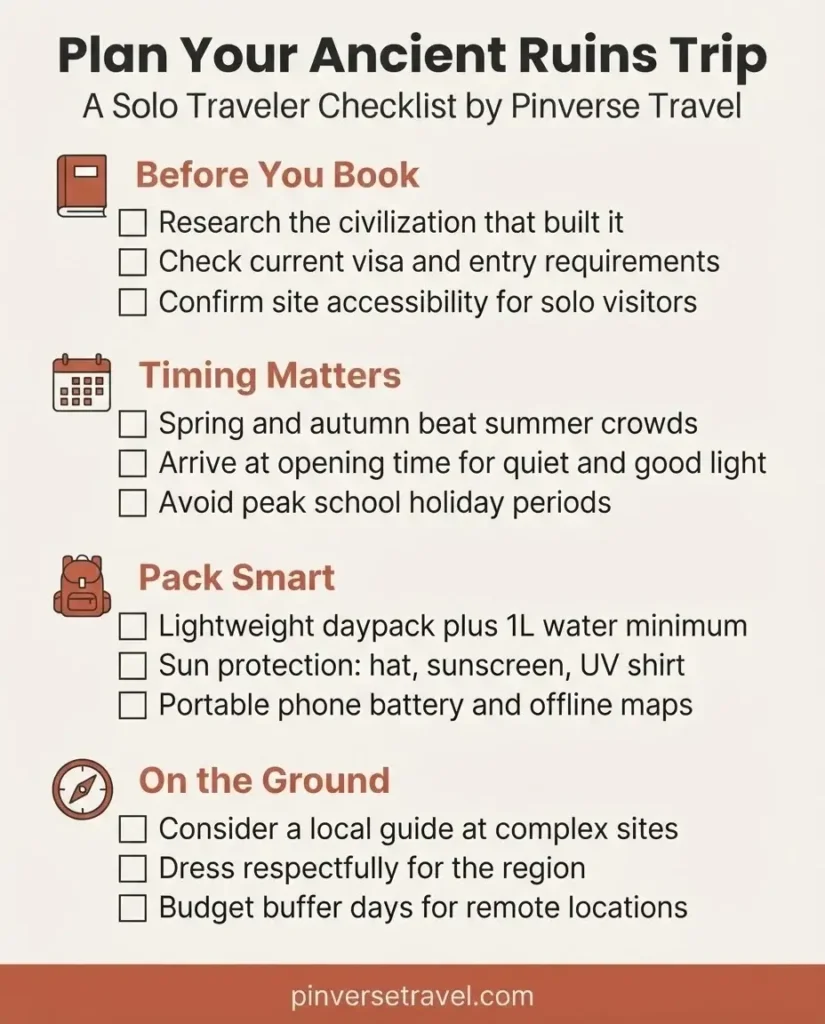
The question of guide versus solo exploration is genuinely worth thinking through. At a well-developed site like Jerash, a self-guided visit with the visitor center map is very satisfying. At a site like Timgad, where the historical layers are complex and the on-site interpretation is limited, a good guide genuinely doubles the value of the visit. Most sites allow you to hire local guides at the entrance, and doing so directly supports the local economy in ways that matter.
Dress and behavior codes are not just formalities. Many ancient sites sit in culturally conservative regions. At Göbekli Tepe, you’re in southeastern Turkey, a deeply traditional and hospitable area where covering your shoulders and knees shows respect, even though the archaeological site itself has no strict dress requirement. At Volubilis and Timgad, you are in rural North Africa where modest dress is appreciated. Travel with respect, not just curiosity.
Finally, early morning visits almost always pay off. The light is better for photographs, the temperature is lower, and the silence is closer to what those spaces deserve. If a site opens at 8:00 AM, be there at 8:00 AM.
Why This Kind of Travel Matters
When I worked as a certified sightseeing guide in New York, I watched thousands of people walk past some of the most interesting history in the world without absorbing any of it. The problem was not the history. It was the speed, the crowds, and the passive consumption. Everyone was moving too fast to feel anything.
The ruins on this list invite you to slow down. Some of them will require real effort to reach. That effort is part of the point. When you stand at Göbekli Tepe and look at carvings made by hunter-gatherers 12,000 years ago, or walk the grid streets of Timgad in the Algerian highlands with almost no one around, the size of human history becomes real in a way no textbook or documentary can replicate.
That is worth traveling for. The imperfect logistics, the long taxi ride, the early morning alarm, all of it. Because on the other side is something that genuinely changes how you see the world and your small, brief, miraculous place in it.
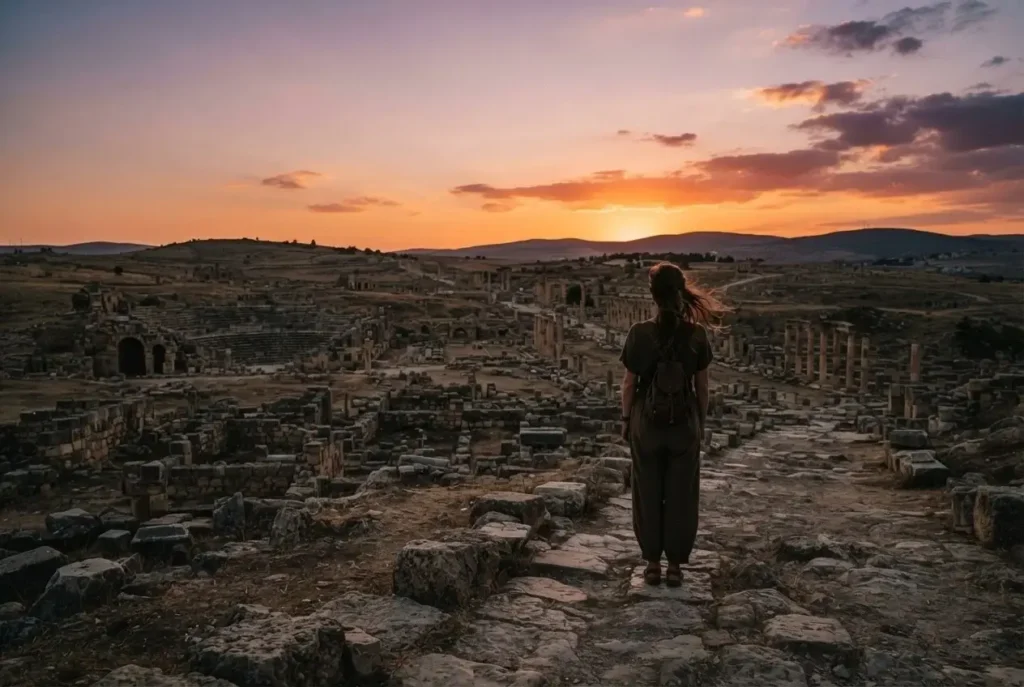
Start planning. Stop waiting for the perfect moment. The ruins are already there.