Best Forest Bathing Experiences in the Americas for Solo Travelers

There is a moment, maybe twenty minutes into a forest walk, when the noise in your head finally stops. Not because you forced it to, but because the trees did something you could not do for yourself. The light shifts, the sound of leaves takes over, and your nervous system quietly exhales. That is forest bathing.
I grew up in New York City. I know what it feels like to be surrounded by concrete and noise every single day, to have your senses constantly pulled in a hundred directions. Working as a sightseeing guide, I spent years pointing at buildings, talking over taxi horns, smiling on cue. It was good work. But every time I got outside the city, even just to a park, I felt something shift. A kind of settling.
When I first heard about forest bathing, I thought it sounded like something invented for a wellness magazine. A walk in the woods dressed up with a fancy Japanese name. Then I looked into the actual research, talked to people who had done it, and started to understand that this is not a trend. It is a practice, and it has real results. The Americas, from the temperate rainforests of the Pacific Northwest to the cloud forests of Costa Rica to the Amazon basin, happen to be home to some of the most powerful forest bathing landscapes on the planet.
This guide is for solo travelers who want to slow down deliberately. Not hike harder. Not rush through. Just slow down, breathe, and let the forest do its work.
What Forest Bathing Actually Is (And What It Is Not)
Forest bathing, or shinrin-yoku in Japanese, literally means “taking in the forest atmosphere.” It was introduced by Japan’s Ministry of Agriculture, Forestry and Fisheries in 1982 as a recognized form of stress management and preventive healthcare. It is now a cornerstone of Japanese wellness culture, and the research behind it has grown substantially over the past four decades.
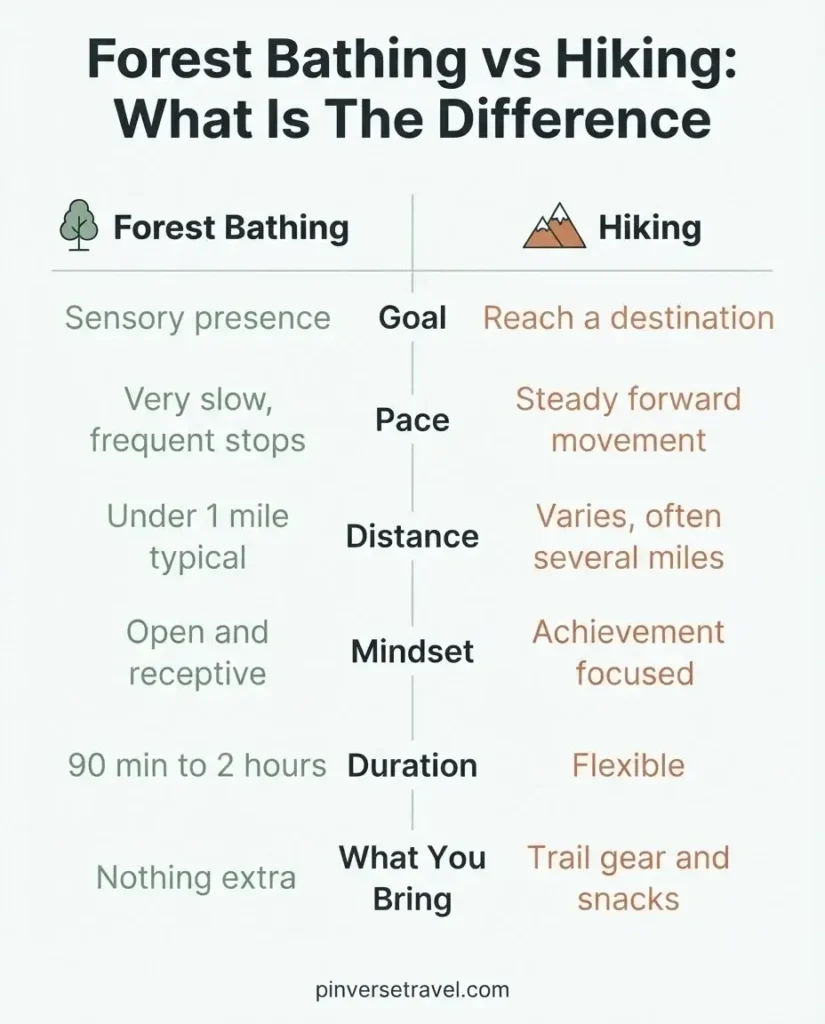
Here is what forest bathing is not: it is not hiking. That distinction matters. Hiking is typically about covering distance, reaching a summit, or achieving a physical goal. Forest bathing is the opposite of that. You move slowly, sometimes covering less than a mile in two hours. You stop. You sit. You notice what is around you: the texture of bark, the sound of water, the smell of pine resin, the way light filters through a canopy. The goal is sensory presence, not distance.
The New York State Department of Environmental Conservation describes the benefits clearly: exposure to forests boosts the immune system, lowers blood pressure, reduces stress, improves mood, increases the ability to focus, accelerates recovery from surgery or illness, and improves sleep. These are not soft claims. They are supported by peer-reviewed science.
The mechanism behind much of this is phytoncides, airborne organic compounds that trees release to protect themselves from insects and disease. When you breathe them in, your body responds. Research published in the National Institutes of Health journal Environmental Health and Preventive Medicine found that a single 3-day, 2-night forest bathing trip significantly increased natural killer cell activity, and that elevated immune function lasted for more than 30 days afterward. A city tourist trip produced no comparable effect. This was not about exercise or travel itself. It was specifically about the forest.
For solo travelers, the mental health angle is especially relevant. Being alone with your thoughts in a forest, moving slowly without a destination, is one of the most effective forms of active mindfulness I know of. You do not need experience. You do not need to be fit. You just need to show up and be willing to slow down.
Guided or Self-Guided: What to Know Before You Go
You can forest bathe on your own, and many people do. But if you are new to the practice, a certified guide changes the experience significantly. A good guide does not lecture. They create invitations: prompts to use your senses in specific ways, moments of stillness, and gentle movement activities that help you drop out of your thinking mind and into your body. The session typically ends with tea made from forest ingredients, which is a quiet, grounding ritual that caps the experience beautifully.
In the United States and Canada, most certified guides are trained by the Association of Nature and Forest Therapy (ANFT), the leading professional body for this practice. Their directory is searchable by location, which makes it easy to find a guide wherever you are traveling. A guided session typically costs between $35 and $80 per person, depending on the location and group size.
If you prefer to go solo, the practice is simple. Find a quiet, forested area. Leave your phone in your bag or on airplane mode. Move slowly. Stop often. Use your senses intentionally: look at what is close to you, not at the horizon. Touch bark, moss, soil. Listen to what changes as you move. Sit for longer than feels comfortable. That discomfort with stillness is exactly what you are practicing through.
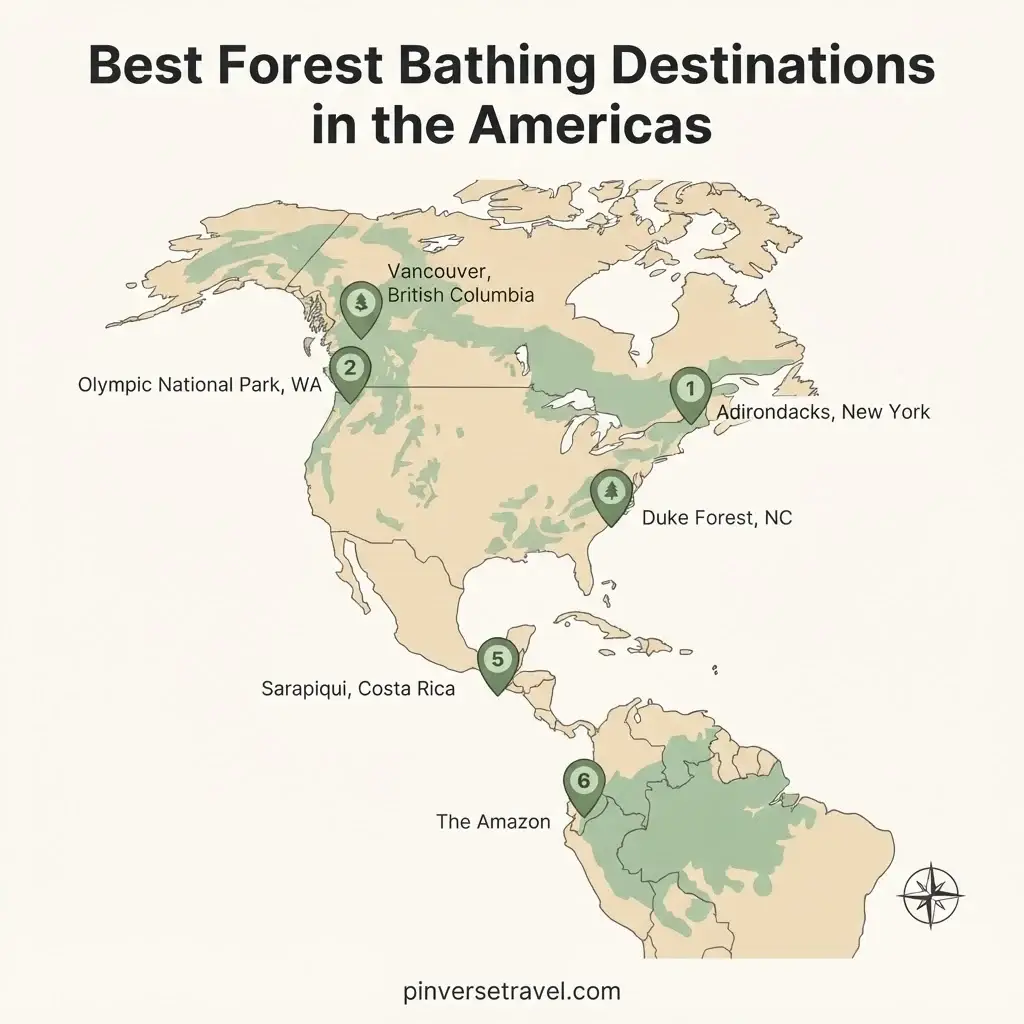
The Adirondacks, New York: A Weekend That Changes Your Week
For anyone based in the Northeast, or traveling through upstate New York, the Adirondack Mountains are one of the most accessible and genuinely rewarding forest bathing landscapes in the country. I have spent time in New York my whole life, and there is something specific about the Adirondack forest, the combination of northern hardwoods, moss-covered rocks, and rivers, that feels immediately restorative.
Adirondack Riverwalking and Forest Bathing, based in Saranac Lake, offers guided sensory walks led by a certified guide on gentle terrain throughout the region, including Saranac Lake, Lake Placid, and Tupper Lake. Their guided season runs from May 1 through December 1, and a session for up to four people costs $200, with $35 per additional adult. Sessions run about 2.5 hours and are designed to be accessible to all fitness levels, including children over six years old. Reviews consistently describe the experience as unexpectedly moving, which I think is exactly the right word for it. You go in thinking it is a walk. You come out wondering why you waited so long to slow down like that.
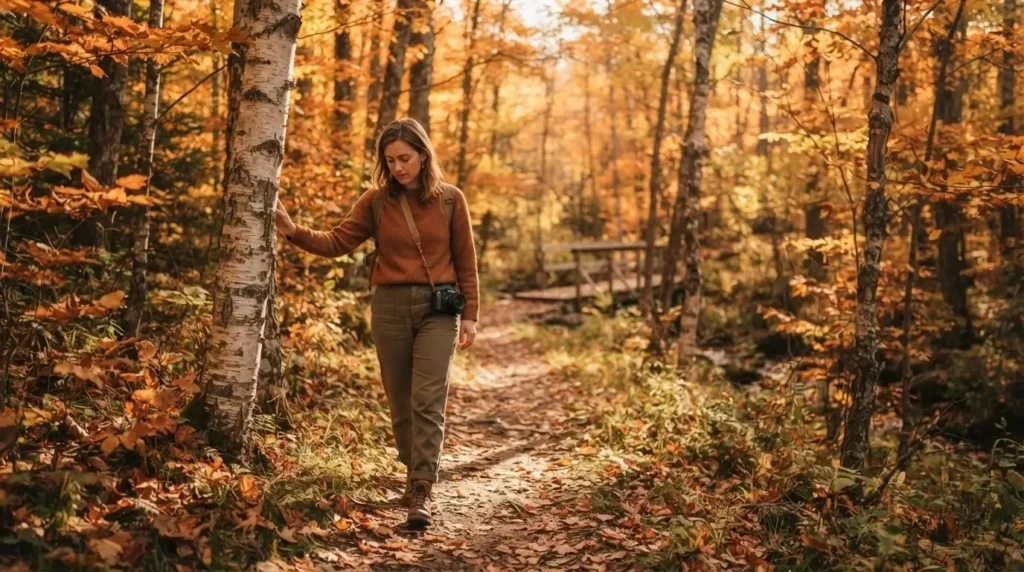
The surrounding Adirondack Park covers over six million acres, which makes it the largest publicly protected area in the contiguous United States. You do not need a guide to wander its trails, but having one your first time helps you understand what you are actually doing and why, which makes it much easier to practice on your own later.
Best time to visit: late May through October for temperate conditions and peak foliage. Winter forest bathing is also offered and has its own quiet intensity.
Olympic National Park, Washington: The Hoh Rainforest
If I were choosing one forest bathing destination in the Americas purely on the quality of the forest itself, the Hoh Rainforest in Olympic National Park would be a serious contender. Solo travelers consistently describe it as one of the most surreal, enveloping natural environments in North America, and from everything I have researched and gathered from people who have experienced it, they are not wrong.
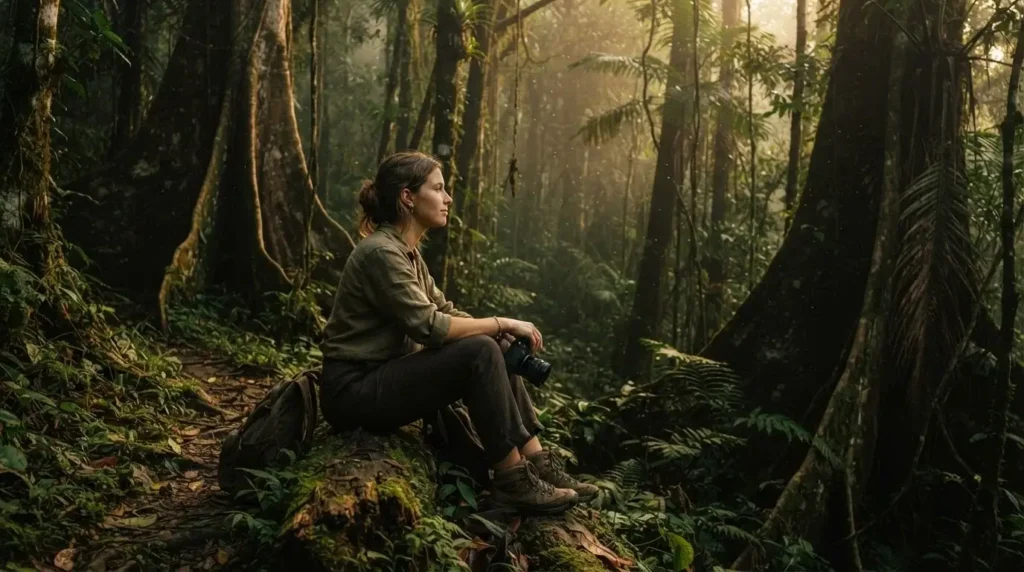
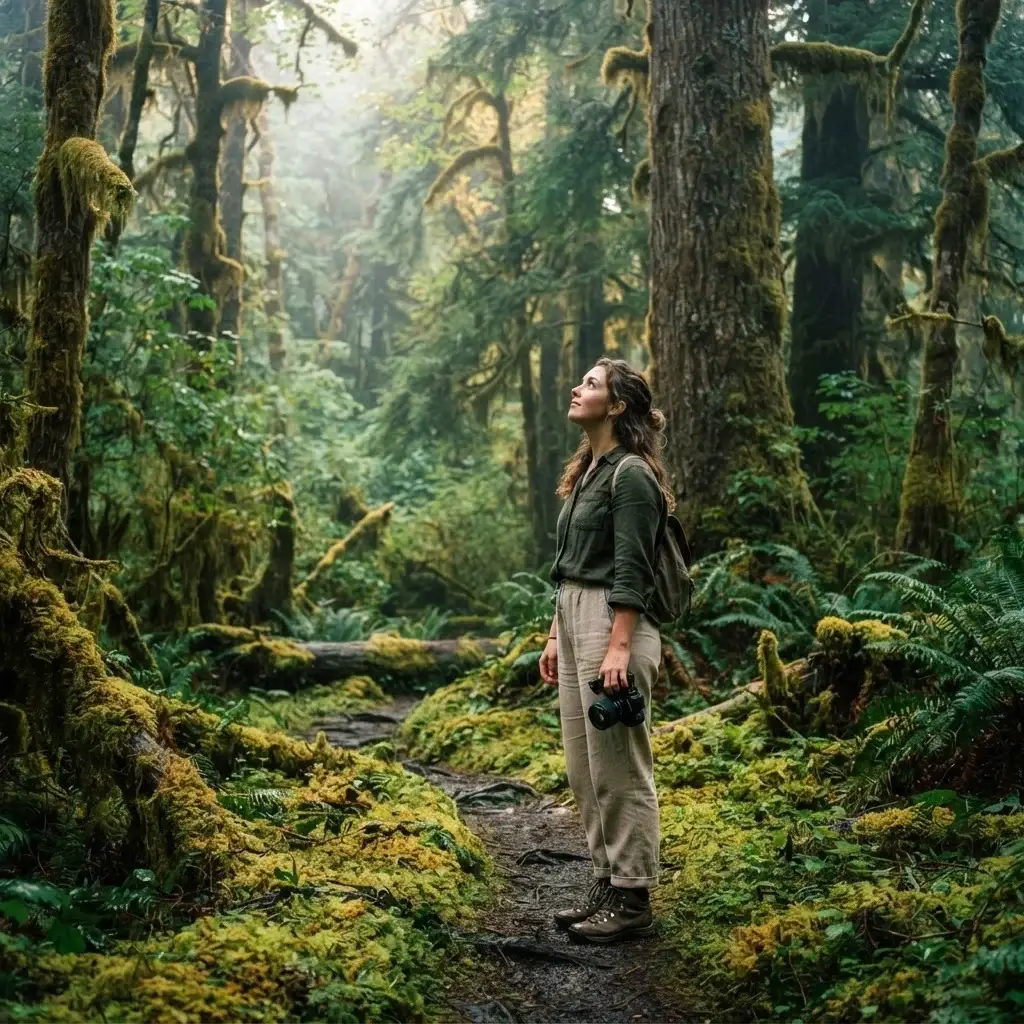
The Hoh is one of the finest remaining examples of temperate rainforest in the United States, receiving an average of 140 inches of rain per year. The result is a landscape draped in hanging moss, enormous Sitka spruce and bigleaf maple, carpets of ferns, and near-total silence except for the sound of the Hoh River. The Hall of Mosses Trail, just 0.8 miles long, loops through old-growth forest with maple trees so moss-covered they look like something from a fairy tale. The National Park Service’s Hoh Rain Forest page has full trail details, campsite info, and seasonal hours.
Entrance to Olympic National Park is $30 per vehicle for a 7-day pass. The America the Beautiful annual pass ($80) is worth it if you plan to visit multiple parks in a year. The Hoh Rainforest Visitor Center is open daily in summer, closed from January through early March, and generally open Friday through Sunday in the spring and fall. The campground within the Hoh area has 72 sites in old-growth forest along the river and is reservable on recreation.gov.
A practical note for solo travelers: the Hoh is remote. The drive from Port Angeles takes about two hours, and there is limited cell service. That remoteness is part of what makes it extraordinary for forest bathing. You are genuinely isolated from the digital world in a way that feels less like discipline and more like relief.
Best time to visit: summer for the most reliable access; spring for green season atmosphere; winter for solitude (though always check road conditions).
Vancouver, British Columbia: Old-Growth on the Edge of a City
One of the more remarkable things about Vancouver is that you can step off a SkyTrain, take a short bus ride, and be standing in old-growth forest within 45 minutes. That accessibility is almost unheard of for a major North American city.
Lighthouse Park in West Vancouver is frequently cited as one of the best urban-adjacent forest bathing spots in the continent. It contains some of the oldest old-growth trees in the region, Douglas firs that are hundreds of years old, and while the area near the lighthouse itself gets busy, the forested trails further inland are genuinely quiet. The Vancouver North Shore tourism board has a helpful guide specifically on forest bathing in the area, including Rice Lake and other quieter spots that are less trafficked than the popular viewpoints.
Guided forest bathing sessions in the Vancouver area run approximately CAD $74 per person for a two-hour session. If you have a full day and a transit pass, you can combine a morning forest bathing session in Lighthouse Park with an afternoon exploring Gastown or Granville Island. That kind of easy rhythm, slow morning in the trees, gentle exploration of the city in the afternoon, is exactly the kind of solo travel day that stays with you.
For forest bathing in a different register entirely, consider Vancouver Island. Old-growth groves like Cathedral Grove in MacMillan Provincial Park feature Douglas firs over 800 years old. There are no entrance fees, and the grove sits right off the highway, making it accessible even on a tight schedule.
Duke Forest, North Carolina: The Free and Accessible Option
Not everyone can hop on a plane to the Pacific Northwest or plan a multi-day Adirondacks trip, and I want to be honest about that. Forest bathing does not require a dramatic destination. The Duke Forest in Durham, North Carolina covers over 7,000 acres, has more than 40 public access gates, and is completely free to enter. Duke University has created a dedicated forest bathing program there, including a self-guided audio experience and volunteer-led outings.
For first-timers who want to test the practice before committing to a longer trip, a morning at Duke Forest is a low-barrier entry point. You bring nothing except comfortable shoes and a willingness to move slowly. The forest itself, with its mix of hardwoods, creek corridors, and shaded trails, provides everything else. This is also a good option if you are in the American South and looking for accessible nature that does not require a national park entrance fee or long-distance travel.
Costa Rica: Forest Bathing in a Living Biological Hotspot
Costa Rica is covered by forest on approximately 60% of its land area, and that statistic alone tells you something. But what makes it particularly interesting for forest bathing is the density of biodiversity. In most temperate forests, you hear birds and you see trees. In Costa Rica, you hear birds you cannot identify, you spot movement in branches you cannot place, and the sheer aliveness of the ecosystem demands a different kind of attention.
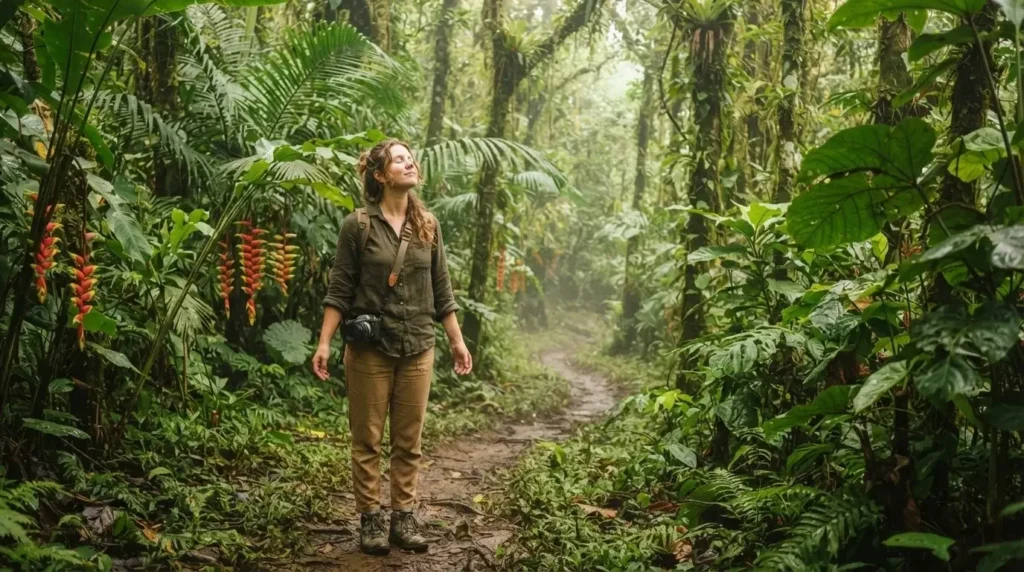
From what solo travelers and forest therapy practitioners consistently report, the Sarapiqui region in the Caribbean lowlands is one of the most immersive spots for this kind of slow nature experience. National Geographic specifically highlights strolling the lowland rainforest trails along the Sarapiqui River as one of the most meaningful forest bathing environments in the world. The region is reachable from San Jose in about two hours and offers a range of eco-lodges that organize guided nature walks and slow forest experiences. These are not the same as a certified shinrin-yoku session, but the environment is so stimulating to the senses that even an unguided slow walk along a jungle path functions the same way in practice.
If you visit during the dry season (December through April), mornings are usually clear and wildlife is most active. The wet season (May through November) brings dramatic rainfall and lush green conditions that many travelers find even more atmospheric for forest immersion, though you will want good rain gear.
The Amazon and Beyond: South America’s Forest Bathing Frontier
The Amazon does not frame itself as a forest bathing destination, but in practice it is one of the most intense sensory immersion environments on the planet. The Amazon Basin, shared across Brazil, Peru, Ecuador, Bolivia, and Colombia, contains the largest tropical rainforest on Earth. The sounds alone, layers of insects, birds, water, and wind, create an auditory environment unlike anything in North America.
Guided rainforest lodges in the Ecuadorian and Peruvian Amazon typically include slow forest walks as part of their core programs, often led by indigenous guides with deep ecological knowledge.
These walks are not marketed as forest bathing, but they function that way: slow movement, deliberate attention to sounds, smells, and textures, with regular pauses to observe. Lodges in Ecuador’s Napo region and Peru’s Madre de Dios region are well-regarded for this kind of immersive, unhurried nature experience.
For solo travelers, this region requires more planning than a National Park visit. A guided lodge package is the practical approach, typically ranging from $150 to $400 per person per night depending on the lodge and what is included. Most require a minimum stay of two or three nights. Entry into the Ecuadorian Amazon is generally through the city of Coca (accessible by short flight from Quito) or through Tena, depending on which area you are visiting.
The Peruvian Amazon entry point is usually Puerto Maldonado for the Madre de Dios region, or Iquitos (accessible only by boat or plane) for the northern Amazon. No specific visa is required for most Western passport holders for stays under 90 days in either country.
What to Bring (and What to Leave Behind)
The most important thing to bring to any forest bathing experience is nothing.
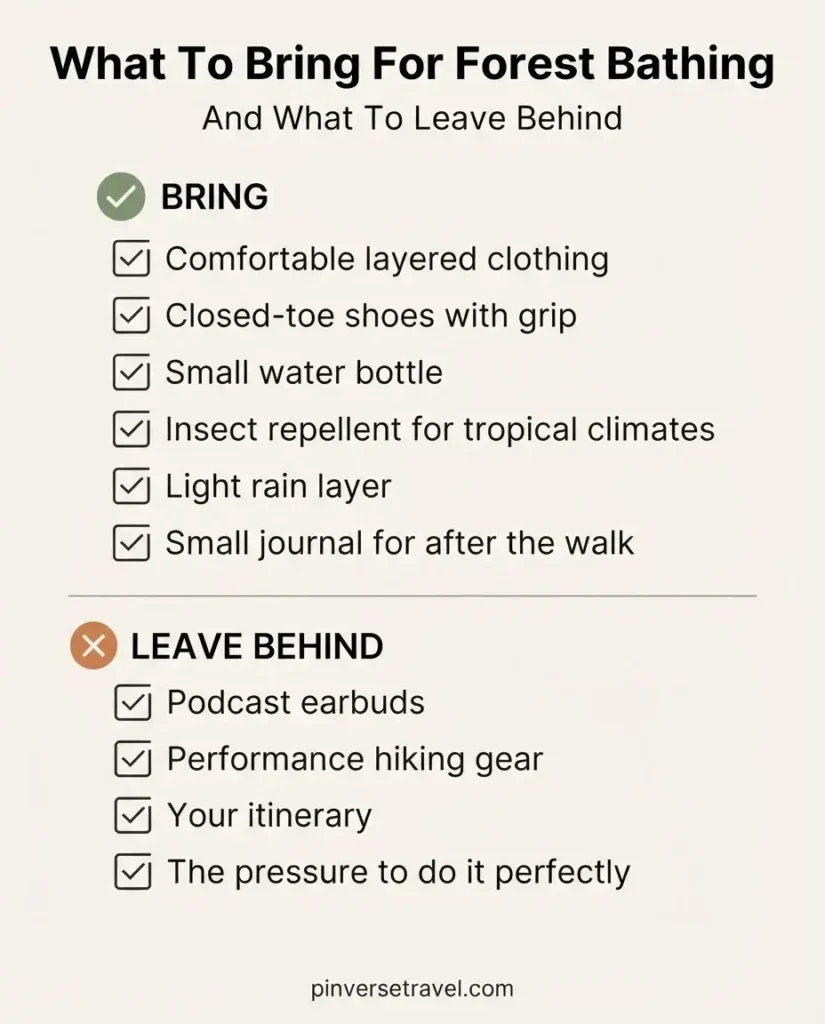
No agenda, no podcast, no podcast earbuds, and ideally no phone within reach. That said, here is a practical list:
Comfortable, layered clothing that you do not mind getting a little muddy or damp. Closed-toe shoes with grip. A small water bottle. Insect repellent for tropical or humid environments. A light rain layer. Optionally: a small journal for writing a few words after, not during, the experience.
Leave behind: performance gear, hiking poles, anything that signals this is an athletic endeavor. The point is to be in the forest, not to conquer it.
How to Make Any Forest Bathing Experience Work for You as a Solo Traveler
Solo travel is uniquely well-suited to forest bathing, and I mean that specifically. When you travel alone, you are already practicing a form of self-directed presence. There is no one to talk to, no one to perform for, no compromise on pace. That freedom maps directly onto what forest bathing asks of you.
A few things that help, based on everything I have gathered from experienced practitioners and regular solo forest bathers: arrive early in the morning when the forest is quietest and wildlife is most active. Do not set a destination or a distance goal. Give yourself a minimum of 90 minutes, two hours if possible. Sit down more than you think you need to. Notice what catches your attention without chasing it. And when the session ends, sit quietly for a few minutes before checking your phone. That transition matters.
The effects of a genuine forest bathing session, reduced cortisol, lower heart rate, improved mood, do not require you to do it perfectly. You just need to do it slowly.
A Note on Seasons
Forest bathing works in every season, and each season offers something different. Spring brings fresh growth, wildflowers, and the particular smell of wet earth and new leaves. Summer is most accessible and most crowded. Autumn in temperate forests like the Adirondacks or Olympic National Park offers dramatic color changes and significantly thinner crowds. Winter forest bathing has its own particular quality: bare branches, silence, and a stillness that feels almost sacred. The Adirondack Riverwalking guides describe winter as one of the peak seasons for the experience, and many practitioners agree that cold-weather forest bathing forces a kind of physical alertness that deepens the sensory experience.
The Americas give you options across every climate and every time of year. There is no bad season to start. There is only the season you are in right now.