The Best Mud Baths in Europe: A First-Timer’s Honest Guide

The first time someone told me to smear warm grey mud all over my body and just sit in it, I laughed. It sounded like the opposite of a treat. But here is the thing I have learned after years of chasing slightly odd, wonderfully human experiences around the world: the moments that make you go “wait, really?” are usually the ones you remember longest.
Mud baths are exactly that kind of moment. They are strange, a little messy, occasionally smelly, and genuinely good for you. And Europe, sitting on top of old volcanoes and mineral-rich lakes, happens to have some of the best mud baths anywhere. The trouble is that most guides either bury them inside long “hot springs” lists or try to sell you a spa package before you understand what you are actually walking into.
So let me be your honest travel companion here. I will show you where to find the best mud baths in Europe, what each one is really like, what to wear, what it costs, and how to do it without that first-timer panic. Whether you are traveling solo or dragging a friend along, by the end of this you will feel ready to get gloriously muddy.
First, Let’s Clear Up What a “Mud Bath” Actually Means
Not all mud is the same, and this trips up a lot of first-timers. There are basically two worlds here, and knowing which one you are in matters for both your enjoyment and your safety.
The first world is the get-in-and-soak kind. This is warm, mineral-rich mud you can smear on your skin or lower yourself into, either in a wild natural pool or a spa setting. Think volcanic mud on a Sicilian island or black lake mud in Romania.
The second world is the medical kind, called balneotherapy or, in Italy, fangoterapia. Here the mud is matured for months, heated to a precise temperature, and applied by trained staff as an actual treatment for things like arthritis and joint pain. It is less “fun day out” and more “gentle health retreat.”
And then there is a third thing that looks like mud but absolutely is not for bathing: boiling geothermal mud pots. These are gorgeous to look at and will scald you badly if you touch them. I will flag which is which as we go, because nobody warned me clearly the first time and I do not want you guessing.
Are they actually good for you? The short version is yes, within reason. The heat boosts blood flow, the minerals can soothe tired muscles and joints, and many people with skin conditions like psoriasis or eczema find relief. There is real research behind this too, and if you like knowing the science before you commit, there is a solid peer-reviewed study on the effects of mud-bath therapy on inflammation and joint mobility that is worth a skim. Just do not expect miracles. Think of it as a lovely, restorative reset, not medicine.
Vulcano, Sicily: The Wild One Everyone Wants
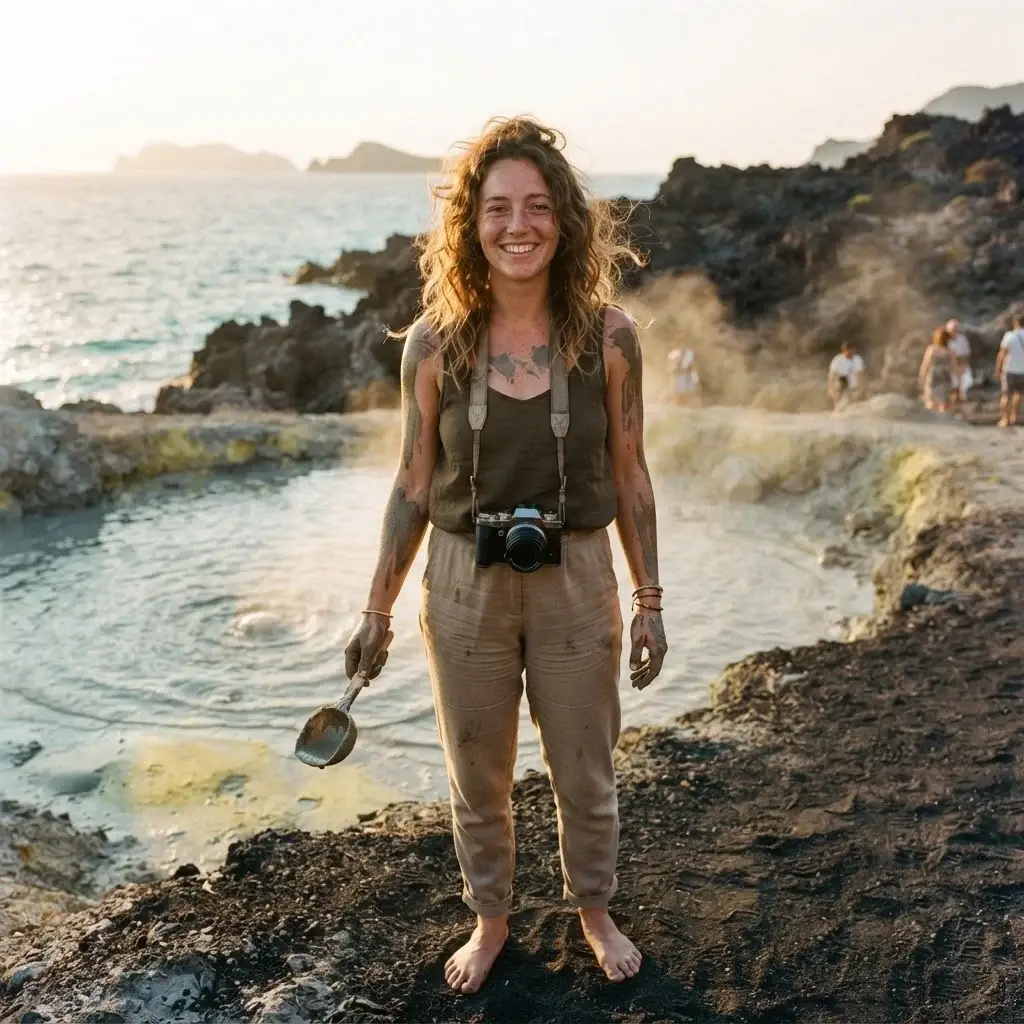
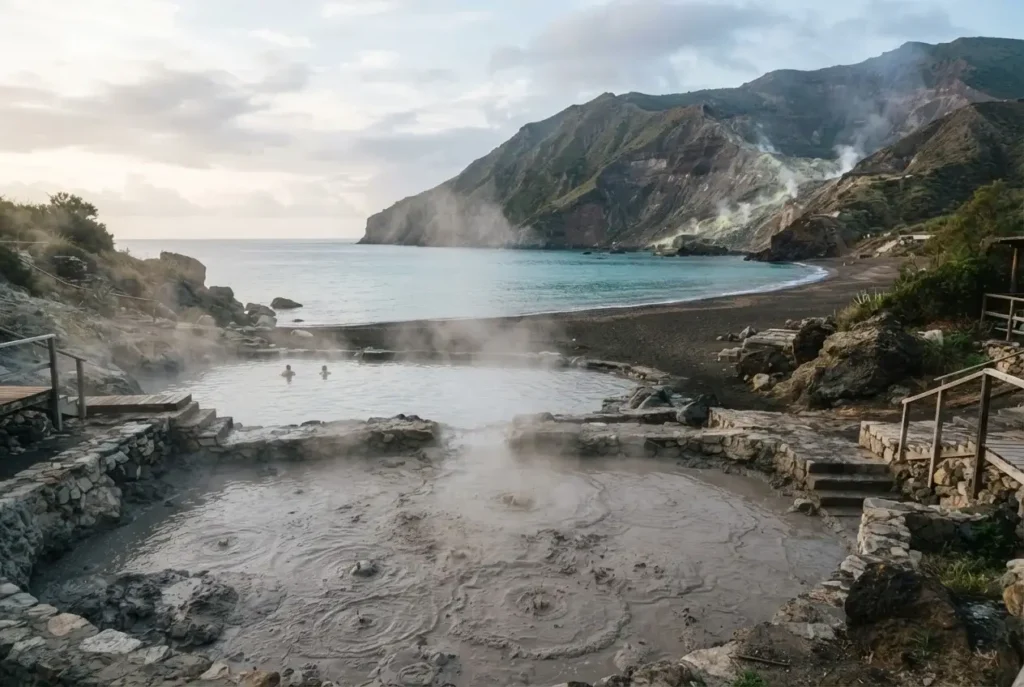
If you picture a raw, natural, slightly wild mud bath, you are picturing Vulcano. This small island in the Aeolian archipelago off Sicily has a famous open-air mud pool, the Pozza dei Fanghi, sitting near the sea against a backdrop of black volcanic sand. The mud is warm, thick, sulphur-rich, and completely natural. People come from all over the world to slather themselves grey and then rinse off in the ocean right beside it.
I have to be straight with you about the catch. Vulcano’s mud pool has had a complicated few years. Because the island is volcanically active, high gas emissions forced the pool to close for several seasons, and it went through legal back-and-forth before reopening. As of the 2026 season it has reopened under a managing operator with controlled access and safety rules, which is great news, but the status here genuinely changes. Before you build a whole trip around it, check current conditions. Italy’s official tourism site has a helpful overview of the volcanic mud and thermal experiences across the Aeolian Islands that is a good starting point.
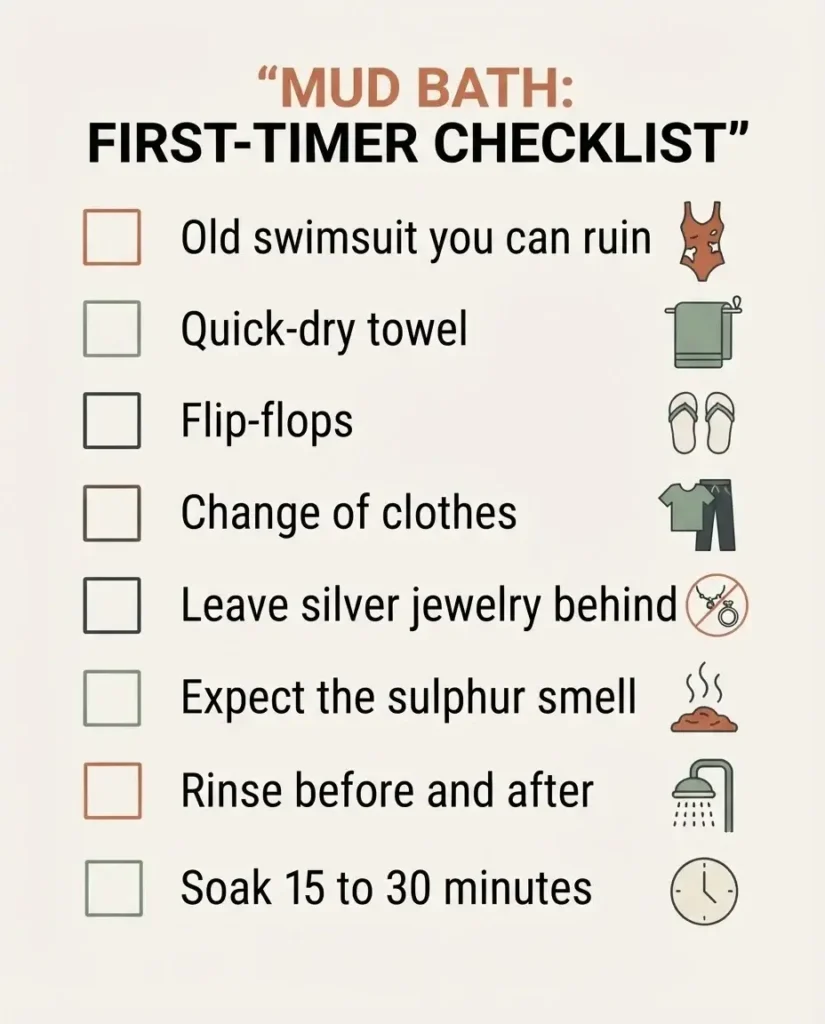
Getting there is part of the adventure. You reach Vulcano by ferry or hydrofoil, usually from Milazzo on the Sicilian mainland or hopping between the other Aeolian islands. The mud pool sits a short walk from the port. Bring a swimsuit you never want to wear again, because sulphur mud stains and the smell clings for a day or two no matter how hard you scrub. Leave silver jewelry at your accommodation, since sulphur tarnishes it fast.
What to eat afterward: this is Sicily, so reward your glowing skin with fresh swordfish, pasta alla Norma, and a granita with brioche for breakfast. Simple, sun-warmed, unforgettable.
Abano Terme and Montegrotto, Italy: Mud as Serious Self-Care
If Vulcano is the wild child, the Euganean Hills near Padua are the calm, grown-up option. The twin spa towns of Abano Terme and Montegrotto have been doing thermal mud therapy for a very, very long time, and they take it seriously. Here the mud is matured in thermal water for months until it develops its therapeutic properties, then applied warm, usually somewhere around 38 to 42 degrees Celsius, by trained staff.
This is proper fangoterapia, and it is popular with travelers dealing with joint stiffness, arthritis, or just deep muscle fatigue from too much walking. If you are the kind of person who wants the health benefits in a structured, professional setting rather than a muddy pool by the sea, this is your place. You will find dozens of thermal hotels offering multi-day programs. The official destination site for Abano and Montegrotto’s thermal offerings lays out what the area has and helps you get your bearings before booking anything.
For solo travelers, I actually love this style of trip. There is something quietly empowering about booking yourself a few restorative days, no one to coordinate with, just you and a slow schedule. Getting here is easy: Padua is a short train ride from Venice, and the spa towns are a quick local connection from there. Pair your treatments with a day trip into Padua to see the Scrovegni Chapel, and eat your way through Veneto with risotto, bigoli pasta, and a spritz that actually tastes like it should in its home region.
Lake Techirghiol, Romania: Europe’s Underrated Black Mud
Here is a place most travelers have never heard of, and that is exactly why I want you to know about it. Lake Techirghiol, near the Black Sea resort town of Eforie Nord, holds a rich black mud called nămol, a sapropelic mud famous across Eastern Europe for treating rheumatism, arthritis, and skin problems. The lake itself is roughly five times saltier than the sea, and the whole area has been a healing destination since the late 1800s.
This is not a polished influencer spot, and I mean that as a compliment. It is a real, working wellness region where people genuinely go to feel better. You can experience the mud through the spa clinics in Eforie Nord, and Romania’s official tourism site has a clear rundown of the mud treatments and spa facilities around Eforie Nord and Techirghiol so you know what is on offer before you arrive.
For a solo or budget-minded traveler, Romania is a gift. Your money stretches, the coast is lovely in summer, and you get an authentic cultural experience far from the crowds. Fly into Constanța, about 7 miles north, or connect from Bucharest by the fast intercity train, then a short local hop down to Eforie Nord. While you are on the coast, eat your way through Dobrogea’s food, which reflects its mix of Romanian, Turkish, and Tatar roots. Try a plăcintă dobrogeană, grilled fish, and local wine from the nearby Murfatlar vineyards.

Hverir and the Mývatn Region, Iceland: Look, Photograph, Never Touch
I am putting Iceland on this list with a big, loving warning, because it is the perfect example of mud you must never get into. Up in North Iceland near Lake Mývatn, the Hverir geothermal area (also called Námafjall) is an otherworldly field of bubbling grey mud pots and hissing steam vents, streaked with yellow, red, and orange minerals. It looks like another planet. It is one of the most photogenic spots in the country.
But that mud is boiling and the ground is unstable, even where it looks solid. You stay on the marked paths, keep your distance, and do not touch anything. The excellent local-expert guide to the Hverir geothermal area and how to visit it safely spells this out well, and it is worth reading before you go. Most people spend 15 to 30 minutes here, there is paid parking and paid toilets, and that sulphur smell is intense, so brace for it.
So where do you actually soak in Iceland? Not in the mud pots, but in the nearby Mývatn Nature Baths, whose milky mineral waters carry fine silica and are gentle on the skin. It is the perfect combo: gawk at the wild mud fields at Hverir, then warm up properly in the baths a few minutes away. Getting around this region is easiest with a rental car along the Ring Road. Refuel afterward with Icelandic lamb soup and the local geothermal rye bread, which is baked slowly in the hot ground itself.

Furnas, the Azores: Volcanic Mud and Food Cooked in the Earth
For something that blends volcanic drama with a warm, welcoming atmosphere, the Furnas valley on São Miguel island in the Azores is hard to beat. This whole green valley sits inside a dormant volcano, so it steams and bubbles with caldeiras, hot springs, and mud pools. It has the geothermal wonder of Iceland but a softer, lusher, more approachable feel, and it is technically Portugal, so it counts as Europe.
At Furnas you can see the bubbling mud and fumaroles up close, then soak in the iron-rich thermal pools nearby, which turn your skin and swimwear a rusty orange, so again, wear something you do not care about. It is a wonderful spot for a first-timer because it feels adventurous without being intimidating, and the island is very solo-friendly and easy to navigate.
The unmissable Furnas experience is food. Locals bury pots of cozido das Furnas, a rich meat and vegetable stew, into the volcanic ground and let the earth’s heat slow-cook it for hours. Eating a meal literally cooked by a volcano, then soaking in its warm water, is the kind of full-circle travel moment I live for. You reach São Miguel by a short flight from mainland Portugal, and a rental car makes the island easy to explore at your own pace.
Budapest and Beyond: The Thermal Bath Culture Around the Mud
Now, if your dream is less “wild mud pool” and more “grand, steamy, historic bathing culture,” you want central Europe’s thermal baths, where mud treatments often sit alongside the pools. Budapest is the obvious star. The enormous Széchenyi complex is one of the largest thermal baths on the continent, a canary-yellow palace full of indoor and outdoor pools, saunas, and treatment rooms. It is social, beautiful, and genuinely easy for a solo traveler to enjoy.
Prices here are refreshingly reasonable for what you get, and you can check current ticket options directly on the official Széchenyi Thermal Bath pricing page so there are no surprises at the door. Go early to beat the crowds, bring flip-flops and your own towel to save on rental fees, and give yourself a few unhurried hours.
Slovenia deserves a mention too, because it quietly has a wonderful thermal and mud culture, with spas that use mud, brine, and mineral waters in their treatments. If you want to weave a mud experience into a broader wellness trip through green, walkable, easygoing countryside, the Slovenian tourist board’s overview of the country’s healing thermal and mineral waters is a lovely place to start dreaming.
What to Wear, What to Expect, and How Not to Panic
Let me answer the questions that quietly stress first-timers, because I had every one of them myself.
What do you wear? An old swimsuit, full stop. Natural mud, especially sulphur and iron-rich mud, can stain fabric permanently, so never wear anything you love. Bring a change of clothes, a towel, and flip-flops.
Do you shower before or after? Both, ideally. A quick rinse before, and a proper wash after to get the mud out of every crease, and trust me, it gets everywhere.
How long do you stay in the mud? For recreational natural mud, most people coat themselves, let it dry a little in the sun, then rinse off, usually 15 to 30 minutes total. For medical mud therapy, the staff control the timing precisely, often around 15 to 20 minutes of application.
Will it smell? Sulphur mud, yes. That rotten-egg smell is normal and harmless, but it lingers on skin and swimwear for a day or so. Wear it like a badge of adventure.
Who should skip it? Anyone pregnant, with heart conditions, high blood pressure, or open wounds should check with a doctor first, since the heat is a real physiological effect. When in doubt, ask before you get in.
The confidence part is simpler than you fear. Everyone around you is also covered in mud looking slightly ridiculous, which is wonderfully levelling. There is no elegant way to do this, and that is the whole charm.
Solo travelers, this is one of the easiest experiences to enjoy alone, because it is relaxing, low-pressure, and full of friendly strangers grinning at each other through grey faces.
How I’d Actually Plan This Trip
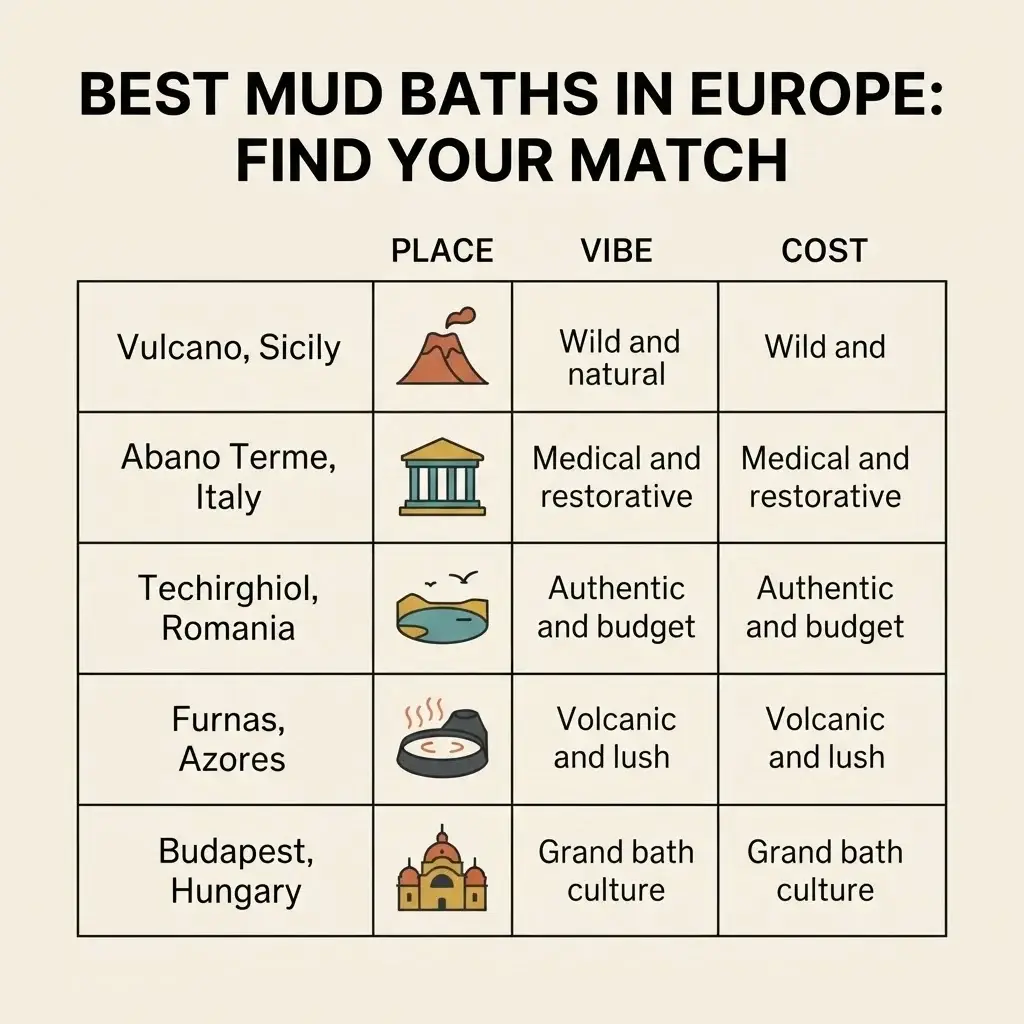
If you are a first-timer who wants the wildest story, Vulcano in Sicily is the headline, but pair it with a backup plan given its changeable status, and honestly the Aeolian Islands and Sicilian food are worth the trip on their own. If you want restorative and structured, go to Abano Terme. If you want authentic and budget-friendly, Romania’s Techirghiol is your secret weapon. If you want jaw-dropping scenery, Iceland or the Azores deliver, just remember which mud you soak in and which you only photograph. And if you want warm, social, grand-scale bathing culture, Budapest wraps it all in one gorgeous package.
Whichever you choose, do not wait for the “perfect” version of this trip to assemble itself. It will not. Pick the one that makes your eyes light up, book the ferry or the flight, pack the swimsuit you are willing to sacrifice, and go get muddy. The strange, funny, glowing-skinned version of you on the other side will be so glad you did.