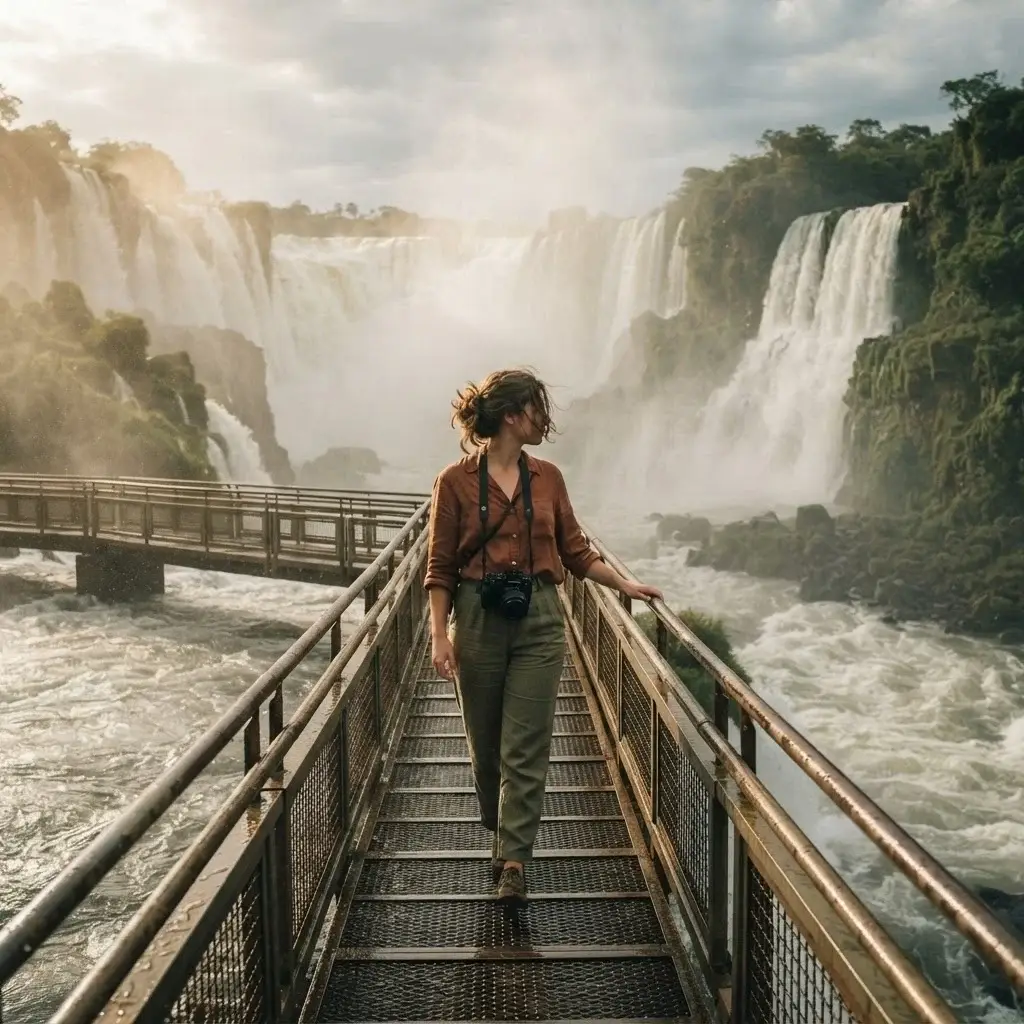
There is a particular moment that every waterfall chaser knows. You hear it before you see it. A low, constant roar that builds the longer you walk, until the sound is everywhere and the mist starts catching the light, and then suddenly the trees break open and it is right there in front of you. Bigger, louder, and more alive than any photograph ever prepared you for.
Waterfalls were not what brought me into travel. It was curiosity about cultures, the pull of unfamiliar streets and languages and food markets that made me want to move through the world. But somewhere along the way, I started noticing that the most moving moments of any trip often happened near water. Sitting on a rock ledge in front of a cascade, completely unable to have a conversation because the noise made it impossible, completely unable to look at my phone because the spray would have destroyed it. Just present. Just there.
The Americas, from the canyon country of the American Southwest to the cloud forests of South America, hold some of the most breathtaking waterfalls on earth. This is not a checklist of every impressive cascade on two continents. It is a practical, honest guide to the ones genuinely worth rerouting your travels for, with specific details on how to get there, what it will cost, when to go, and what no one tells you before you show up.
Let’s get into it.
Iguazu Falls, Argentina and Brazil: The One That Reframes Everything
There is a reason Eleanor Roosevelt reportedly said “poor Niagara” after seeing Iguazu for the first time. The falls span nearly 2,700 meters across, with roughly 275 individual cascades, and the sound is not a waterfall sound. It is something closer to the sound of the earth doing something structural. The mist cloud is visible from the air. The width alone makes it genuinely difficult for your brain to process what you are looking at.
Iguazu sits on the border between Argentina and Brazil, and both countries have developed their own national park around it. Both sides hold dual status as UNESCO World Heritage Sites, and both are worth visiting if your itinerary allows. The question solo travelers always ask is which side to prioritize, and the honest answer is that it depends on what you want.
The Argentine side is the larger park, and it puts you inside the falls rather than in front of them. The trail system leads you out over the water on elevated walkways, into the spray, right to the edge of the Devil’s Throat. You can spend a full day here and still feel like you have not seen everything. Entry for international visitors is approximately $38 USD. The Brazilian side is smaller, takes maybe two to three hours, and gives you the panoramic view, the kind of wide shot that makes sense of the scale. Entry there runs around $32 USD. If you only have one day, the Argentine side has more to offer. If you have two, do both.
The nearest airports are Cataratas del Iguazú International on the Argentine side and Foz do Iguaçu International on the Brazilian side. Solo travelers will find Puerto Iguazú on the Argentine side a more relaxed and walkable base town. The park is open from 8:00 AM to 6:00 PM on the Argentine side. Bring cash, waterproof everything in your bag, and wear shoes you do not mind getting wet.
What to eat nearby: Puerto Iguazú has a small but surprisingly good food scene. Look for empanadas and grilled river fish at the local restaurants away from the tourist strip. On the Brazilian side, Foz do Iguaçu has a large Arab-Brazilian community, and the Lebanese and Syrian food there is genuinely excellent, an unexpectedly good cultural meal after a day at the falls.
Angel Falls, Venezuela: The World’s Tallest Waterfall and How to Reach It
Angel Falls drops 979 meters uninterrupted off the edge of Auyan-Tepui, a flat-topped sandstone mountain called a tepui, deep inside Canaima National Park in southeastern Venezuela. At nearly a kilometer of free fall, it is the tallest uninterrupted waterfall on earth, and it sits inside one of the most otherworldly landscapes I have ever read about, a plateau world that looks like it belongs in a different era of the planet.
I want to be straightforward with you here: I have not been to Venezuela myself, and given the travel complexities involved, this section is built on thorough research and the consistent accounts of solo travelers who have made the journey. Here is what they report, and what you need to know before you plan.
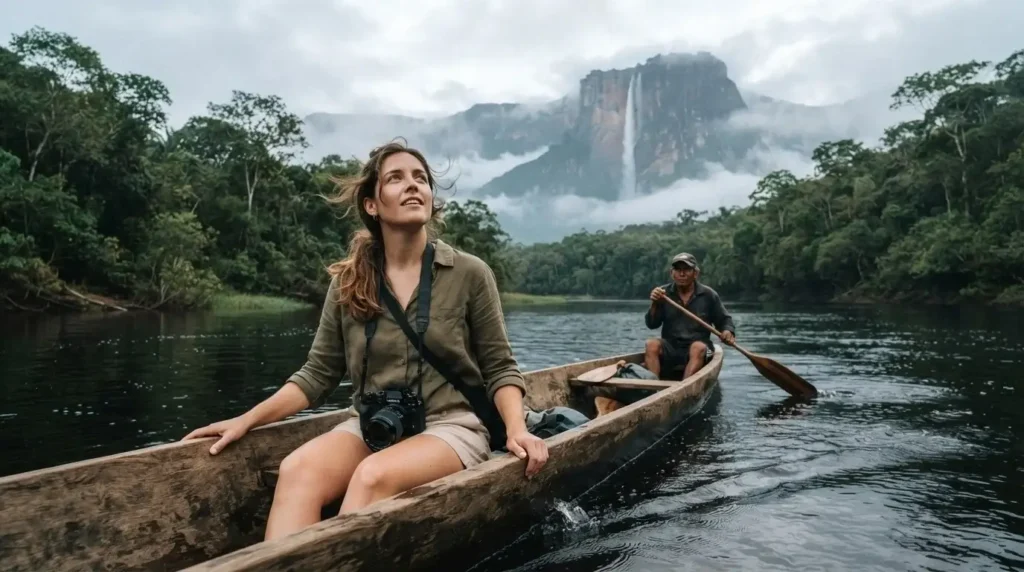
Canaima National Park is a UNESCO World Heritage Site covering 3 million hectares, recognized for its extraordinary tepui formations and the biodiversity they contain. The park is accessible, but Angel Falls itself is not something you visit independently. Access requires flying into Canaima village (from Ciudad Bolivar or Caracas) and then taking an organized river journey by dugout canoe, followed by a hike through rainforest to the base. There is no road. There is no trail you can find on AllTrails. The organized tour is the experience.
Budget-conscious solo travelers can find 3-day tours from Ciudad Bolivar for around $200-$300 USD per person, covering the flight into Canaima, boat, accommodation in camp hammocks, and meals. Tours from Caracas with more comfortable lodging run from roughly $795 to over $1,000 USD per person for a 4-5 day package. The rainy season (June through November) is when the falls are at full power, though the jungle trails become more demanding. In the dry season (December through April) the falls can thin to a narrow ribbon. Most experienced visitors recommend aiming for June through August, when the water is strong and visibility is better than at peak rainy season.
This is a destination that rewards patience and planning. It is not a casual detour. But the people who make the journey almost universally say it changed something in them. A waterfall that falls for nearly a kilometer, surrounded by a landscape that has barely changed in millions of years, has a way of doing that.
Havasu Falls, Arizona, USA: The Blue-Green Miracle in the Canyon
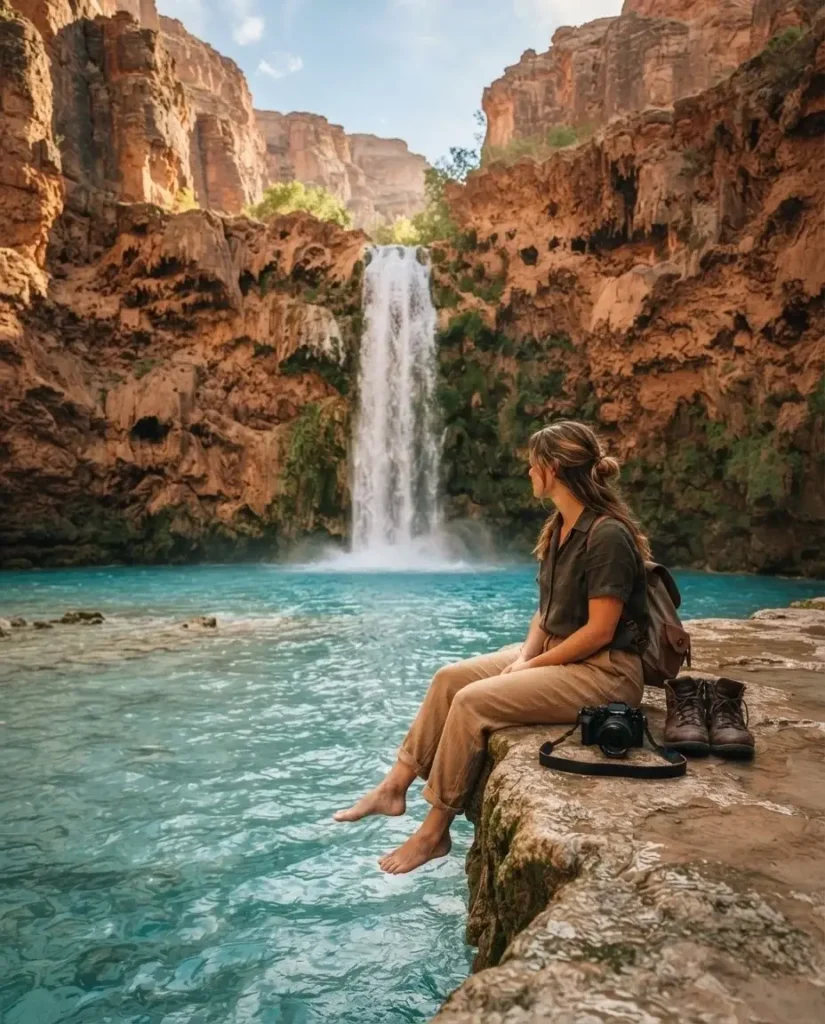
If you have been anywhere near travel social media in the last several years, you have seen Havasu Falls. The water is an improbable turquoise-blue, so vivid it looks filtered even when it is not, cascading over rust-red travertine rock in the middle of the Havasupai reservation in the western Grand Canyon. It is as visually stunning in person as every photograph suggests, possibly more so.
What the photographs do not show is how much effort it takes to get there.
Havasu Falls sits on the Havasupai Tribal Nation’s land, and visiting requires both a permit and a physically demanding hike. The hike in from the Hualapai Hilltop trailhead covers 10 miles (16 km) each way, dropping roughly 2,600 feet in elevation. It is not a casual day hike. You will be carrying your camping gear and enough water to stay hydrated in desert heat, which can exceed 100 degrees Fahrenheit in summer. That said, it is absolutely manageable for a reasonably fit person who prepares properly and goes at a smart pace. Many solo travelers do this hike every year, and the trail, while long, is well-defined.
The permit situation is what requires the most advance planning. As of 2025, a 3-night campground reservation costs $455 per person through the Havasupai Tribe’s reservation system via the National Park Service. Permits for peak season sell out within minutes of release. The early access window for 2026 permits opened in January 2026, so if you are planning a trip this year, your best move is to watch for any released permits and also consider shoulder season dates (late September through early November) when demand is slightly lower and the heat is more forgiving.
The turquoise color comes from high calcium carbonate content in the water, which creates the travertine rock formations and gives the falls their signature color. A flood in 2024 temporarily changed some of the formations around Mooney Falls, the taller cascade below Havasu. Check current conditions before your trip. The experience of swimming in that water, surrounded by red canyon walls, is one of those things you genuinely cannot replicate anywhere else on the continent.
Pack a water filter, trekking poles, and layers for the cold nights even in warmer months. Solo travelers report that the campground has a strong community feel, and you will almost certainly meet other people heading in the same direction.
Multnomah Falls, Oregon, USA: The One You Can Actually Reach Today
Not every great waterfall requires a week of planning and a permit lottery. Multnomah Falls in the Columbia River Gorge, about 30 miles east of Portland, drops 620 feet in two tiers over a basalt cliff face, with a historic stone bridge arching across the lower tier for a view that has appeared in thousands of photographs and still manages to surprise you when you see it in person. It is one of the most visited natural sites in the Pacific Northwest, and it absolutely earns that reputation.
The US Forest Service manages the site, and you can find the official visitor and trail information at the Columbia River Gorge National Scenic Area page. During peak season (May through Labor Day), timed-use permits are required to park at the falls. These are available up to 14 days in advance through Recreation.gov and cost $2 per vehicle, with around 100 daily permits available and 25 free walk-up permits distributed in person each morning. Outside of peak season, no permit is required, and early mornings on a weekday in autumn are genuinely magical here.
The short trail at the base takes about 20 minutes round trip. If you want more, the paved trail up to the bridge is easy and offers an excellent view, and you can continue on to the top of the upper falls for a longer, more rewarding hike with views across the Gorge. The surrounding Columbia River Gorge National Scenic Area has dozens of additional waterfalls nearby, including Latourell, Bridal Veil, and Horsetail Falls, which makes this an ideal destination for a waterfall-focused road trip.
From Portland, the falls are accessible by car, and there is a historic highway trail system that connects several of the Gorge’s waterfalls by hiking trail, bike, or shuttle in peak season. Solo travelers who do not have a car should look into the Columbia Gorge Express shuttle, which runs from Gateway Transit Center in Portland directly to the falls.
Yosemite Falls, California, USA: North America’s Tallest Cascade
At 2,425 feet total drop across its upper and lower sections, Yosemite Falls is the tallest waterfall in North America, and standing in Yosemite Valley looking up at it in late May, when snowmelt is pushing the water volume to its peak, is one of those experiences that requires no embellishment. The scale of Yosemite Valley itself makes every feature in it feel almost surreal, and the falls pouring off the granite cliffs above the valley floor are central to that feeling.
The National Park Service’s official Yosemite Falls Trail page offers two approaches. The Lower Yosemite Fall loop is 1 mile and easy, suitable for almost anyone, and gives you the view of both the upper and lower falls together with the valley as a backdrop. If you want to earn the view from the top, the Upper Yosemite Falls Trail is roughly 7.2 miles round trip with about 2,700 feet of elevation gain. It is strenuous but manageable for anyone who hikes regularly, and the perspective from the top looking back down into the valley is extraordinary.
Timing matters enormously here. The waterfalls in Yosemite are largely fed by snowmelt, and late April through early June is peak season for water volume. By late summer, many of the secondary falls slow to a trickle or dry up completely, and even Yosemite Falls can thin significantly. If seeing the falls at full force is the priority, plan for late spring.
Yosemite requires advance reservations to drive into the valley during peak season (roughly late March through early November). Book early.
Kaieteur Falls, Guyana: The Most Powerful Fall Most People Have Never Heard Of
This one is for the travelers who have already seen the famous places and are looking for something that genuinely surprises them.
Kaieteur Falls drops 226 meters in a single unbroken plunge over the edge of Potaro Plateau, deep in the rainforest of central Guyana. What makes it extraordinary is not just the height but the volume. Kaieteur is considered the largest single-drop waterfall in the world by the combination of height and flow rate. The Potaro River simply falls off the edge of an ancient sandstone shelf, and the result is a wall of water so powerful that the mist cloud it generates is visible from miles away. There are almost no other tourists. There is no gift shop line. There is no waiting for the shot.
Getting to Kaieteur requires effort, and that is part of why it remains so uncrowded. The falls sit inside Kaieteur National Park, Guyana’s oldest protected area established in 1929 and managed by the Protected Areas Commission of Guyana. The only practical way to reach the falls is by small charter plane from Georgetown, roughly an hour’s flight. Day tours from Georgetown run through local operators and typically include the flight, a guided walk to three viewing platforms, and return the same day. Prices vary but a day flight tour generally runs in the range of $150-$250 USD per person depending on group size and operator.
Georgetown itself is a fascinating city that does not get nearly enough attention, with beautiful colonial architecture, an enormous outdoor market, a strong curry tradition in the Indo-Guyanese food culture, and some of the friendliest people I have read about from travelers coming through South America. Solo travelers who have visited consistently describe Guyana as one of the most underrated countries on the continent. Kaieteur is a reason to go. Georgetown is a reason to stay a few extra days.
How to Decide Which Waterfall to Visit First
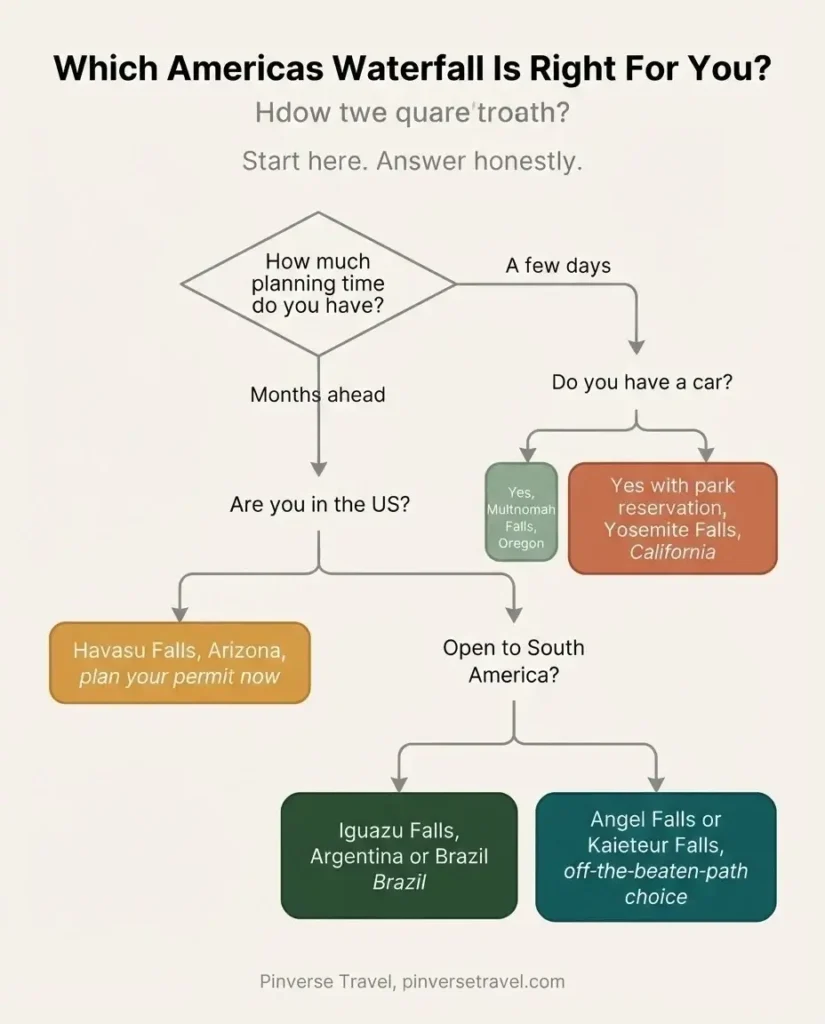
The honest answer is that it depends on where you are, what your budget is, and how much planning you want to do right now.
If you are in the US and want something accessible without months of planning, Multnomah Falls and Yosemite Falls are both achievable on a long weekend with a car. Multnomah especially requires almost no lead time outside of peak season.
If you are a planner who likes to lock things in well ahead, Havasu Falls rewards the effort of early permit booking more than almost any other waterfall on this list. It is a genuine expedition, and the payoff is proportional.
If you are already in South America or planning a trip there, Iguazu Falls should be on the list simply because nothing in the Northern Hemisphere compares to its scale. A two-day visit covering both the Argentine and Brazilian sides is achievable, affordable, and will recalibrate everything you thought you knew about what a waterfall can be.
If you are drawn to the road less traveled, Kaieteur and Angel Falls offer experiences that are genuinely rare in the modern world: places that are still wild, still difficult to reach, still populated mostly by people who came specifically because they wanted something real.
A Few Practical Notes Before You Go
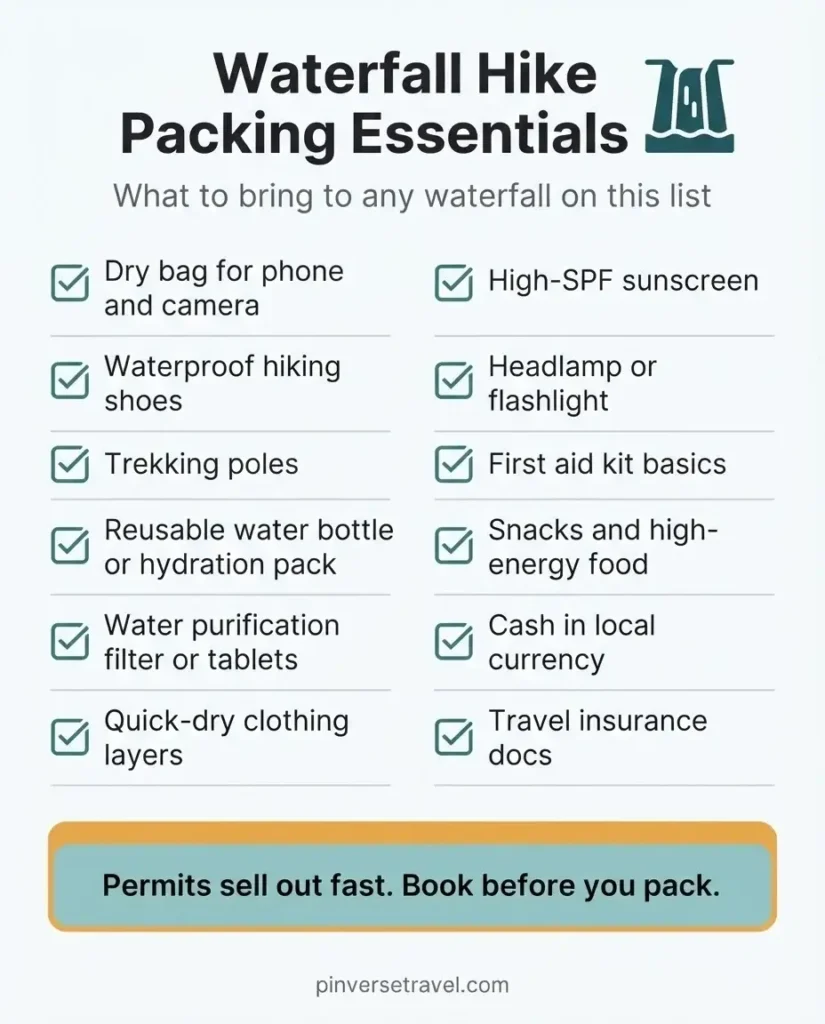
Waterfall chasing has its own specific packing logic. Waterproof bags or dry bags for your phone, camera, and valuables are essential near any of the falls on this list, especially Iguazu and Kaieteur, where the mist is constant and heavy. Trekking shoes with grip matter more than technical hiking boots for most of these trails, though for Havasu’s 10-mile approach and Angel Falls’ rainforest trek, proper support is worth prioritizing.
Travel insurance is worth taking seriously for any trip involving remote natural areas, particularly Angel Falls and Kaieteur where evacuation logistics are complex. Look for policies that cover adventure activities, not just standard medical.
Finally, all of these places exist within ecosystems and, in many cases, on indigenous or nationally protected land. The Havasupai have managed their canyon for generations long before it appeared on any social media feed. Canaima is indigenous Pemon territory. Kaieteur’s rainforest is one of the most biodiverse on the planet. Visit with that awareness, follow permit rules, stay on marked trails, and leave the places you find them.
The falls will be here long after the photographs fade. The goal is to make sure they stay that way.