Where Shamanic Healing in South America Is Most Authentic

There is a version of this trip that goes beautifully. You spend time in the jungle or the mountains, sit in ceremony with a genuine healer who has trained for decades, and come home with a shifted perspective on your life. You feel quieter, clearer, more yourself.
There is also a version that goes badly. You find an operation that runs ceremonies like a conveyor belt, the “shaman” learned their role six months ago, there is no medical screening, and nobody supports you before or after the experience.
The difference between those two outcomes comes down almost entirely to how well you research before you book.
I am not writing this as someone who has sat in an ayahuasca ceremony in the Peruvian Amazon. I haven’t. The experience-honesty rule I hold myself to on this blog matters to me, and inventing memories is not something I do. What I can offer you is thorough research, conversations with the travel community, a deep respect for these traditions, and the same careful judgment I bring to every destination I write about. If you are planning this trip, here is what you genuinely need to know.
Why South America, and Why “Authentic” Matters So Much Here
South America is the heartland of shamanic healing not because it is trendy but because these traditions are thousands of years old and still actively practiced by indigenous communities across Peru, Bolivia, Colombia, Ecuador, and Brazil. The word “shamanic” covers a wide range of practices. In the Amazon basin, it often refers to plant medicine ceremonies, most notably ayahuasca. In the Andes, it encompasses curanderismo, Pachamama offerings, San Pedro/Huachuma cactus ceremonies, and the work of healers who read coca leaves and cleanse energy. In Bolivia, it refers specifically to the Kallawaya, a lineage of itinerant healers recognized the world over for their botanical knowledge.
The reason “authentic” matters so much here specifically is that shamanic tourism has grown fast enough that a significant number of operations in popular areas now cater almost entirely to the spiritual tourism market, with little connection to the indigenous knowledge systems they claim to represent. Choosing poorly in this space is not just a waste of money. It can be genuinely unsafe. So the first thing I want to do is give you a clear map of where the most grounded traditions live, and then walk you through how to find a ceremony worth attending.
Peru: The Peruvian Amazon and the Sacred Valley
Peru is the country most travelers associate with shamanic healing, and for good reason. In 2008, the Peruvian government officially recognized traditional ayahuasca use by indigenous Amazonian communities as National Cultural Patrimony, making Peru one of the only countries in the world where the practice has direct government protection. That declaration was specifically about indigenous, traditional use, not the commercial retreat industry, but it reflects how deeply embedded this knowledge is in Peruvian culture.
Iquitos and the Shipibo Healers
The city of Iquitos, only accessible by boat or air from Lima, is the gateway to the largest ayahuasca tourism hub in the world. It sits deep in the Amazon rainforest, and the surrounding jungle is home to communities of Shipibo people who have practiced plant medicine healing for generations. Shipibo healers work with icaros, sacred songs sung during ceremony that are understood to carry healing intention directly into the participant’s energy field. The songs are learned over years, often decades, and they are the marker of a healer who has done the genuine work.

Retreat costs in this region vary significantly. A 7-day, 3-ceremony all-inclusive retreat near Iquitos can start at around $850. More established centers with Western-trained integration support, professional medical screening, and larger facilitation teams tend to run between $1,500 and $4,500 for multi-day programs. The higher cost is not automatically better, but it does tend to correlate with more rigorous safety protocols. Look for centers that require a medical application form, ask about your psychiatric history and medications, and have dedicated integration support after each ceremony.
The Temple of the Way of Light, located in the Amazon outside Iquitos, is one of the more well-documented centers working specifically with Shipibo healers and requiring detailed health screening before acceptance. They are transparent about what makes them functional and what makes a retreat safe, which is itself a reassuring quality.
The Sacred Valley and Andean Curanderismo
Not all healing traditions in Peru involve ayahuasca. The Sacred Valley near Cusco is home to Q’ero shamans and Andean curanderos who work with despacho ceremonies, offerings to Pachamama (earth mother), coca leaf readings, and energy cleansing rituals called limpia. These ceremonies tend to be gentler in their physical effects, more accessible to people who are drawn to indigenous spirituality but not ready for or interested in a full plant medicine experience.
The distinction matters because a lot of travelers arrive in Peru with one very specific expectation and miss the richness of what the Andean tradition offers. If you are based in Cusco for a week before or after Machu Picchu, connecting with a local curandero through a reputable tour operator for a despacho ceremony is a meaningful, grounded way to engage with indigenous healing that doesn’t require weeks of preparation.
Ecuador: San Pedro and the Mountains of Vilcabamba
San Pedro, also called Huachuma, is a cactus native to the Andes Mountains that has been used in ceremonies by Andean indigenous communities for an estimated 3,000 years. It is older than ayahuasca in terms of documented use, and in Ecuador it is the primary plant medicine tradition, especially in the mountain regions around Vilcabamba and Lentag.
San Pedro ceremonies are typically held during the day, outdoors, in nature. They involve music, prayer, movement, and time to walk, sit, and observe. The experience is often described as more expansive and less internally confrontational than ayahuasca, with a quality that solo travelers who attend frequently describe as connective and grounding. For someone newer to plant medicine, it is sometimes recommended as a gentler starting point, though “gentler” is relative and preparation still matters.
Casa del Sol in Vilcabamba is one center that has developed a reputation for ceremonies rooted in Andean tradition. Healers from this region typically trace their lineage to southern Andean healing practices, and ceremonies are held in natural settings with prayer and personal healing time. Costs for a single San Pedro ceremony in Ecuador tend to run between $150 and $400 depending on the facilitator and the length of the session. Multi-day retreats combining ceremony with dieta, integration, and accommodation will run higher.
Colombia: Yage and the Taita Tradition
Colombia approaches this differently than Peru or Ecuador. There is no specific legislation either permitting or prohibiting yage (the Colombian name for ayahuasca), but it has strong cultural recognition, particularly in the Putumayo department where indigenous communities including the Inga, Siona, Cofan, and Kamentsa peoples have maintained yage traditions for centuries.
According to research published by ICEERS on Colombia’s yage territory, Colombia actually has the highest prevalence of ayahuasca use of any country with official surveys on the topic. Nearly 300,000 Colombians have tried yage, and in the Putumayo region specifically, close to 20% of the population has had some experience with it. This is not an imported wellness trend. It is a living part of the culture.
In the Colombian tradition, the healer is called a Taita. Taitas are typically trained over many years, often beginning in childhood or young adulthood within an indigenous lineage. Putumayo has historically been the geographic heart of this tradition, though Taitas have traveled to Bogota, Cali, and other cities to hold ceremonies for decades. If you are traveling in Colombia and want to engage with this tradition, the most authentic route is to connect through indigenous cultural organizations in Putumayo or through reputable centers that work explicitly with Inga or Kamentsa Taitas rather than outside practitioners who adopt the aesthetic without the lineage.
One honest note: Colombia has complex security dynamics in certain rural areas, particularly near the Ecuadorian and Venezuelan borders. Research current safety conditions for any specific region you are considering, and stay flexible. The tradition is real and powerful. The logistics require extra care.
Bolivia: The Kallawaya Healers
Bolivia is the least visited of the major shamanic healing destinations in South America, which is precisely why it deserves a mention here. The Kallawaya are an indigenous group from the northern Bolivian Andes who have practiced itinerant healing for centuries, traveling on foot through diverse ecosystems to gather medicinal plants and offer healing to communities along the way. Their botanical knowledge encompasses roughly 980 plant species. Their cosmovision, which integrates ritual, mythology, spiritual ceremony, and herbalism into a single system of healing, was inscribed on the UNESCO Representative List of Intangible Cultural Heritage of Humanity in 2008.

Interacting with Kallawaya healers is a different kind of experience than attending an ayahuasca ceremony. It is less ceremony-focused and more oriented around consultation, diagnosis, and treatment through plant-based medicine and ritual cleansing. For travelers who are drawn to indigenous medicine but prefer something outside the plant medicine ceremony format, Bolivia’s Kallawaya tradition is genuinely remarkable and remarkably underexplored by the travel writing world.
The base for exploring Kallawaya culture is typically the Charazani region of northern Bolivia, roughly a day’s travel from La Paz. Local guides who maintain respectful relationships with Kallawaya healers are your best point of access.
Before You Go: The Preparation That Actually Matters
Regardless of which tradition you are drawn to and which country you visit, preparation is not optional. It is the difference between a meaningful experience and a difficult, potentially dangerous one.
The Dieta
If you are attending an ayahuasca ceremony, you will be asked to follow the dieta, a preparation diet that typically begins two weeks before your retreat and continues for two weeks after your last ceremony. The ayahuasca dieta guidelines from the Temple of the Way of Light are among the most thorough publicly available, and they give you a clear sense of what is required: avoiding pork, alcohol, fermented foods, excessive sugar, recreational drugs, and sexual activity. These are not arbitrary rules.
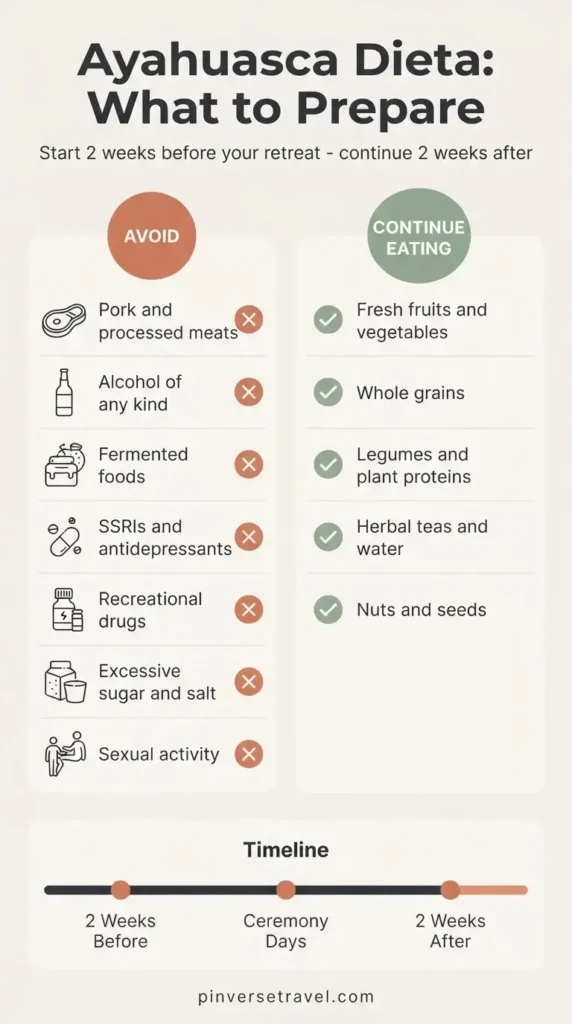
Ayahuasca acts as a monoamine oxidase inhibitor (MAOI), and certain foods and substances interact with MAOIs in ways that can be physically dangerous.
Medical Screening Is Non-Negotiable
The most critical preparation step is honestly disclosing your medications and health history to your chosen retreat before you book. Ayahuasca is contraindicated with SSRIs, SNRIs, and other serotonergic medications because combining MAOI-containing ayahuasca with these drugs can trigger serotonin syndrome, which is a serious and potentially fatal medical emergency. It is also contraindicated with certain heart medications, decongestants, stimulants, and a significant list of other pharmaceuticals. If you take any regular medication, tell your retreat before you commit. A legitimate operation will screen you. One that doesn’t ask is a red flag.
The Temple of the Way of Light’s medical guidelines offer a detailed breakdown of which medications require a washout period and which conditions disqualify someone from safely attending. Even if you don’t attend their retreat specifically, their resource is worth reading as a general reference for what responsible screening looks like.
People with a personal or strong family history of schizophrenia, bipolar disorder, or psychosis should approach this with extra caution and clear medical guidance. This is not a scare tactic. It is a fact, and any honest retreat will tell you the same.
The US Embassy Advisory: What It Actually Means
The U.S. Embassy in Lima has an active health alert advising U.S. citizens not to use ayahuasca or kambo while visiting Peru. It cites risks including nausea, vomiting, increased heart rate, psychological distress, and reports of deaths in unregulated settings.
It is worth reading this advisory without either dismissing it or treating it as the final word. The Embassy is not wrong that there are unregulated and unsafe operators in Peru. They are not wrong that deaths have occurred in poorly run ceremonies. The advisory is primarily a response to incidents in low-quality, unscreened operations where predatory or undertrained practitioners took advantage of vulnerable visitors.
It is not a statement that shamanic healing in Peru is inherently unsafe. The science from ICEERS indicates that ayahuasca, when administered in a controlled setting by experienced practitioners to healthy individuals without contraindicated medications, is physically and psychologically safe. The risks spike sharply in unregulated settings. The solution is rigorous vetting, not avoidance of the tradition entirely. Read the advisory. Take the safety dimensions seriously. Vet your center accordingly.
How to Choose a Retreat You Can Trust
From what solo travelers and long-time researchers of this space consistently report, the best retreats share several qualities: they have a clear, documented application process; they ask for your medical history and medications before accepting you; they are transparent about who their healers are and what training those healers have; they offer pre-ceremony preparation guidance and post-ceremony integration support; and they do not promise guaranteed healing, cures, or transformational results.
Red flags are just as important to recognize. Walk away from any center that accepts you without medical screening, promises to cure depression or trauma, has heavy influencer-style marketing focused on glamour and mystical aesthetic, has no visible accountability structure, or pushes you to attend multiple ceremonies in a short period without adequate recovery time.

Solo travelers have an additional layer to consider. You are going to be in a vulnerable state during and after ceremony, in an unfamiliar country, potentially in a remote location. Having a point of contact back home who knows where you are, choosing a retreat with on-site support staff around the clock, and building extra days into your itinerary for rest and reflection before traveling again is not overcaution. It is just smart.
Integration: The Part Nobody Talks About Enough
Almost every piece of travel content about shamanic healing focuses on the ceremony. Very little addresses what comes after, which is actually where a lot of the work happens.
Integration is the process of making sense of what you experienced and carrying any insights into your daily life. This can take weeks or months. Some people feel energized and clear afterward. Others feel raw, emotional, or disoriented for a period. Both are normal. Having a therapist, a trusted friend, or a structured integration program to return to after your trip is something I would encourage you to plan for in the same way you plan your flights and accommodation.
Many reputable retreats now offer post-ceremony integration sessions via video call for weeks after you return home. Take them up on it.
A Note on Respect
These are living, breathing spiritual traditions that have sustained indigenous communities through centuries of extraordinary hardship, including colonization, suppression, and cultural erasure. They are not wellness products. They are not tourist attractions. The most important thing you can bring to this experience, before any logistical preparation, is genuine respect for the culture that created and maintained these traditions.
Learn something about the Shipibo, the Q’ero, the Inga, or the Kallawaya before you arrive. Understand that you are being invited into something that has roots far deeper than the retreat industry that has grown around it. Show up with curiosity, humility, and patience. Tip your staff generously. Do not take photographs during ceremony. Follow every preparation guideline, not because a form told you to, but because you understand why it matters.
The travelers who come back from these experiences describing them as genuinely life-changing are almost universally the ones who came with open hands rather than a checklist.