Street Food in the Americas: What to Eat and Where to Start

There’s a moment that happens in every traveler’s life at least once. You’re standing on a busy street in a city you don’t fully know yet, you smell something extraordinary cooking nearby, and you have absolutely no idea what it is or whether you should walk toward it. I know that feeling well. Growing up in New York, I spent years walking past street carts selling hot dogs and salted pretzels without giving them a second thought. They were just part of the backdrop of the city. It wasn’t until I started traveling seriously and standing in front of food stalls in places where I didn’t speak the language that I realized how much of a country’s soul lives in its street food.
The Americas stretch from the Arctic south to Patagonia, and in between there is one of the most staggering concentrations of street food culture on the planet. From the trompo-spun tacos of Mexico City to the charcoal-grilled skewers of Lima, from the cheesy, pillowy bread balls of Brazil to the bold, stuffed arepas of Colombia, this part of the world rewards curious eaters in ways that no restaurant menu quite can. Street food in the Americas is not just about the flavors. It’s about watching something be made in front of you, understanding where it comes from, and connecting, even briefly, with the person who made it.

This guide covers the dishes you genuinely should not miss, where to find them, what to order specifically, and how to eat smart so you enjoy every bite without spending a day in your hostel wishing you hadn’t.
Starting Close to Home: New York City’s Street Food Scene
For readers in the United States, or for anyone whose Americas journey begins in New York, the street food scene here is worth understanding before you head further south. I grew up in New York and worked as a sightseeing guide here, which meant I spent hundreds of hours on the streets of Manhattan, Brooklyn, and Queens. What strikes you, once you start paying attention, is how international New York’s street carts actually are. The classic image, the grey cart with its spinning hot dogs and salted pretzels, is genuinely iconic and worth trying at least once, especially from a cart in Midtown on a cold day when the smell hits you from half a block away.
But the more interesting street food in New York lives in its neighborhoods. Flushing, Queens is widely considered one of the best destinations for street food in North America, with a dense network of Chinese, Korean, and Taiwanese vendors selling dumplings, scallion pancakes, and bubble tea from stalls inside the Flushing Mall food court and along Main Street. Jackson Heights in Queens covers the street food of Ecuador, Colombia, and South Asia all within a few blocks. The halal cart on 53rd and 6th in Midtown has been a New York institution for decades, with its chicken-and-rice platters drawing lines that circle the block at lunchtime.
New York is a great warm-up city for street food adventuring because it teaches you the skills you’ll use everywhere else: scanning for the busiest stall, watching how food is assembled, knowing roughly what you’re looking at before you point. Those skills travel.
Mexico: Tacos Al Pastor and the Art of the Trompo
If there is a single dish that earns the most consistent, passionate devotion from travelers throughout the Americas, it is the taco al pastor from Mexico City. No list of the most delicious street foods in the Americas would be complete without it sitting near the very top.
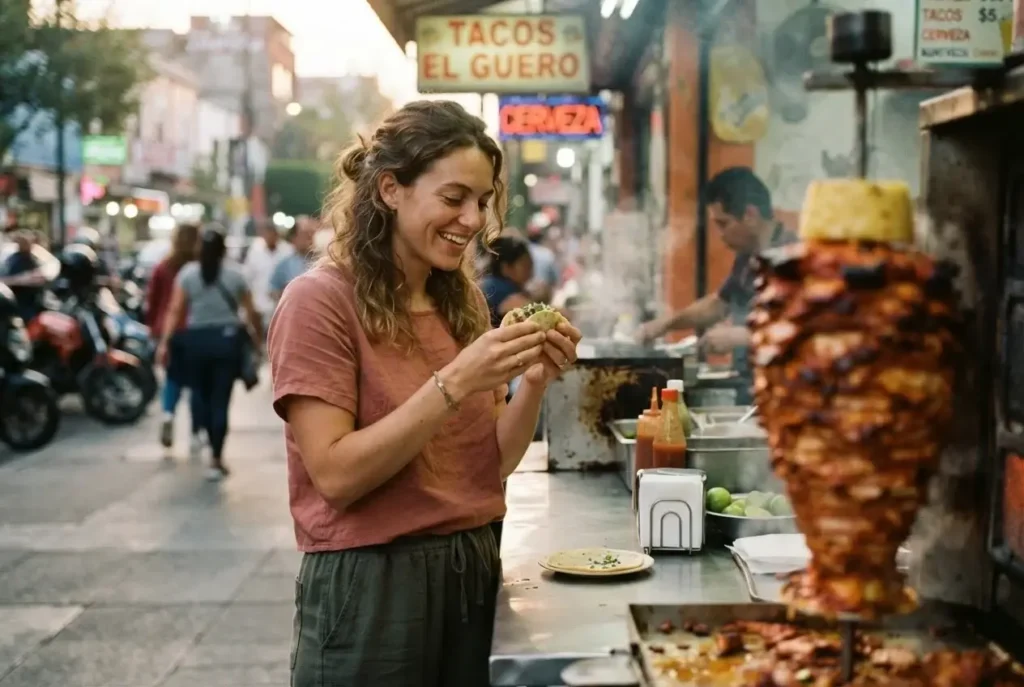
Al pastor tacos are made from pork that has been marinated in dried chiles, achiote paste, and spices, then stacked onto a vertical spit called a trompo and slow-cooked for hours. The taquero carves thin slices directly off the spinning spit, catches them on a small corn tortilla, and tops the taco with a sliver of fresh pineapple, white onion, and cilantro. The combination of the smoky, spiced pork against the brightness of the pineapple is genuinely one of the best flavor pairings in the world. A good taco al pastor in Mexico City costs roughly 20-35 MXN per taco, which is about $1-2 USD. If you’re paying significantly more than that at a street cart, you’ve probably wandered into a tourist zone.
The reason Mexican street food carries such cultural weight goes deeper than taste. Mexico’s traditional cuisine was formally inscribed on UNESCO’s Representative List of the Intangible Cultural Heritage of Humanity in 2010, recognizing not just the food itself but the entire community system of farming, cooking, and sharing that surrounds it. Corn tortillas, the vessel for nearly every taco you’ll eat in Mexico, represent thousands of years of agricultural and culinary knowledge. When you eat a street taco in Mexico City, you are eating something with roots that run very deep.
Beyond al pastor, look for elotes and esquites when you’re in Mexico. Elotes are whole grilled corn cobs brushed with mayo, cotija cheese, lime, and chili powder. Esquites are the same flavors in a cup, the corn kernels cut off and served warm. Both are sold from carts throughout Mexican cities and towns for a few pesos and are completely irresistible. Tamales wrapped in corn husks, sold by women from large steaming pots early in the morning, are another essential. The vendors near metro stations in Mexico City are often the most reliable for finding fresh, hot tamales before 9 a.m.
Colombia: Arepas, Empanadas, and the Breakfast You Didn’t Know You Needed
Colombia’s street food culture is built around corn, and the arepa is its most beloved expression. An arepa is a round, flat disc made from ground corn dough, griddled or grilled until the outside develops a slight char and the inside stays soft and chewy. That description makes it sound simple. The reality is more interesting.
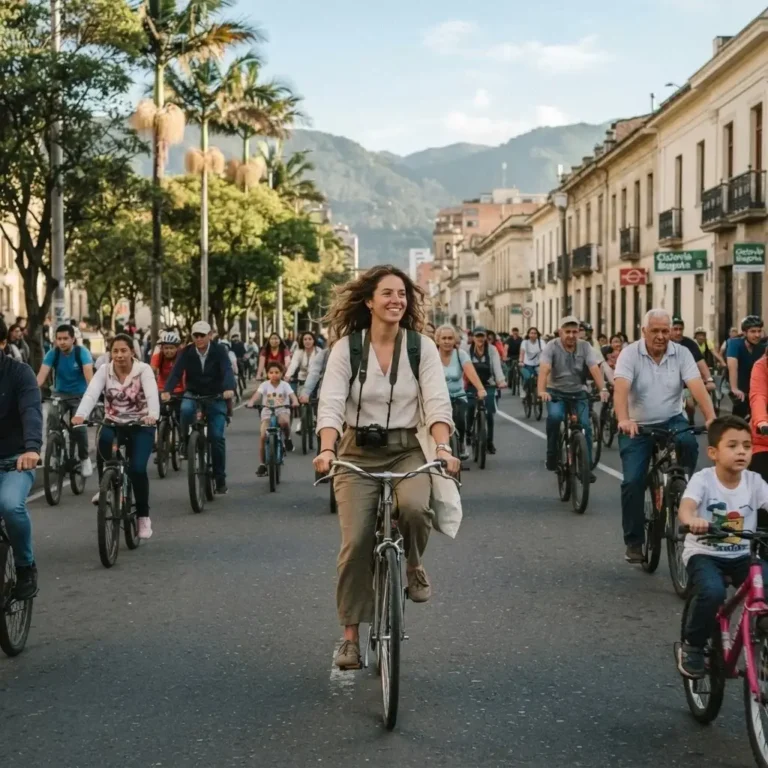
In Bogota, you’ll find arepas made from yellow cornmeal, often served plain or with butter and salt as a breakfast staple. In Cartagena, the version called arepa de huevo takes things further: a corn dough disc is fried until it puffs up, then a raw egg is injected inside and the whole thing is fried again until the egg sets inside its crispy casing. It’s one of the most satisfying street food experiences in South America and costs well under a dollar from a street cart. The resource Uncover Colombia’s guide to Colombian street food breaks down regional arepa varieties by city, which is genuinely useful if you’re moving around the country and want to understand what you’re eating in each place.
Empanadas in Colombia are another constant presence. Unlike the large, baked empanadas of Argentina, Colombian empanadas are small, fried, and filled with a mixture of seasoned beef or chicken and potato. They are typically sold from street carts in batches, kept warm under a cloth, and eaten in two or three bites. A small bag of them costs almost nothing. They make an excellent afternoon snack or a quick breakfast eaten standing up while you figure out your plans for the day.
Peru: The Street Food Capital of South America
Peru has earned a serious international reputation as one of the great food cultures of the world, and its street food is where that reputation was built long before Lima’s fine-dining scene attracted global attention. From what solo travelers consistently report, and from what the food research makes clear, Peru’s two essential street foods are anticuchos and ceviche.
Anticuchos are beef heart skewers, marinated overnight in vinegar, cumin, dried aji panca chiles, and garlic, then grilled over charcoal until the outside is lightly charred and the inside stays tender. They are served with a boiled potato and a drizzle of peanut sauce. The dish has pre-Columbian Andean roots and became widely popular in Lima during the colonial era, when enslaved Africans and working-class communities turned overlooked cuts of meat into something extraordinary. Today you’ll find anticucho carts set up throughout Lima from dusk onward, the smoke from the charcoal grills visible from across the street. Expect to pay roughly 5-15 PEN per skewer, which is approximately $1.50-4 USD. For a detailed look at what’s on offer, the Apus Peru guide to Peruvian street food covers the full range from anticuchos to picarones with good regional context.
Ceviche in Peru is a different experience from what most travelers expect. This is not a dish that’s typically eaten at a street cart late at night. In Lima, ceviche is a daytime food, a lunch dish, and many Peruvians will not eat it after midday because fresh seafood deteriorates quickly in the heat. The real ceviche experience in Peru involves markets: Mercado N 1 de Surquillo in the Miraflores area of Lima is one of the most accessible for travelers, with vendors selling fresh ceviche made to order right in front of you. A generous portion of fresh fish ceviche, properly made with aji amarillo, lime, red onion, and a slice of choclo corn, will cost you roughly 15-25 PEN ($4-7 USD) and is one of the best things you will eat anywhere.
Don’t overlook picarones either. These are Peruvian donuts made from a dough of sweet potato and squash, fried in rings and served with a dark syrup made from chancaca (raw cane sugar). They sell from street carts in the evenings throughout Lima and Cusco, and they are one of those dishes that tastes like nothing else in the world.
Brazil: Acaraje, Pao de Queijo, and the Street Food of Two Worlds
Brazil’s street food exists in two distinct registers that reflect the country’s complex cultural history. In the southeast, in cities like Sao Paulo and Rio de Janeiro, you’ll encounter fast, casual street food that is largely Portuguese and Italian in origin: pasteis (fried pastry pockets filled with cheese or meat), coxinhas (teardrop-shaped fried dough filled with shredded chicken), and the universally beloved pao de queijo, small cheese bread rolls made from tapioca flour that emerge from the oven puffy, chewy on the inside, and slightly crisp on the outside. You can find pao de queijo at almost every bus station, petrol station, and bakery across Brazil. BBC Good Food’s profile of Brazil’s essential dishes gives a good overview of why pao de queijo has become something of a national comfort food.
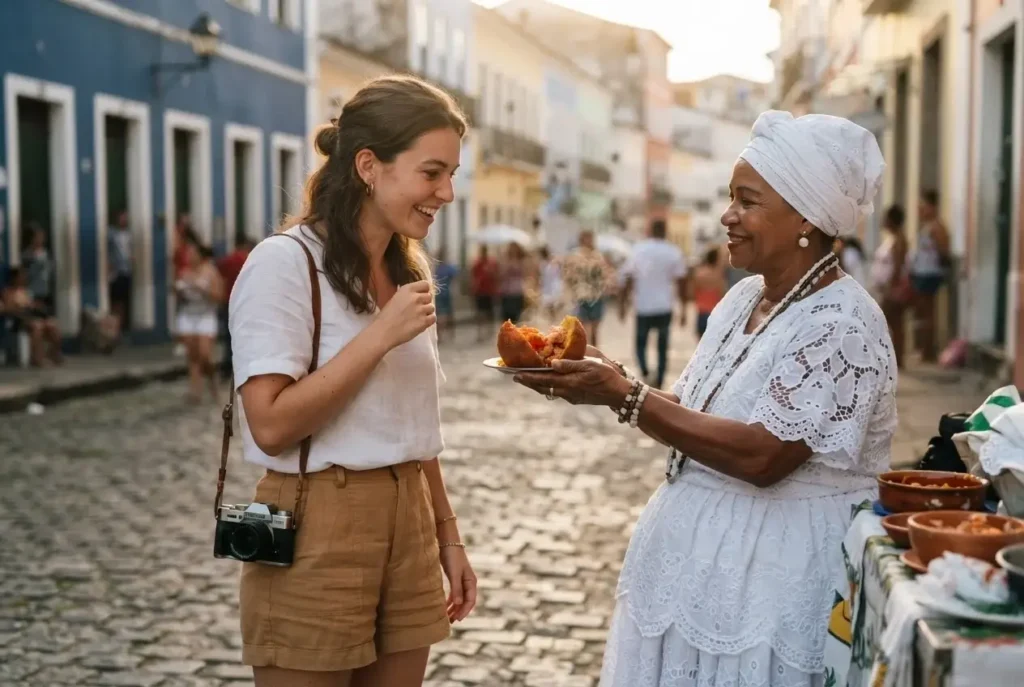
In the northeast, particularly in Salvador, Bahia, the street food is something else entirely. Acaraje is a fritter made from mashed black-eyed peas, seasoned with onion and salt, formed into balls, and fried in dendê palm oil, which gives the exterior its distinctive deep orange color and rich, earthy flavor. The fritter is split open and filled with vatapa (a thick paste of shrimp, bread, coconut milk, and peanuts), dried shrimp, and caruru (okra cooked with onions and dendê). The result is dense, savory, and complex in ways that are hard to describe until you’ve eaten one.
Acaraje was brought to Brazil by enslaved West African women and has been sold on the streets of Bahia by women known as Baianas de Acaraje for generations. The tradition is recognized as cultural heritage and carries enormous significance for Afro-Brazilian identity. The Parts Unknown deep-dive on acaraje in Bahia tells the full story of why this dish is so much more than street food, and it’s worth reading before you visit Salvador. Acaraje from a Baiana on the streets of Salvador costs roughly 15-25 BRL, about $3-5 USD, and is one of the most culturally meaningful things you can eat anywhere in the Americas.
Argentina and Chile: A Quick Hit on the Southern Cone
Argentina’s street food culture is quieter than its neighbors to the north, but empanadas here deserve their own mention. Argentine empanadas are large, baked or fried, and the fillings vary dramatically by region: beef with olives and hard-boiled egg in the northwest, humita (creamy corn) in Salta, caprese-style in Buenos Aires. Every region has its own version, and trying empanadas as you move through the country is a low-cost, high-reward way to understand Argentina’s regional diversity.
In Chile, the completo is the local take on the hot dog and it is dramatically more serious than it sounds. A completo is a steamed hot dog in a soft bun, topped with a mountain of diced tomato, avocado, and mayonnaise in quantities that seem almost aggressive by North American standards. It is sold from kiosks throughout Santiago and coastal cities and costs a few hundred Chilean pesos. Solo travelers on tight budgets consistently report that a completo plus a fresh juice from a street market is one of the most satisfying cheap lunches Chile offers. TasteAtlas rates the completo among the top-rated street foods in South America, which gives you some sense of how seriously Chileans take it despite its deceptively humble format.
How to Eat Street Food Well Without Making Yourself Miserable
I want to talk about this honestly, because every travel blog that covers street food should. The fear of getting sick from street food is real, and it stops a lot of people from having some of their best travel experiences. Here’s how I think about it.
The single most reliable indicator of a safe street food stall is volume. If locals are lined up, the food turns over quickly, which means nothing is sitting out for hours. Look for stalls where food is cooked to order right in front of you, where the person handling money is different from the person handling food, and where you can see the cooking surface. These are not foolproof rules but they are what experienced street food eaters across the Americas consistently rely on. The CDC Travelers’ Health food and water safety page is worth reading before any trip to Latin America. It covers which foods and drinks carry the highest risk and which precautions genuinely make a difference.

A few practical notes. Ice in drinks is riskier than food that’s been cooked through, especially in countries where tap water is not safe to drink. Fresh cut fruit from a street cart is generally fine if you eat it immediately and it hasn’t been sitting out. Raw seafood ceviche is safe when it’s made fresh to order at a busy, well-regarded market stall; the lime juice does chemically cook the fish, but freshness is everything. Carry a small bottle of hand sanitizer and use it before you eat, not because street food is dirty but because you’ll touch a dozen things between the market entrance and the cart and it’s just smart.
The bigger risk, in my experience, is not the street food itself. It’s skipping it entirely out of caution and spending your whole trip eating in restaurants that cater to tourists, where the prices are triple and the food is half as interesting. Eat the street food. Just eat it smart.
How to Find the Best Stalls Wherever You Are
Arrive when locals eat, not when tourists do. Breakfast and lunch are when street food is freshest and busiest throughout Latin America. Evening carts in Peru tend to specialize in grilled items like anticuchos because the charcoal heat is easier to manage after dark. Follow the noise, the smoke, and the clusters of people standing and eating without chairs.
Ask your hostel reception, not the concierge of a hotel, but the person at the front desk of a hostel who is usually a local in their twenties with opinions and they will almost always point you to something worth eating. Markets are your other great resource: covered markets throughout Latin America typically have a food section where you can eat at a communal table, try multiple things in one sitting, and compare notes with other travelers who have already done some reconnaissance.
The Americas stretch across so many climates, histories, and cultures that no single trip can cover it all. That’s what makes street food such a good lens for exploring it. You don’t need an itinerary. You don’t need a reservation. You just need to slow down, follow the smell of something cooking, and be curious enough to ask what it is.
That curiosity, more than any guide or list, is what gets you the best meal of your trip.