Best Eco-Lodges in Europe Without the Greenwashing Traps

The first time I heard a hotel call itself “eco,” I was in my early twenties, still working flexible jobs and squirreling away tip money so I could keep traveling. The word sounded good. It also, I slowly learned, could mean almost nothing. A little card on the bathroom sink asking me to reuse my towel is not the same thing as a lodge that runs on its own solar power and hires from the village down the hill.
So before I hand you a list of the best eco-resorts and lodges in Europe, I want to give you the thing most travel roundups skip: a simple way to tell the real ones from the pretenders. Once you can do that, choosing becomes easy, and the trip becomes something you feel genuinely good about. This guide is built for the daydreamer who wants clean air, slow mornings, and a clear conscience, and who maybe, like a lot of my readers, is planning to go alone.
What “Eco” Actually Means (and Why It Gets Faked)
Here’s the honest version. “Eco” has no legal meaning on its own. Any hotel can print it on a website. What separates a truly sustainable stay from a marketing exercise is measurable practice: where the energy comes from, how water and waste are handled, whether food is local, and whether the local community actually benefits.
The good news is that Europe has some of the most trustworthy sustainability certifications in the world, and they’re free for you to check. The one I trust most for accommodation is the official EU Ecolabel, and you can browse verified properties and read exactly what they’re judged on through the European Commission’s EU Ecolabel tourist accommodation program. It isn’t a vibe or a logo a hotel bought. A property has to meet 22 mandatory criteria and clear a points threshold on top of that, and there are now around 800 certified accommodations across the EU. When I see that label, I stop worrying.
The second name worth knowing is Green Key, an international standard covering more than 9,000 places in over 90 countries. The reason I mention it isn’t for you to memorize, it’s because you can search their live database yourself. Before I book anything, I cross-check the property against the official Green Key certified sites list, which is updated monthly. If a lodge shouts about being green but appears on none of the major registries, that’s not a dealbreaker for a tiny off-grid family operation, but for a slick resort with a marketing team, it makes me ask questions.
The Fastest Way to Spot Greenwashing
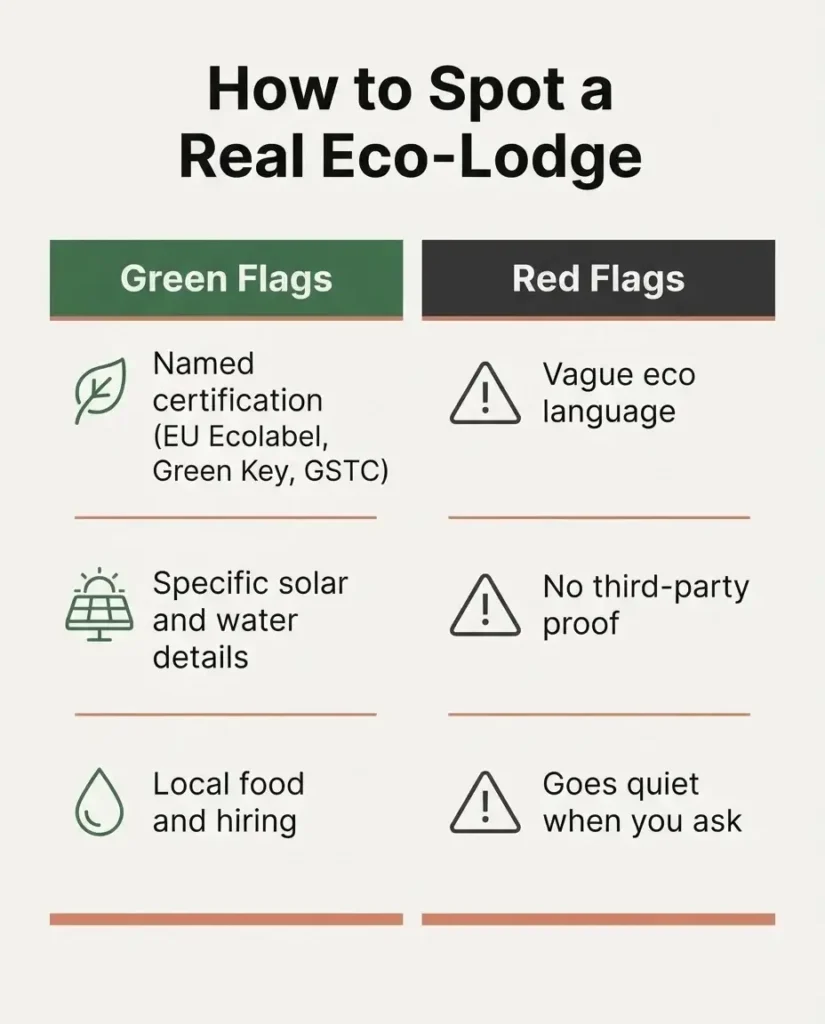
Let me save you the years it took me. Vague language is the first red flag. “Committed to the environment” tells you nothing. Real operators get specific: solar arrays, rainwater harvesting, a number of trees planted, a named local supplier.
The second flag is a total absence of third-party proof. This is where a global benchmark helps. The Global Sustainable Tourism Council sets the criteria that most reputable certifications are measured against, and their GSTC certification framework runs on a three-year cycle, which means a certified place has to keep earning it, not buy it once and coast. If a property claims to be sustainable but can’t point to any recognized certification and won’t tell you specifics when you email and ask, I take my money elsewhere. And do email. I’ve found that genuinely green operators love answering these questions, while the fakers go quiet.
One more thing I’ve noticed over years of slow travel: the truly sustainable places are often quieter about it than the pretenders.
They’re too busy composting and running the reforestation project to plaster “eco” across every surface.
The Alps: Car-Free Comfort at Altitude
If you want your first eco-lodge trip to feel like a fairy tale, start in the mountains. The Alps have led Europe on car-free, low-impact luxury for two decades.
Switzerland’s Whitepod is the poster child, a cluster of geodesic dome tents pitched at around 1,250 meters in the Valais region, designed so the mountainside is the luxury and the footprint stays light. It opened back in 2004, well before “eco-luxury” was a marketing category. In Italy’s South Tyrol, Vigilius Mountain Resort sits at roughly 1,500 meters and is reachable only by cable car, which is the whole point. No cars, no engine noise, just the Dolomites and a building made largely from natural materials.
For a first-timer worried about being stranded, this region is reassuring because the car-free access is a feature, not a hurdle. You take a train, then a cable car or a shuttle. When I backpacked through Europe alone, the Alpine rail network was the part that made me feel most capable, because everything connects and everything runs on time. You genuinely do not need to drive.
Central Europe: Easy to Reach, Easy on the Wallet
Not every eco-stay costs a fortune, and this is the part the luxury listicles bury. Slovenia is quietly one of the greenest countries in Europe, and the Bohinj Eco Hotel sits right on the edge of Triglav National Park in the Julian Alps. It bills itself as the country’s first eco hotel, and it’s a strong pick for a solo traveler because there’s a wellness center, a restaurant, and organized activity, so you’re never awkwardly alone at dinner but you’re free to hike all day. You can see the setup and current rates on the Bohinj Eco Hotel’s official site, and the surrounding lake and park are the real attraction.
What I love about the Slovenian option is how doable it is. It’s an easy reach from Ljubljana, prices sit well below Alpine-luxury territory, and the whole country is compact enough that a nervous first-timer can build confidence fast. This is exactly the kind of place I point people to when they say they want to try slow travel but can’t picture spending a fortune to do it.
The Mediterranean: Off-Grid Islands and Stone Villages
The Mediterranean does eco differently. Here it’s less about geodesic domes and more about old ways of living that were sustainable long before it was trendy.
The standout is Milia Mountain Retreat, tucked into the forested slopes of the White Mountains in western Crete. It’s a restored 17th-century stone village that runs off-grid, surrounded by chestnut trees, with food grown or sourced right there. You can read the ethos straight from Milia Mountain Retreat’s own site, and it’s the kind of place that changes how you think about “luxury.” There’s no television fighting for your attention. The luxury is the silence, the mountain air, and a plate of food that traveled about fifty feet to reach you.
On the food front, this is where eco-lodges shine. Expect seasonal, local, often vegetarian-leaning menus. In Crete, that means wild greens, fresh cheese, local olive oil poured with abandon, and slow-cooked lamb or bean stews. My rule at any eco-lodge is to eat whatever they grow themselves and to ask the staff what’s in season, because that answer is the whole reason you came.
A quick honest note for solo travelers: the more remote the property, the more you’ll want to sort transport in advance. Many Mediterranean eco-villages are deliberately hard to reach. Confirm airport transfers or the nearest bus and taxi options when you book, rather than assuming you’ll figure it out on arrival.
Iberia: Where Wine Country Meets Serious Sustainability
Portugal’s Douro Valley is one of my favorite recommendations for someone who wants comfort without guilt. The Six Senses Douro Valley has earned GSTC recognition, which puts real proof behind the polish, and it runs genuine programs around plastic reduction and local ecology. You can dig into the specifics on the Six Senses Douro Valley sustainability page, which is refreshingly detailed rather than fluffy.
This is the splurge end of the spectrum, and I want to be straight with you about that. From what solo travelers consistently report, luxury eco-resorts like this are wonderfully safe and easy to navigate alone, but you pay for the setting and the service. If your budget is tighter, the certification-checking skills from earlier in this guide will help you find smaller Portuguese and Spanish guesthouses with EU Ecolabel status for a fraction of the price. The label is the same trustworthy standard whether the room costs 90 euros or 900.
The Nordic and Arctic North: Nature as the Whole Point
If you want the trip that reorders your priorities, go north. This is where eco-lodges stop being accommodation and start being the destination itself.
Sweden’s Treehotel in Lapland is the famous one, a collection of architect-designed treerooms suspended in the forest near the Lule River. Prices give you a sense of the range: the smaller treerooms start around 550 dollars for two adults, and the large 7th Room, which sleeps five, runs closer to 1,700 dollars a night, breakfast included. You can see the individual rooms on the official Treehotel site, and each one is a genuine piece of design, not a gimmick. In winter you may catch the northern lights from your bed. In summer you get light that barely fades.
Further west, Scotland’s Highlands hold one of the most inspiring projects in Europe. Alladale Wilderness Reserve spans 23,000 acres and is one of the UK’s largest privately owned rewilding efforts, actively restoring native woodland and wildlife. Stays start from around £166 per person per night, and you can learn about the conservation work at the Alladale Wilderness Reserve site. Staying here isn’t just low-impact, your money funds the restoration of the land you’re walking on. For a solo traveler, it leans toward the exclusive-use and small-group end, so it suits someone who wants deep quiet and a real sense of purpose over a social buzz.
Are Eco-Lodges Actually Good for Solo Travelers?
Short answer, yes, and often better than a standard hotel. Here’s my thinking after years of doing this alone.
Eco-lodges tend to be small, which means staff learn your name and other guests are the kind of people who chose the same slow, curious trip you did. Shared dinners, guided hikes, and communal spaces make it natural to fall into conversation without forcing it. I’ve watched shy first-time solo travelers arrive tense and leave with new friends, purely because the setting does the social work for you.
The one thing to plan around is transport, since remoteness is the trade-off. Lean on Europe’s excellent trains, confirm the last leg of the journey before you go, and don’t be shy about emailing the lodge to ask exactly how people without a car usually arrive. Every good operator has answered that question a hundred times.
Budgeting Honestly Across the Spectrum
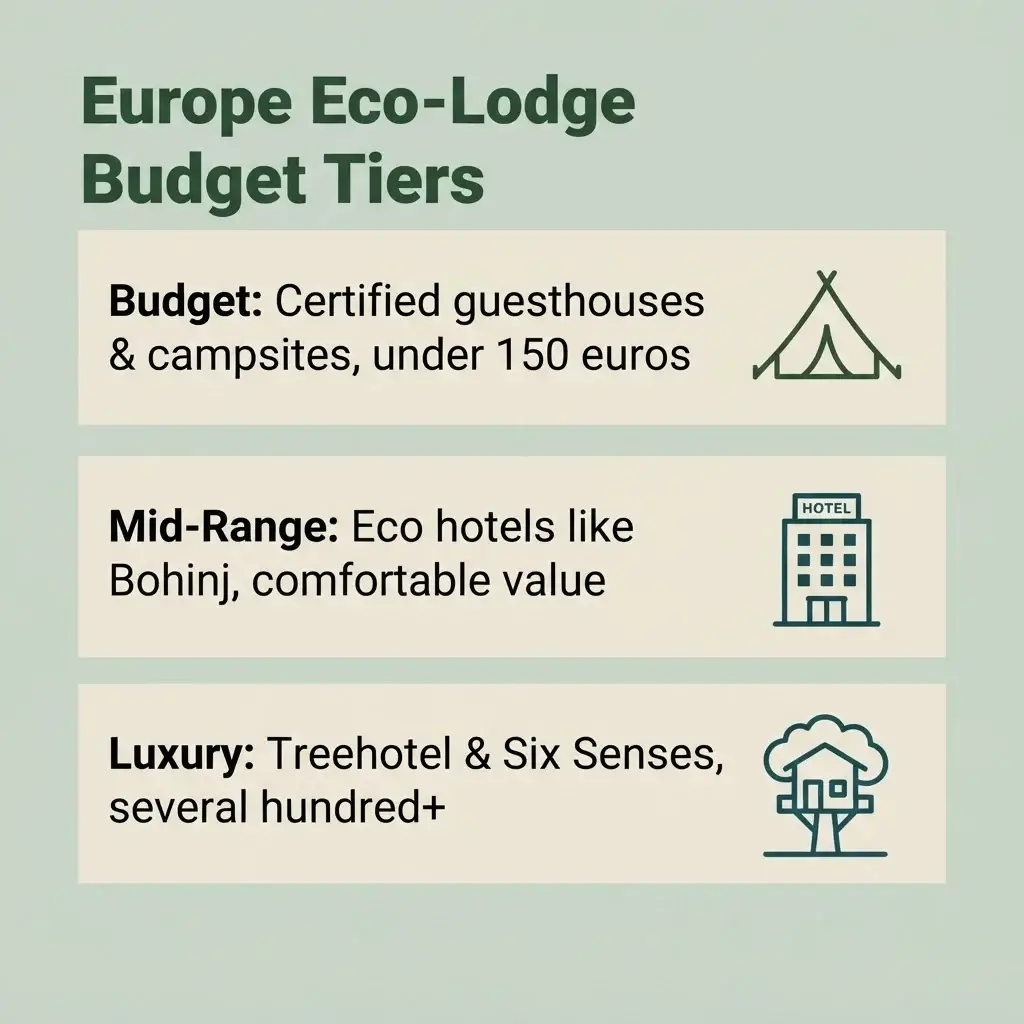
Let me demystify the money, because “eco” spans a huge range. At the top, design-forward stays like Treehotel or a Six Senses run several hundred dollars a night and up. In the middle sit places like Bohinj or a certified Portuguese guesthouse, comfortable and often under 150 euros. And there’s a whole world of EU Ecolabel campsites, farm stays, and small guesthouses where you can travel sustainably for very little, since a large share of certified properties are modest one to three-star spots, not resorts.
My advice, and the reason I built the certification section first, is to decide your budget and then filter by the label rather than the price tag. A certified budget guesthouse is doing more real good than an uncertified “luxury eco-resort” charging five times as much.
When to Go and What to Pack
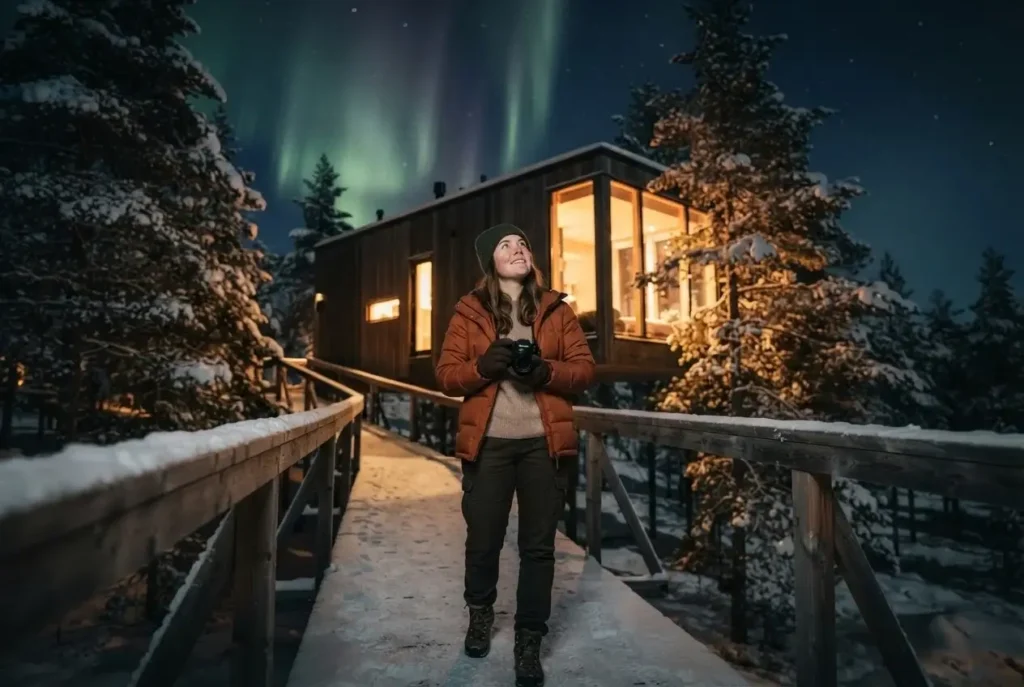
Timing depends on the region. The Alps and Nordic north are magical in winter for snow and northern lights, and glorious in summer for hiking and long light. The Mediterranean is best in spring and autumn, when it’s warm, green, and far quieter than the July crush.
Packing for eco-lodges is a little different because you’re often in nature and sometimes off-grid. Bring layers, proper walking shoes, a reusable water bottle, and a power bank, since remote places may have limited outlets. Skip the single-use everything. And pack lighter than you think, because I have never once regretted a smaller bag, but I have absolutely regretted lugging a heavy one up a mountain path to reach a lodge that was worth every step.
The last thing I’ll say is the thing I believe most. You do not need to wait for the perfect moment or the perfect budget to do this. Start with one certified stay, one region, one long weekend if that’s all you have. The confidence, and the quiet, come faster than you’d expect.