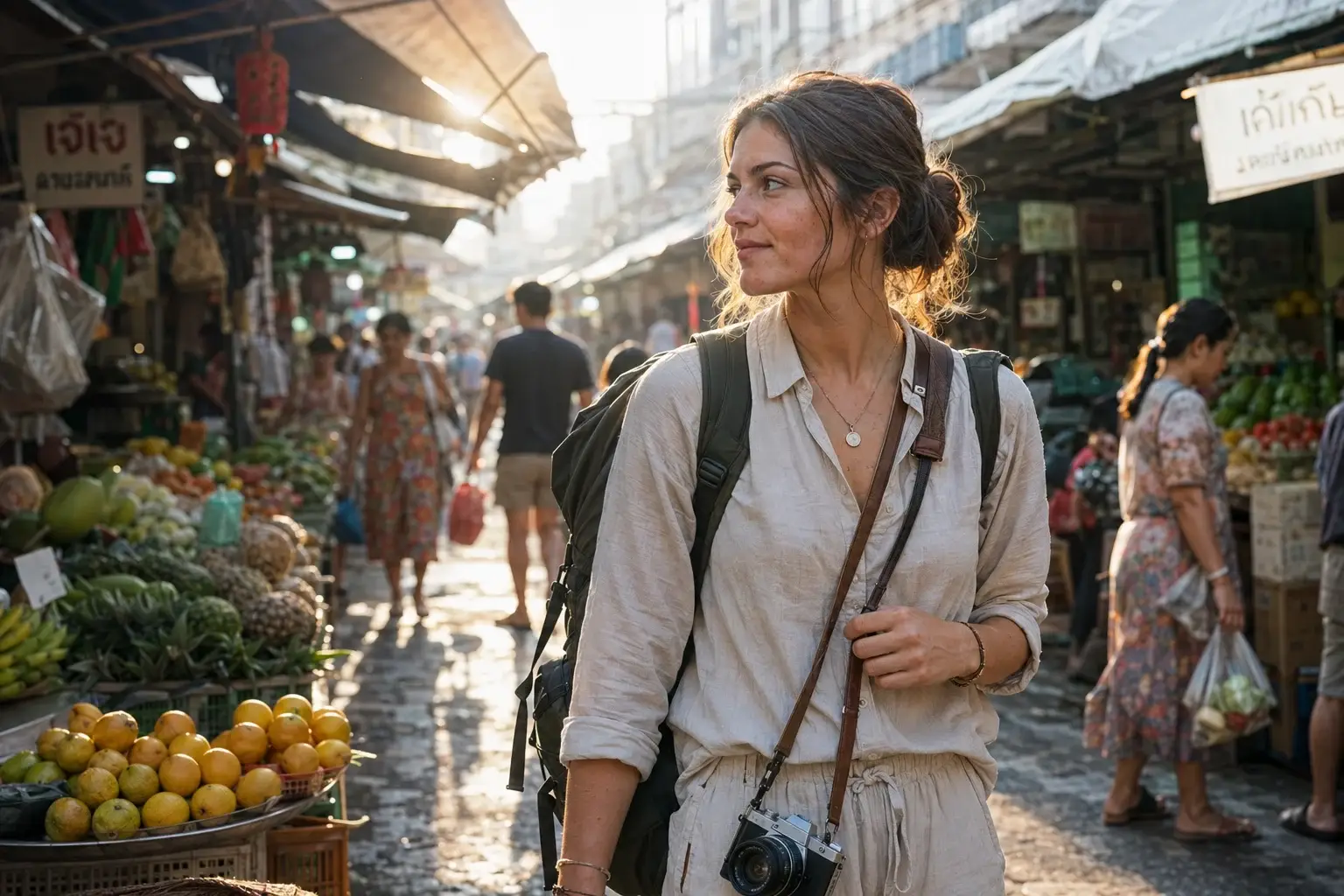
I still remember the absolute panic I felt right before my very first solo backpacking trip across Europe. I was standing in the middle of my tiny New York apartment, surrounded by an ocean of clothes, three different pairs of heavy shoes, a massive first-aid kit that could support a small army, and a towering 70-liter backpack. I stuffed, shoved, and forced everything inside until the seams groaned. When I pulled that monstrous bag onto my shoulders, I nearly fell backward onto my floor.
During my first week on the road, that heavy bag felt like a physical punishment. I dragged it up endless flights of stone stairs in old European train stations. I bumped into locals on crowded city buses. I arrived at my hostels completely exhausted, sweaty, and frustrated.
That was the moment I realized a major truth about travel: when you overpack, you are carrying your fears on your back. You pack extra things because you are worried about the unknown. But carrying too much stuff actually robs you of the very freedom, agility, and independence that solo travel is supposed to give you.
Eventually, I left my rigid 9-to-5 corporate office job for good to pursue a life on the road. I worked flexible jobs, waitressed long hours to save up money, and even worked as a certified sightseeing guide in New York City. Through years of moving from place to place—including living with a family in Ghana and teaching English in rural Thailand—I finally mastered the art of minimalist packing.
You do not need a massive suitcase to explore the world. In this deep-dive guide, I am going to share my absolute best space-saving travel packing hacks. These practical strategies will help you shrink your luggage, build your solo travel confidence, and help you focus on the beautiful cultural experiences in front of you rather than the heavy bag on your back.
The Mental Shift: Why Packing Less Means Experiencing More
When you are preparing for your first solo trip, it is completely normal to feel a bit anxious. Your brain starts inventing wild, worst-case scenarios. “What if it rains for a week straight? What if I get invited to a formal dinner? What if I spill coffee on my only nice shirt?”
As a result, you pack for every single hypothetical situation. But after years of slow travel through dozens of countries, I can tell you that those scenarios rarely happen. And if they do, you can almost always find a local solution.
When you embrace space-saving travel packing hacks, you are choosing to trust yourself. You are acknowledging that you can handle small surprises without carrying a security blanket in your suitcase. Moving through the world with just a single carry-on bag or a small backpack changes your entire travel experience. You can change your plans on a whim, jump onto a local bus without hassle, and walk through vibrant local neighborhoods without looking like a vulnerable, overwhelmed target. You blend in, you move fast, and you stay energized.
1. The Core Philosophy of the Minimalist Wardrobe
Clothing is always the biggest space-stealer in any bag. The secret to mastering space-saving travel packing hacks is not finding a way to cram 30 separate outfits into a tiny space. Instead, it is about choosing a small number of versatile pieces that can all be worn together.
The Power of the Capsule Wardrobe
A travel capsule wardrobe is a small collection of clothes that look great in any combination. When I select clothes for a long solo journey, I use a strict color palette. I stick to neutral base colors like black, navy, grey, or white, and add one or two accent colors. Every top must match every bottom. If an item only works with one specific outfit, it stays home.
The Rule of Three
For a trip of any length—whether it is two weeks or two months—I follow the Rule of Three for my core clothing items. You pack three tops, three bottoms, and three sets of undergarments.
- One to wear: You wear one set while traveling or moving between cities.
- One to wash: One set is drying on a line in your hostel or guesthouse room.
- One to spare: One clean set is packed away in your bag, ready for use.
This rule forces you to do quick sink-washes along the way, which keeps your bag incredibly light. It works perfectly whether you are navigating the historic, narrow streets of Tokyo or exploring European capital cities.
Material Matters: Choosing Performance Fabrics
To make the Rule of Three work, you must pay attention to fabric types. Heavy cotton shirts take a long time to dry and hold onto odors. Instead, look for lightweight Merino wool, linen, or high-quality synthetic blends. Merino wool is a solo traveler’s superpower. It regulates your body temperature, stays fresh for multiple days without washing, and rolls up into a tiny ball.
2. Advanced Compression and Organization Hacks
Once you have selected your versatile clothing pieces, the next step is maximizing the physical space inside your bag. This is where physical space-saving travel packing hacks come into play.
Rolling vs. Folding: The Ranger Roll Technique
If you are still folding your clothes into flat squares, you are losing valuable space and creating unnecessary wrinkles. Army personnel and experienced backpackers use the “Ranger Roll” technique. To do this with a t-shirt, you fold the bottom edge of the shirt inside out by a few inches to create a small cuff. Then, you fold both sides inward to meet in the middle. Finally, you roll the shirt down tightly from the collar to the bottom cuff, and flip the cuff over the roll to secure it. This creates a tight, burrito-like bundle that takes up a fraction of the space of a folded shirt.
Packing Cubes: The Ultimate Organization System
I never set foot on a plane or bus without my packing cubes. These lightweight nylon fabric containers act like miniature dresser drawers for your luggage. I use one cube for tops, one for bottoms, and a smaller one for undergarments and socks.
For maximum space savings, invest in compression packing cubes. These specialized cubes have a secondary perimeter zipper designed to squeeze out all the excess air after the cube is filled. It compresses your clothing down into a flat, solid brick, saving up to 40% more space inside your main compartment.
The Bundle Packing Method
If you are traveling with structured clothing like a blazer, a button-down shirt, or a dress, the bundle packing method is an incredible space saver. You start with a central “core” item, like a small pouch filled with socks. Then, you wrap your clothing items tightly around that core, layer by layer. Because the clothes are wrapped in a continuous, curved shape around the center rather than sharp creases, they take up less volume and remain completely wrinkle-free.
3. Footwear Strategies for Solo Explorers
Shoes are bulky, heavy, and notoriously difficult to pack. They are the ultimate enemy of the carry-on traveler. To keep your bag light and organized, you must limit yourself to a maximum of two pairs of shoes.
The Two-Pair Maximum Rule
- Pair One (The Heavy Lifter): This is your supportive, broken-in walking shoe or trail runner. You will wear this pair on travel days so it never takes up physical space in your bag. You will use these for walking miles through historic districts, catching trains, or hiking.
- Pair Two (The Lightweight Companion): This is a slim, compressible shoe that packs flat against the inner walls of your bag. Think of a minimalist canvas slip-on, a sleek leather sandal, or a high-quality barefoot-style shoe.
Utilizing Empty Shoe Space
Never pack an empty shoe. The inside of your packed shoes is prime real estate. Roll up your socks tightly and stuff them deep into the toe boxes of your shoes. You can also use this space to store fragile electronic items, small charging cables, or travel-sized perfume bottles. This not only saves valuable space but also helps your shoes maintain their shape under the pressure of your backpack.
4. Downsizing Your Toiletries and Personal Care
It is easy to accidentally pack two pounds of liquid soaps, lotions, and hair products. Not only do these items take up immense space, but they also cause massive delays at airport security checkpoints.
Solid vs. Liquid Toiletries
The fastest way to shrink your toiletry kit is to swap out your liquids for solid alternatives. Today, you can find high-quality solid shampoo bars, conditioner bars, solid body deodorants, and even dehydrating toothpaste tablets.
Solid bars last much longer than liquid bottles, they cannot spill and ruin your clothes, and they do not count toward your airline liquid limits. When I taught English in Thailand, switching to solid shampoo bars allowed me to travel across Southeast Asia for months with just a small, palm-sized toiletry bag.
The Contact Lens Case Trick
If you must bring liquid skin creams, makeup primers, or liquid foundations, do not bring the original bottles. For short trips or weekend getaways, pump a small amount of the product into the individual wells of a plastic contact lens case. Each well holds enough product for several days of use, and the screw-on caps create a completely airtight, leak-proof seal that takes up almost zero space.
Strategic Planning for Medical Supplies
When you are traveling solo, safety is a top priority. However, you do not need to pack a full first-aid kit. Instead of bringing entire cardboard boxes of pain relievers or allergy medications, cut out small strips of the blister packs and place them into a tiny, labeled zip-top bag.
Keep in mind that modern pharmacies exist all over the world. To ensure you have the correct health preparations and see what medications are common globally, it is smart to check the official guidelines on the CDC Travelers’ Health destination advisories before you depart. This allows you to carry only the absolute essentials for emergencies, knowing you can easily buy general items at your destination.
5. Electronics and Gear Minimalism
In our digital world, it is tempting to pack a laptop, a tablet, an e-reader, a camera with multiple lenses, and a mountain of charging cords. But heavy gear will quickly weigh you down and increase your anxiety about theft.
The All-in-One Smartphone Strategy
For your first solo trip, your smartphone is your most valuable asset. Modern smartphones function as your high-resolution camera, your guidebook, your map, your language translator, and your entertainment center. Unless you are working full-time on the road as a digital nomad, leave the heavy laptop and bulky DSLR camera at home. Using your phone for everything lightens your physical load and allows you to stay fully present in the beautiful moments you are experiencing.
Universal Charging Blocks and Cord Management
Instead of packing a different wall adapter for every device, invest in a single, high-wattage multi-port USB charging block. Look for one that uses Gallium Nitride (GaN) technology, which allows the charger to be incredibly small while providing enough power to charge a phone, a power bank, and a tablet all at the same time. Pair this with a single multi-tip charging cable that features USB-C, Lightning, and Micro-USB connectors on one end.
6. How to Apply These Hacks in Real-World Destinations
To show you how these space-saving travel packing hacks work in real life, let’s look at a few classic solo travel destinations. Packing light changes how you navigate these unique environments.
Destination Case Study: Exploring Bangkok, Thailand
Imagine landing at Suvarnabhumi Airport in Bangkok for your very first solo adventure. The air is warm, the sounds are incredible, and the energy is unmatched. If you brought a massive suitcase, you would have to pay for an expensive private taxi just to fit your luggage.
But because you used space-saving travel packing hacks, you can easily slide into a crowded Airport Rail Link train car, transfer smoothly to the BTS Skytrain, and walk down the bustling streets of Sukhumvit directly to your guest house. For navigating local transit options seamlessly, you can review transit patterns on the official Grab app overview to understand how ride-hailing and transport function across the region.
When packing for Thailand, you only need ultra-lightweight linen pants, thin breathable shirts, and a light sarong to cover your shoulders when visiting stunning temples. For delicious local meals, look for street food stalls serving up fresh Pad Thai or green curry. You can eat like a king for just a couple of dollars, and because your bag is small, you can easily pull up a plastic stool at a busy night market without your luggage blocking the narrow walkway.
Destination Case Study: Historic European Exploration
Let’s look at another classic route: backpacking through Europe. Imagine arriving at a historic train station in Italy or France. The streets are made of historic cobblestones that easily destroy the small plastic wheels of giant suitcases. Old boutique hotels and local hostels rarely have elevators, meaning you will have to carry your bag up four or five flights of narrow stairs.
A light, 40-liter backpack makes this effortless. You can zip past struggling tourists, catch a last-minute train to a nearby village, and keep your bag safely under your seat or in the overhead bin.
When you travel light in Europe, you can easily spend your afternoon sitting outside at a small cafe, enjoying a fresh plate of pasta or a pastry, without worrying about a giant suitcase attracting the attention of local pickpockets. To make sure you understand the documentation required for moving smoothly between these countries, it is highly recommended to review the official details on US Department of State Travel entry requirements during your planning stage.
7. The Ultimate Space-Saving Packing Checklist
Here is a comprehensive breakdown of exactly what goes into a 40-liter carry-on bag for a multi-week solo journey. Every item is chosen for its versatility and small physical footprint.
Clothing (Packed in Compression Cubes)
- 3 Lightweight Tops: Merino wool or synthetic blend shirts that dry quickly.
- 1 Long-Sleeve Layer: A lightweight fleece or a thin merino wool sweater for chilly flights or cool evenings.
- 2 Pairs of Pants/Bottoms: One pair of durable travel pants and one pair of comfortable shorts or a versatile skirt.
- 1 Swimsuit: Double-functions as workout gear or lounge shorts.
- 1 Ultralight Rain Jacket: A packable shell that rolls down into the size of an apple.
- 4 Pairs of Socks & Underwear: High-quality, moisture-wicking fabrics that can be washed in a sink and dry in a few hours.
Footwear
- 1 Pair of Walking Shoes: Worn on your feet during travel days to save space.
- 1 Pair of Flat Sandals or Slip-ons: Packed flat along the inner edge of your bag.
Toiletries (In a Clear, Quart-Sized Pouch)
- Solid Shampoo & Conditioner Bars: Cut in half to make them even smaller.
- Solid Deodorant: Compact size.
- Toothpaste Tablets: Stored in a small, reusable tin.
- Travel-Sized Sunscreen & Insect Repellent: Essential for skin protection.
- Small Emergency Medical Strip: A few tablets of ibuprofen and motion sickness medication.
Electronics & Miscellaneous Gear
- Smartphone: Your primary tool for photography, navigation, and language translation.
- Compact Power Bank: Keeps your phone charged during long days of exploring new neighborhoods.
- GaN Multi-Port Wall Charger: A single plug to charge all your devices simultaneously.
- Universal Plug Adapter: Essential for international wall outlets.
- Microfiber Travel Towel: Packs down to the size of a small wallet and dries ten times faster than a standard cotton towel.
8. Overcoming the Fear of Leaving Things Behind
The biggest obstacle to packing light isn’t a lack of space-saving travel packing hacks. It is the emotional fear of letting go of your comfort items. It is the worry that you will find yourself in a situation where you don’t have exactly what you need.
But here is the beautiful secret of solo travel: the world is full of kind people, local shops, and accessible resources. If you arrive in a new city and discover that you absolutely need a warm hat, a local market will have exactly what you need. Buying a local item not only solves your immediate problem but also gives you an authentic souvenir and a wonderful story to tell.
When you purposefully leave room in your bag, you are creating space for the unexpected. You are making room for local art, unique textiles, or small gifts that you might discover along the way. More importantly, you are clearing away the physical clutter so you can focus entirely on the personal growth, the building of confidence, and the deep cultural connections that make solo travel so life-changing.
Your Turn to Take Action
The next time you sit down to plan your big adventure, challenge yourself to step outside your comfort zone. Lay out everything you think you need on your bed, and then purposefully cut that pile exactly in half. Use the compression cubes, practice the Ranger Roll, choose versatile clothes that work together, and trust that you are fully capable of navigating the world with less.
You do not need a mountain of luggage to have a meaningful, deep, and beautiful journey. The world rewards curiosity, courage, and an open mind far more than a heavy suitcase. Pack light, stand tall, and step forward into your first solo adventure with absolute confidence. The road is waiting for you!