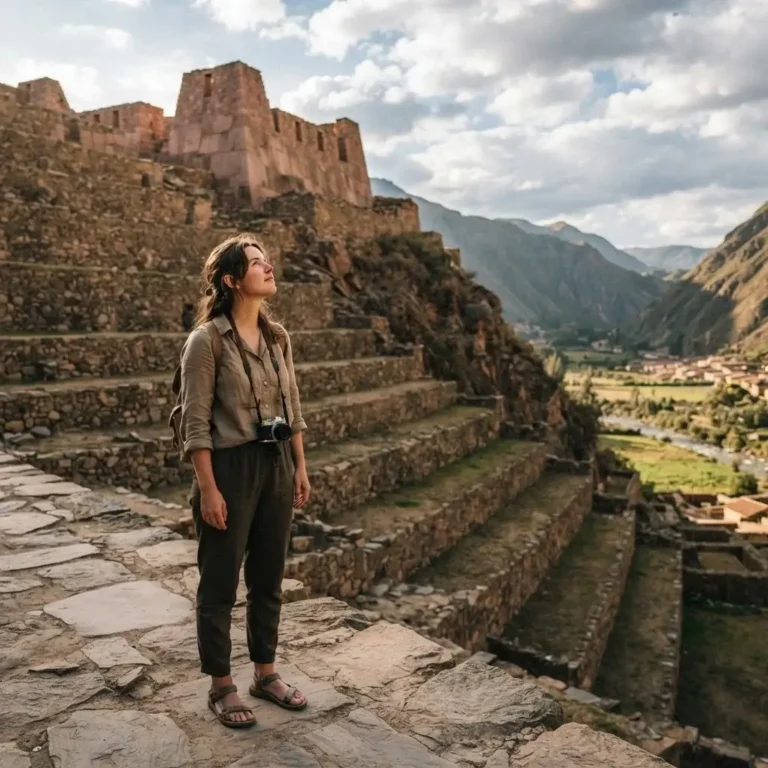
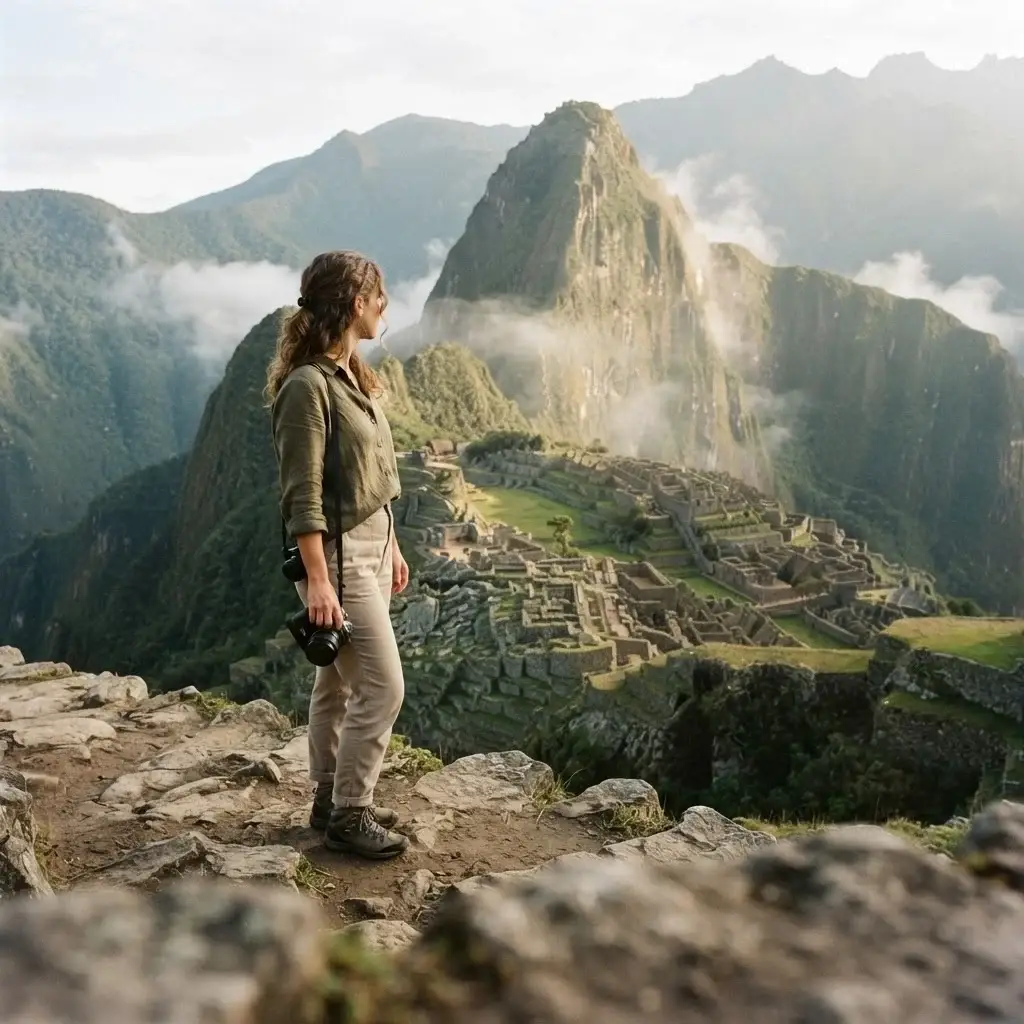
There’s a version of Peru that exists in most travel articles. It’s all golden light over Machu Picchu, ceviche by the sea in Lima, and dramatic Andean landscapes that make you want to cry a little. That version is real. I promise you it is.
But the budget reality of getting there? Most articles either undersell it with suspiciously low daily numberFor a two-week trip, you’re lookings or pad it out with costs only a luxury traveler would encounter. Neither version is actually useful if you’re sitting at your kitchen table trying to figure out whether this trip can fit inside your savings account.
So here’s what I want to do instead. I want to give you the honest breakdown. The things I wished someone had spelled out before I started planning. The hacks that work, the costs you won’t see coming, and the mindset shifts that make traveling Peru not just affordable but genuinely extraordinary.
Because Peru is one of those places that can change how you see yourself. And you don’t need a big budget for that.
Before You Go: Entry, Visas, and What You Actually Need
Let’s get the logistics out of the way first, because stress about this stuff can kill your momentum before you even start.
If you’re from the US, UK, Canada, Australia, or most EU countries, you do not need a visa to enter Peru for tourist stays under 90 days. You show up, you get stamped, you’re in. You will need a passport valid for at least six months beyond your entry date, and you should carry proof of onward or return travel, since Peruvian immigration officials do occasionally ask for it. For the most current entry requirements, I always point readers to the U.S. Embassy in Peru’s travel information page, which is updated regularly and has clear guidance for American travelers.
One thing worth knowing: when you arrive, do not declare cash if you’re carrying less than $10,000 USD. If you’re carrying more than that, you are legally required to declare it. Most budget travelers are nowhere near that threshold, but it’s good to know.
Is Peru Safe? The Honest Answer
This comes up in every Peru conversation, and I refuse to brush past it with a dismissive “just be sensible.” You deserve a real answer.
Peru has a Level 2 “Exercise Increased Caution” advisory from the US State Department, which means you should be aware and prepared, not that you should cancel your trip. The full Peru travel advisory is worth reading yourself, because it’s actually more reassuring than the headline sounds. The advisory explicitly states that the city of Cusco, the Sacred Valley, the Inca Trail, and Machu Picchu are not in the higher-risk zones. The areas of real concern are the Colombian border region and the VRAEM valley, which are nowhere near the places most travelers visit.
Petty theft is the main risk in Lima and Cusco. Pickpocketing on public transport, bag snatching in busy markets, and phone theft in tourist areas are real. Here’s how solo travelers consistently manage this: use a crossbody bag with a zipper rather than a backpack on city streets, keep your phone in your front pocket or bag rather than visible in your hand, carry a small amount of cash daily and leave your main stash in your hostel’s safe, and use official taxis or ride-hailing apps rather than unmarked cabs. In my experience guiding tourists around New York, I noticed that the travelers who had problems were almost always the ones who were distracted or visibly uncertain. Staying present and walking with purpose changes everything about how you’re perceived.
Night travel outside cities carries more risk, and there’s a reason the US government advises its own employees to avoid overnight road travel on certain routes. Stick to reputable overnight bus lines for long hauls, and you’ll be fine.
The Real Budget Numbers
Okay. Here’s what you actually want to know.
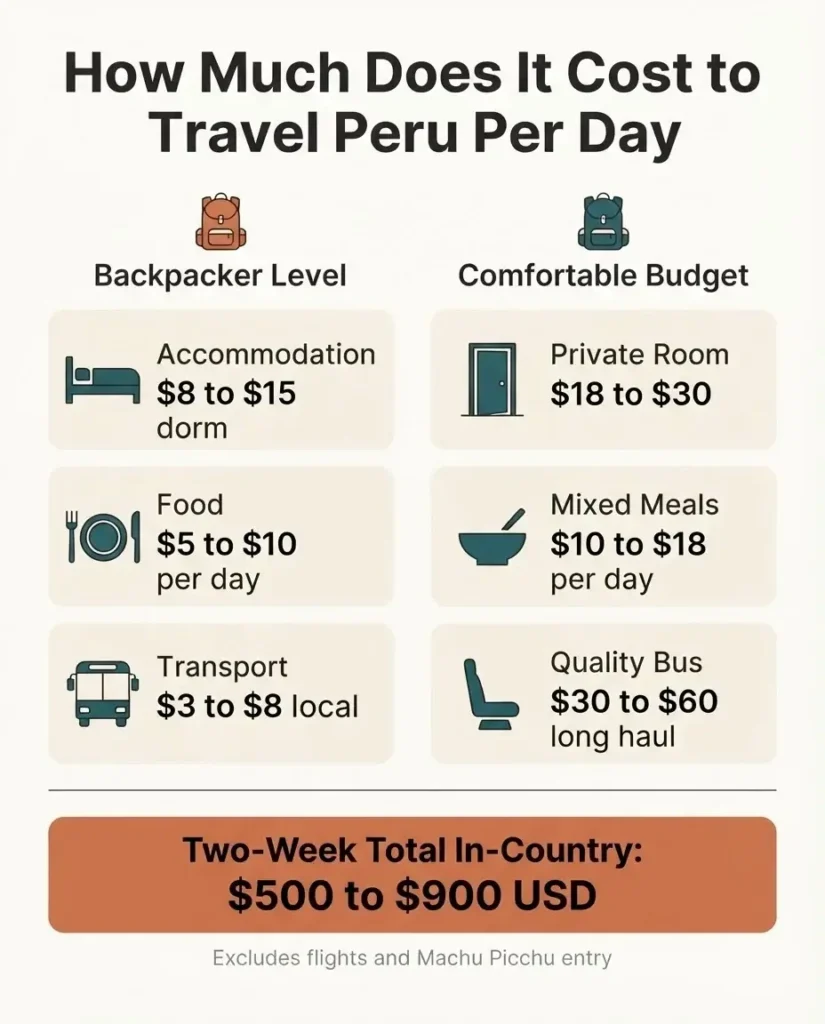
Peru is genuinely affordable by any global standard, but it’s not as cheap as Southeast Asia. If you’re coming off a Thailand budget mindset expecting $15-a-day all-in, recalibrate slightly. Here’s a realistic framework based on what travelers consistently report across forums, recent trip reports, and first-hand accounts:
Backpacker/shoestring level: $25 to $35 per day. This means dorm beds in hostels, eating almost every meal at local restaurants or markets, taking local buses within cities, and being selective with paid activities.
Comfortable budget traveler: $40 to $60 per day. Private budget rooms, eating a mix of local meals and the occasional sit-down restaurant, taking quality overnight buses instead of the cheapest option, and fitting in a few paid experiences.
For a two-week trip, you’re looking at roughly $500 to $900 in country, plus your flights and your big-ticket items like Machu Picchu (more on that shortly).
It’s entirely doable. Thousands of solo travelers do it every year on tight budgets and come back saying it was the best money they’ve ever spent.
Getting Around: The Lima-to-Cusco Dilemma
Most Peru itineraries flow through Lima, down to Cusco, out to Machu Picchu, and often to Arequipa or Lake Titicaca. The decision that will most affect your budget is how you get between Lima and Cusco.
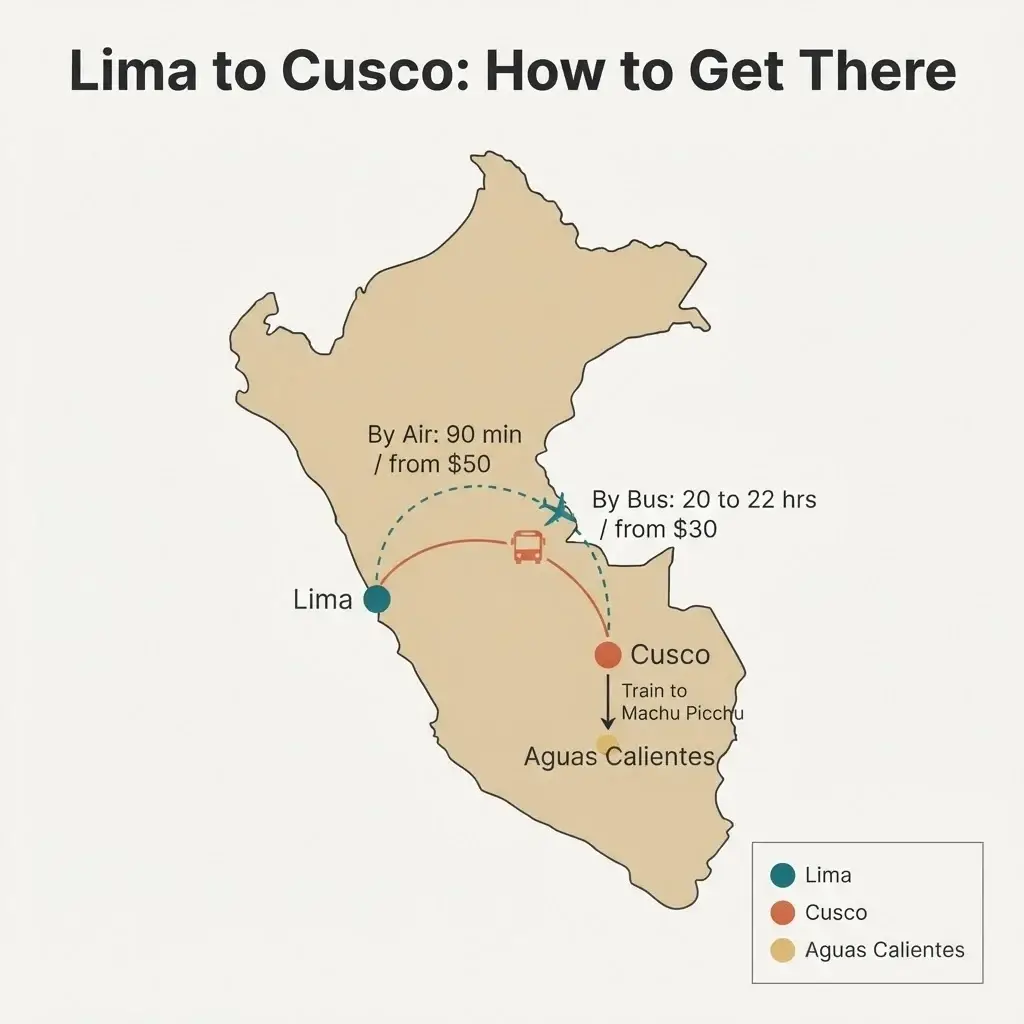
The bus takes around 20 to 22 hours and costs roughly $30 to $60 for a cama-class seat (a reclining or nearly flat seat, more like a plane seat than a regular coach). Companies like Cruz del Sur and Oltursa are the ones seasoned Peru travelers use for this route. The journey is long but surprisingly comfortable on a good cama bus, and doing it overnight means you’re not wasting a day sitting on a bus.
Flying takes about 90 minutes and budget carriers like Latam, Sky Airline, and JetSmart often have fares as low as $50 to $80 one way if you book ahead. If your time is limited, flying makes sense. If you have the flexibility, the bus saves money and is a perfectly comfortable experience.
Within cities, use local combis (small shared minibuses) and mototaxis for dirt-cheap rides. In Lima, grab-style ride apps work well and are far safer than unmarked street taxis.
The Menu del Dia: Your Single Best Budget Hack
If there is one thing that separates travelers who have a comfortable Peru budget from those who blow through it, it’s whether they discovered the menu del dia.
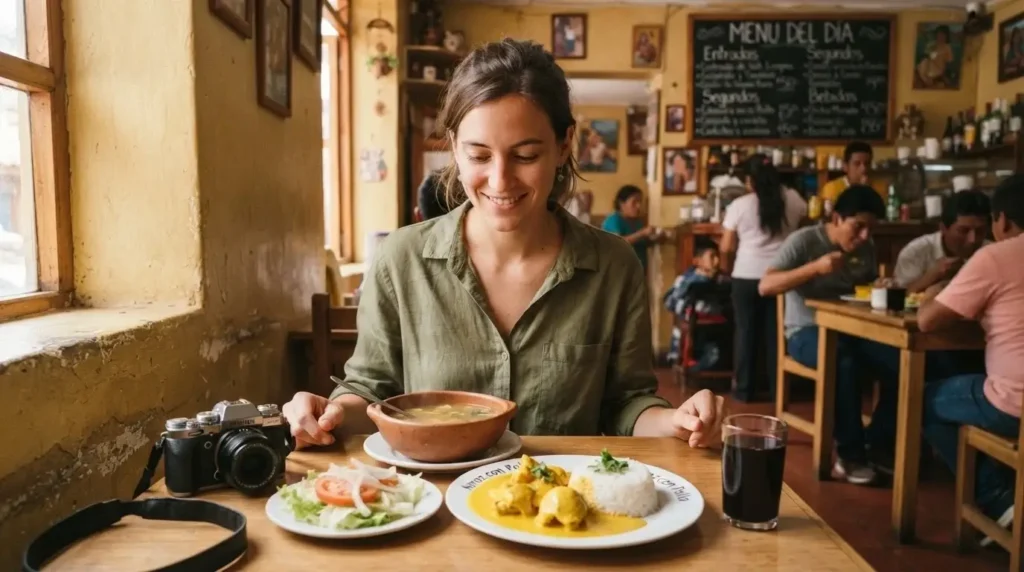
Every working-class neighborhood in every Peruvian city has small local restaurants that serve a set lunch, typically between noon and 3pm, for somewhere between 8 and 18 soles. That’s roughly $2 to $5 USD. For that, you get a soup course, a main plate of meat or fish with rice and sides, sometimes a small dessert, and a drink. It’s not a snack. It’s a real, filling meal.
These places are easy to find. Look for hand-written signs that say “Menu” or “Menu del Dia” in the window. Markets often have them. The further you get from the tourist center of a neighborhood, the cheaper and more authentic they get. In Cusco, you might pay 12 soles in a local restaurant two blocks off the main square for the exact same style of meal that costs 40 soles at a tourist-facing restaurant on the Plaza de Armas.
Peru has one of the most celebrated food cultures in South America. You should eat ceviche, lomo saltado (a stir-fry of beef, tomatoes, onions, and fries that reflects Peru’s Chinese immigrant influence, called chifa), aji de gallina, and anticuchos (grilled beef heart skewers from street stalls). None of these need to be expensive. The best ceviche I’ve read solo travelers rave about isn’t from fancy Lima tasting menus. It’s from cevicherias locals actually use.
Accommodation: Where to Stay and What to Expect
Peru has a solid hostel scene, especially in Lima (Miraflores and Barranco neighborhoods), Cusco (the historic center and San Blas), and Arequipa. Dorm beds run $8 to $15 per night in well-rated hostels. Private budget rooms in hostels typically run $18 to $30.
The official tourism promotion site peru.travel by PROMPERÚ, Peru’s national tourism board, is a good starting point for understanding regions and official information, though for actual hostel booking you’ll use the usual accommodation platforms. In Cusco specifically, hostels near the Plaza de Armas are convenient but priced slightly higher. Moving five minutes uphill into the San Blas neighborhood gives you more character and often lower prices.
A few things to know about hostels in Peru: altitude affects your sleep, especially your first couple of nights in Cusco. Bring earplugs regardless of where you stay. Check whether your hostel’s safe is actually bolted to the wall before storing anything valuable, and always get a receipt when you hand something over.
The Machu Picchu Ticket Situation (And Why You Need to Read This Carefully)
Here is where I see most budget travelers get blindsided, and it’s not because Machu Picchu is outrageously expensive. It’s because the ticketing system is confusing and time-sensitive.
Machu Picchu has a daily visitor limit, divided across specific time slots and entry circuits. Tickets sell out, sometimes weeks or months in advance during peak season (June through August). If you show up without a pre-booked ticket, you cannot get in. There is no on-site ticket window that will save you.
The only official government platform for buying tickets is tuboleto.cultura.pe, linked directly from the official Machu Picchu government website. Adult tickets cost around S/154, which is roughly US$40 to $45 depending on the circuit you choose. Children’s tickets (ages 3 to 17) are around S/70. You must book your specific date and time slot. Different circuits give you different areas of the site, and Circuit 2 is generally the most popular for first-timers as it covers the classic viewpoints.
Do not buy from third-party sellers claiming to have tickets.
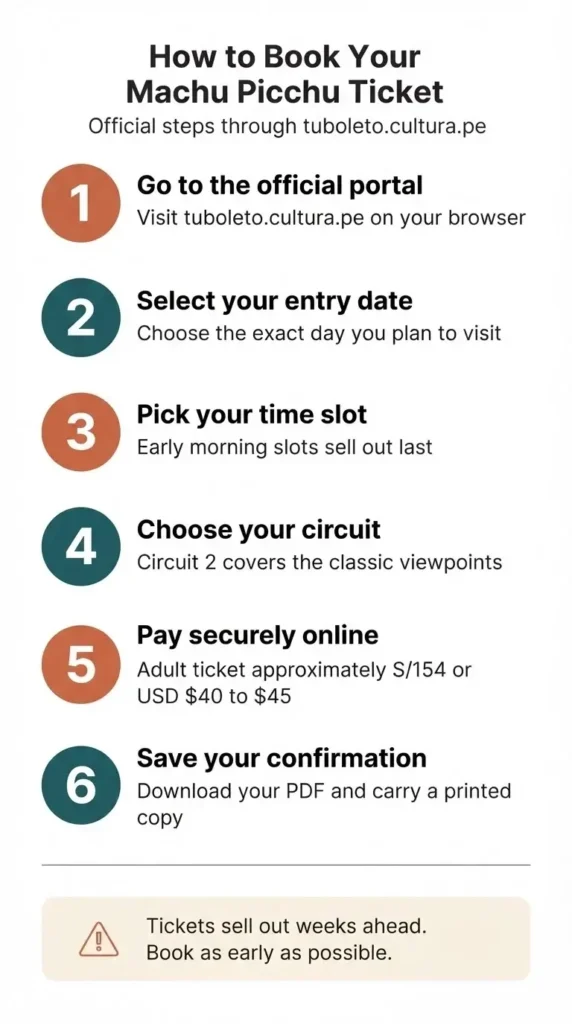
The official platform is it. If it shows sold out on your target date, try early morning slots which sell out last, or look at dates a few days earlier or later.
To reach Machu Picchu from Cusco, you go by train to Aguas Calientes (the nearest town, also called Machu Picchu Pueblo) and then a bus up the mountain. The train is a genuine cost; budget expect to pay $30 to $60 each way for economy options on Peru Rail or Inca Rail. This is one place where Peru doesn’t do “budget” the way Southeast Asia does. Factor it in. It’s still worth every cent.
The Inca Trail and Its Cheaper Alternatives
The Classic Inca Trail to Machu Picchu requires a permit (approximately S/292, around US$80-90) plus a licensed tour operator, making the full package typically $400 to $700 for the four-day trek. Permits sell out four to six months in advance, especially for the peak season months of May through September.
If the Classic Trail is outside your budget or already sold out, the Salkantay Trek is the most popular alternative. It’s longer (five days typically), arguably even more dramatic scenically, and considerably cheaper at roughly $150 to $300 for a guided group trip. It ends at Aguas Calientes where you take the bus up to Machu Picchu. Many solo travelers who planned to do the Inca Trail end up preferring Salkantay once they’ve done it.
Altitude Sickness Is a Budget Issue Too
This is something that almost no budget guide addresses honestly. Altitude sickness can affect anyone regardless of fitness level, and Cusco sits at 3,400 meters (about 11,155 feet) above sea level. Symptoms include headache, nausea, dizziness, and extreme fatigue. In most cases, they pass within a day or two if you rest, hydrate, and don’t push yourself.
But here’s the budget connection: if altitude sickness hits you hard, you will spend an extra day or two in bed, which costs you accommodation money, activity days, and potentially a rescheduled transport. The CDC Travelers’ Health page for Peru recommends speaking with your doctor before the trip about medications like acetazolamide (Diamox), which some travelers use prophylactically. The site also notes that Cusco and Machu Picchu are explicitly listed as high-altitude destinations requiring preparation.
Practical things that help: fly into Lima first and spend a day or two there before heading to Cusco. When you arrive in Cusco, spend your first day resting. Walk slowly. Drink water constantly. Avoid alcohol your first night. Local coca tea (mate de coca), freely available everywhere in Cusco, is widely used by residents and visitors alike and many travelers find it helpful for mild symptoms. Don’t skip the acclimatization period because you’re trying to save a day of accommodation cost. Getting sick costs you more in the end.
Free and Very Cheap Things to Do
Peru is full of meaningful, memorable experiences that cost nothing or nearly nothing. This is important to emphasize because many people assume the Inca Trail and Machu Picchu are the whole experience. They’re a part of it. But the broader cultural immersion is what happens everywhere else, and most of that is free.
In Cusco, the Free Walking Tours Peru organization runs pay-what-you-want walking tours of the historic center daily at 10am, 1pm, and 3:30pm. The tours are led by Indigenous local guides and cover the Plaza de Armas, San Pedro Market, colonial architecture layered over Inca stonework, and the extraordinary story of Cusco as the navel of the Inca world. The tour runs about 2.5 hours and the suggested tip is 30 to 50 soles (around US$10 to $15). For that price, you’ll come away understanding this city at a level that a rushed paid tour rarely achieves. Start your first full day in Cusco this way.
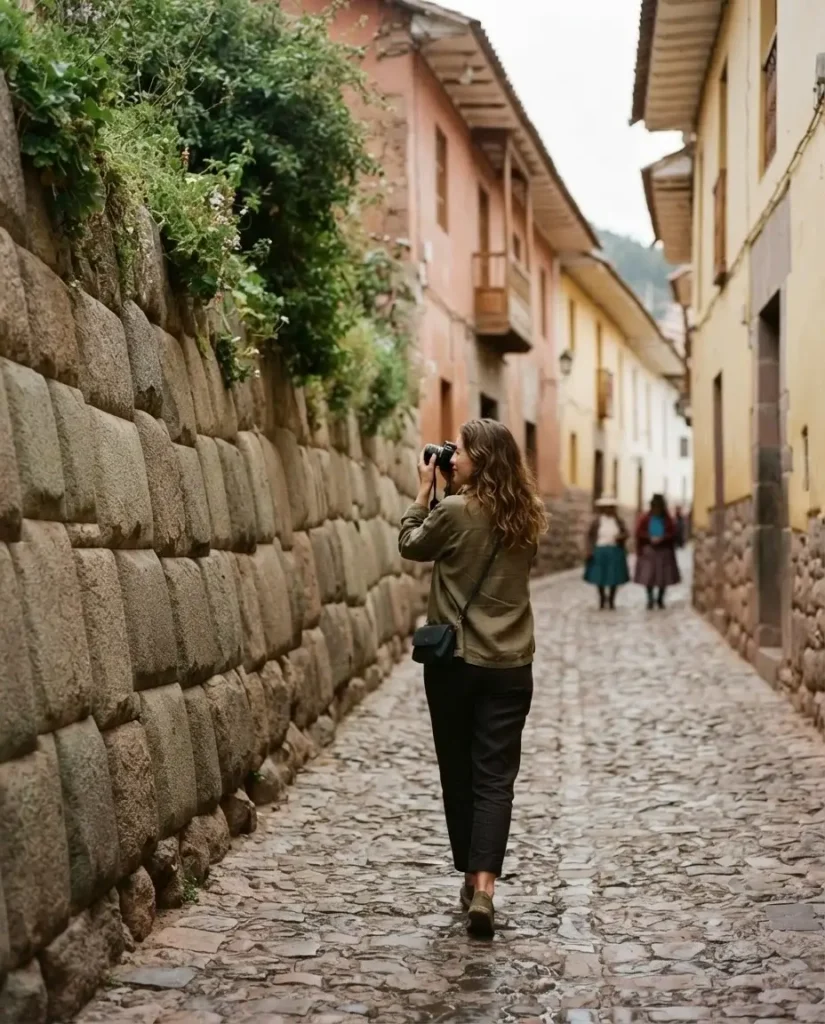
In Lima, walk the Miraflores cliffside path (the malecón) for free views over the Pacific that genuinely take your breath away. The Barranco neighborhood has street art, colorful colonial houses, and a bohemian atmosphere that costs nothing to soak up. The historic center’s Plaza Mayor and the surrounding colonial architecture are free to walk.
San Pedro Market in Cusco and Surquillo Market in Lima are both places where you can eat an extraordinary meal for a few soles while sitting among locals shopping for their week. That, to me, is what slow travel looks like in practice.
Money, Currency, and the Airport Exchange Trap
Peru’s currency is the Peruvian Sol (PEN). As of mid-2025, roughly 3.7 to 3.8 soles to the US dollar. Prices throughout the country are listed in soles.
The worst thing you can do is exchange money at the airport. The rates are often 10 to 15 percent lower than what you’ll get in the city. Bring some US dollars in cash if you can (small bills, clean and unripped, as torn or old bills are sometimes refused), and exchange at a reputable casa de cambio (exchange house) in Miraflores or Cusco’s city center. Compare rates at a few windows before exchanging, they vary.
ATMs work in Lima and Cusco, but fees add up fast. Withdraw larger amounts less frequently rather than small amounts repeatedly. Some ATMs charge a flat fee regardless of how much you take out, so optimizing your withdrawal size matters on a tight budget.
Avoid the airport, avoid hotel exchange desks, and avoid anyone who approaches you on the street offering to exchange money. The legitimate cambio offices are behind windows in fixed storefronts.
When to Go: Rainy Season as Your Budget Secret Weapon
Peak season in Peru runs from June through August, when skies are clear, trails are dry, and flights and accommodation are at their highest prices. If you want to visit at the most popular time, plan six months ahead, especially for Machu Picchu tickets and Inca Trail permits.
But here’s something that consistently surprises first-time visitors: the rainy season (roughly November through March) is not the monsoon nightmare people imagine. In most areas, rain falls in intense afternoon showers, and mornings are often clear and beautiful. Machu Picchu is frequently wreathed in mist during the rainy season, which many travelers find even more atmospheric than the clear-sky version. Flights and accommodation are noticeably cheaper. The ruins have far fewer people. And the Andes turn lush and green in a way that’s genuinely stunning.
If you have flexibility in your schedule, shoulder months like April to May and September to October offer a sweet spot: decent weather, lighter crowds, and better prices than peak season.
A Few Final Things Worth Knowing
Pack layers for everywhere. Even in Lima, the coastal climate can shift. Cusco is cold at night year-round, with mornings in particular requiring a proper jacket regardless of what season you visit. Arequipa and Puno can be extremely cold overnight if you’re heading toward Lake Titicaca. This isn’t just a comfort issue. Having proper layers means you’re not spending money on overpriced tourist-area gear shops when you arrive underprepared.
Get travel insurance. This is not negotiable on a budget trip because it’s what saves your entire financial plan if something goes wrong. A trip to an altitude-related medical consultation, a rescheduled flight, or a stolen phone can easily cost more than the insurance policy itself. I say this as someone who worked flexible jobs for years to fund travel and knows exactly what it feels like to be watching every dollar. Insurance is the one thing you don’t cut.
Learn a few basic Spanish phrases. Peru is far less English-friendly outside of tourist centers than, say, much of Europe or Thailand. “Cuanto cuesta?” (how much does it cost), “Donde esta…?” (where is…?), “Un menu por favor” (one set menu please) will take you further than you’d expect, and locals respond warmly to any genuine effort to speak Quechua or Spanish. When I taught English in Thailand, I watched how much goodwill came from my stumbling attempts at Thai. The same dynamic applies everywhere. People notice effort.
Peru is the kind of place that stays with you. The history layered under every city block, the food that somehow keeps surprising you, the way the Andes feel both ancient and immediately present. You don’t need a luxury budget to experience any of it. You need a plan, a realistic expectation of costs, and the willingness to step into a place on its own terms rather than the curated tourist version.
That’s what slow, curious, budget-conscious travel actually looks like. And Peru is one of the most rewarding places on earth to practice it.