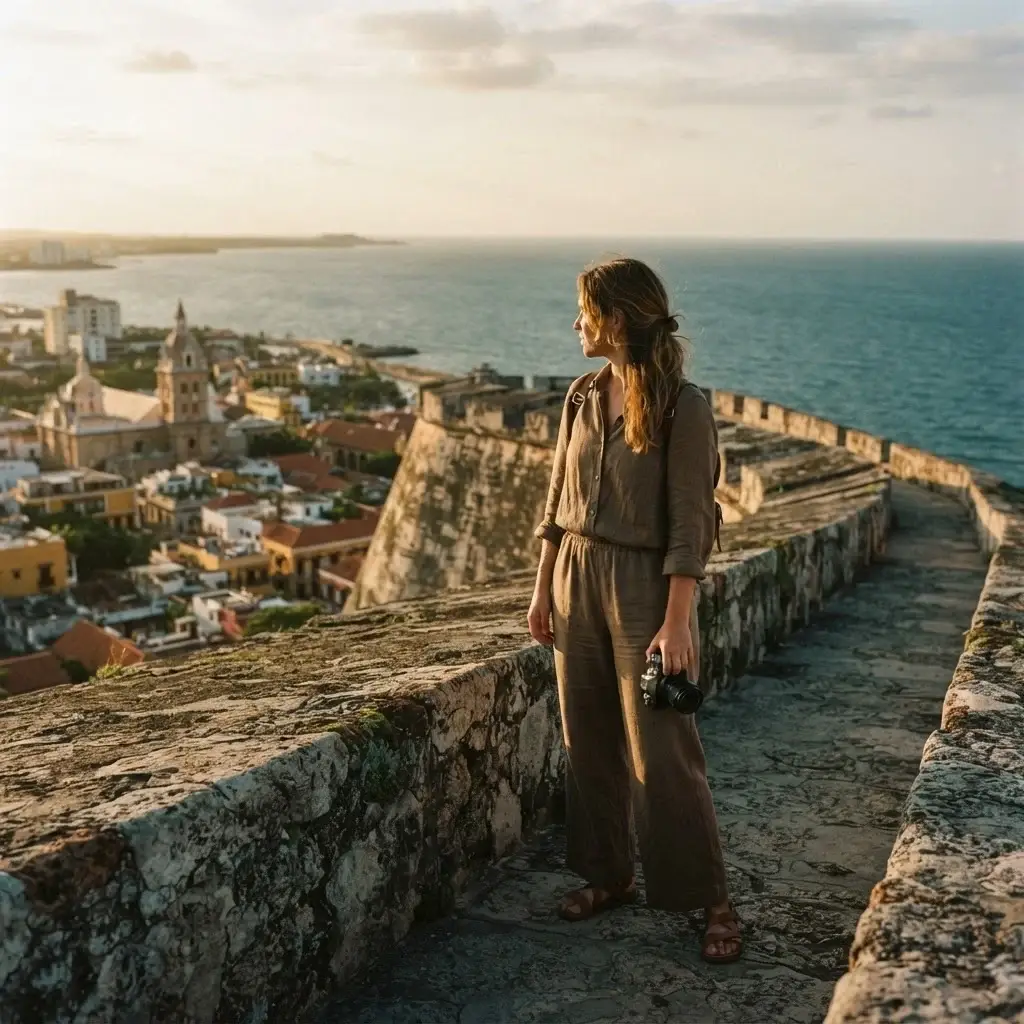
Colombia was not on my radar for a long time. I think, like a lot of people, I carried an outdated mental image of it shaped by news headlines rather than reality. It took friends coming back from Medellin and Cartagena practically glowing, talking about the food and the music and how warm and alive everything felt, to shake that image loose.
What solo travelers consistently report about Colombia is that it surprises them. Not because it is perfect or without challenges, but because it is vivid. It is a country where the culture is genuinely on the surface, in the streets, in what people eat, how they greet strangers, how they dance, and what they are proud of. You do not havlight turn everything gold, is one of those completely free experiences that no tour can replicatee to hunt for it.
This guide is for travelers who want to feel Colombia, not just photograph it. It is organized around the experiences that offer the richest cultural return on your time and energy, whether you have ten days or three weeks.
Before You Go: The One Practical Thing Worth Knowing First
If you are a U.S. citizen, you do not need a visa to visit Colombia for tourism stays of up to 90 days. The U.S. State Department’s Colombia travel page has the current entry requirements and advisories worth reading before you book. Colombia has a Level 2 (“Exercise Increased Caution”) advisory, which covers most of Latin America. It is not a reason to skip the trip. It is a reason to travel with the same common sense you would use anywhere unfamiliar.
The Colombian peso is the local currency. At the time of writing, you get a lot of purchasing power as a foreign traveler, which means Colombia is genuinely affordable for the depth of experience it offers. That matters when you are trying to go deep, not just wide.
Colombia Is Not One Culture. It Is Several.
This is the thing most travel content gets wrong about Colombia, and it is worth understanding before you arrive.
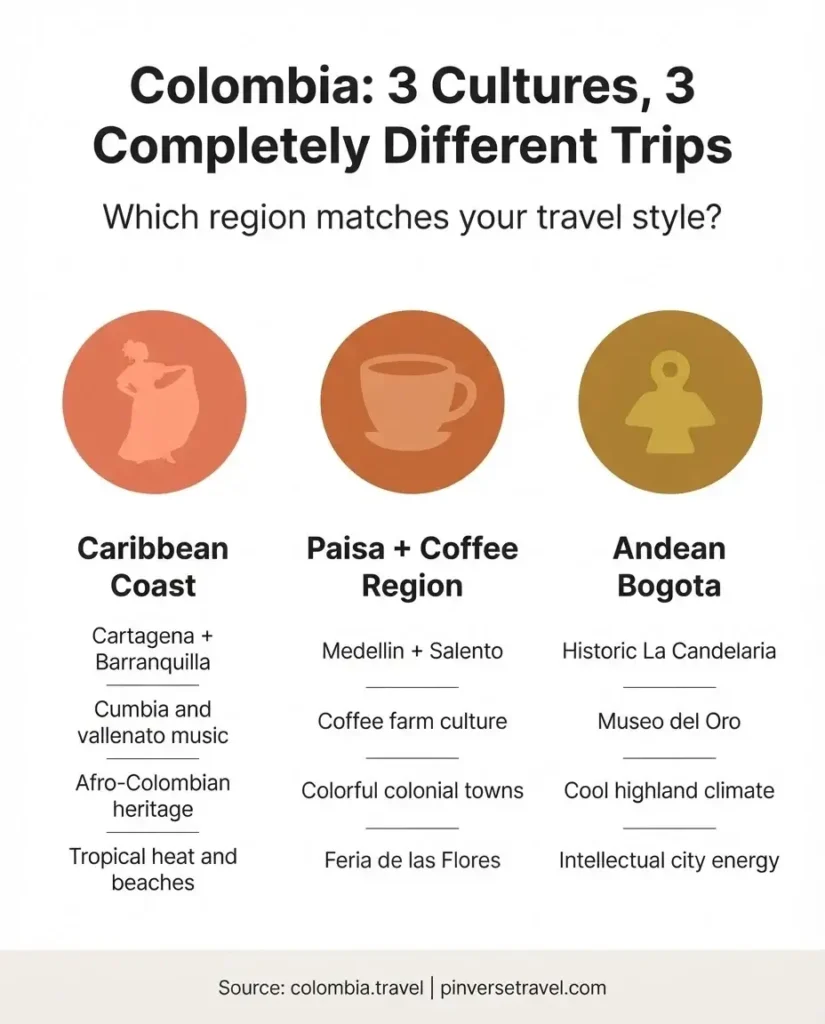
Colombia’s Caribbean coast, its Andean highlands, and the coffee-growing Paisa region (centered around Medellin and the Eje Cafetero) each have distinct personalities, accents, food, music, and social rhythms. Costeños (coastal people) are famously warm and expressive, the birthplace of cumbia and vallenato. The Paisa culture of Antioquia is known for its hard-working, entrepreneurial spirit. Bogota, sitting high in the Andes at 2,600 meters above sea level, has an intellectually intense, cosmopolitan energy that surprises many visitors.
This is not a country you understand in a single city. Every region will teach you something different.
Cartagena: Where History Lives in the Walls
Cartagena de Indias is one of those cities that makes you feel the weight of history in a physical way. The walled Old Town, a UNESCO World Heritage Site since 1984, is among the most complete systems of military fortifications in the Americas. Walking along the city walls at sunset, watching the Caribbean light turn everything gold, is one of those completely free experiences that no tour can replicate.
The Old Town’s three neighborhoods each have a different character. El Centro holds the cathedral, the Palace of the Inquisition, and the grand colonial palaces turned into hotels and restaurants. San Diego, to the north, is quieter, lined with boutiques and small cafes. Then there is Getsemani, which is where many solo travelers end up spending most of their time.
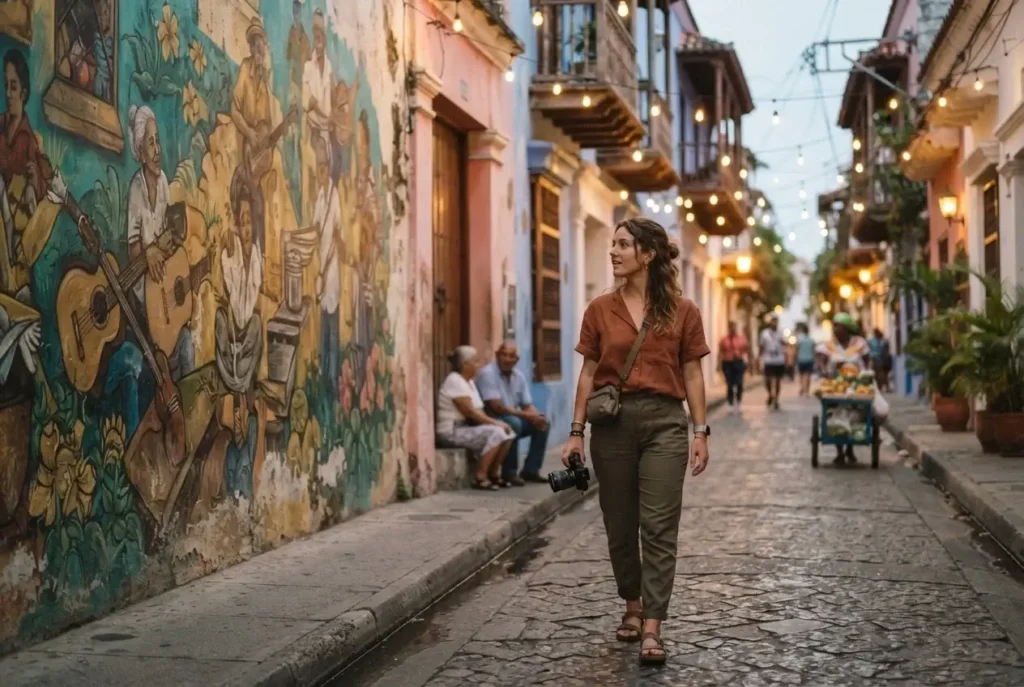
Getsemani was once dismissed as a rough neighborhood. Today it is one of the most creatively alive places in the city, full of street murals, corner tiendas, and open-air communal life. Come here in the evening when the plaza fills up with people dancing, kids playing, and vendors selling coconut milk and patacones. It costs nothing and teaches you more about Colombian daily life than any paid experience can.
A short walk (or inexpensive taxi ride) from the Old Town is the Castillo San Felipe de Barajas, an enormous 17th-century fortress built into a rocky hillside. It is visually dramatic and historically fascinating. Budget around two hours for it, and go in the morning before the heat peaks.
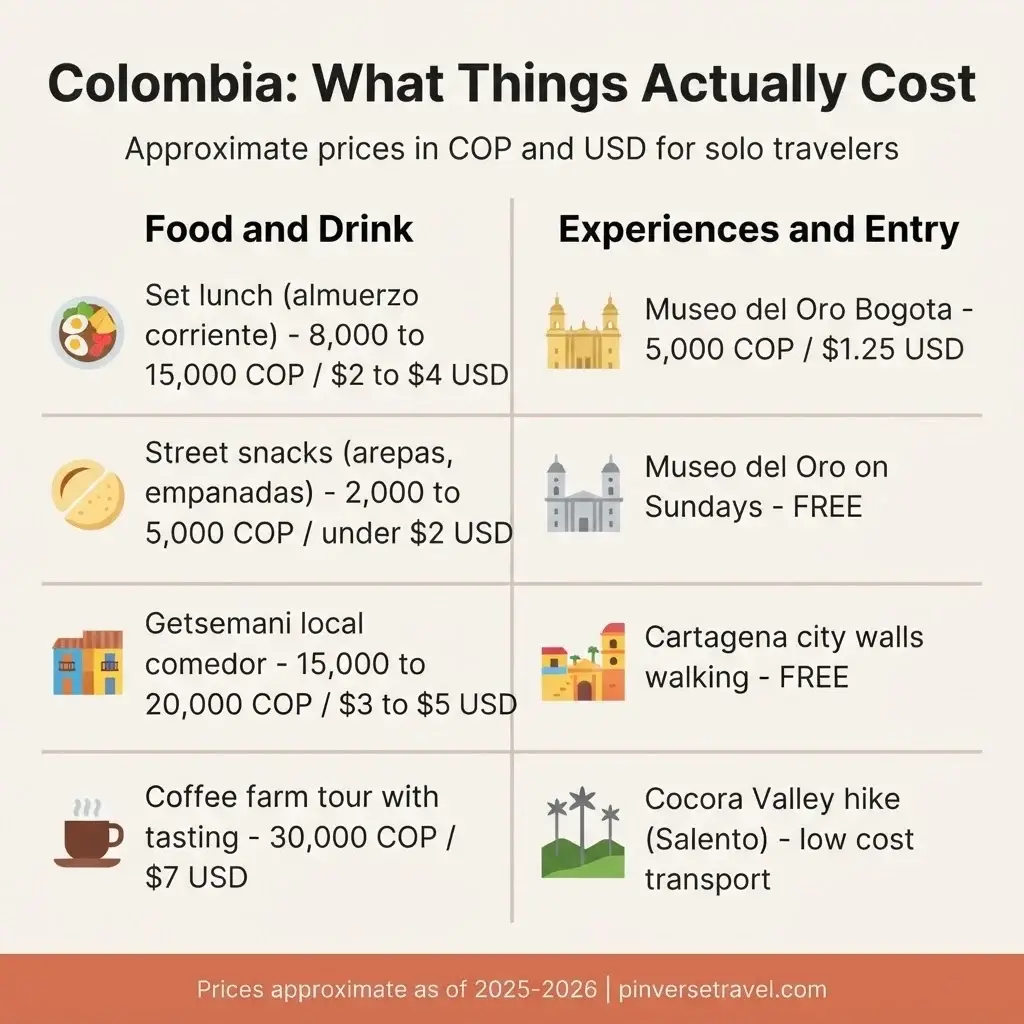
For food in Cartagena, do not skip the street snacks. Look for buñuelos (cheesy fried dough balls), arepas de huevo (corn cakes stuffed with egg), and the fresh fruit with lime and salt that vendors carry in baskets through the streets. A full lunch at a local comedor (neighborhood kitchen) in Getsemani runs about 15,000 to 20,000 COP, roughly $3 to $5 USD. That is not a typo.
San Basilio de Palenque: The Most Important Village You Probably Have Not Heard Of
About 50 kilometers south of Cartagena sits one of the most historically significant communities in the Americas, and it is almost entirely absent from mainstream travel content.
San Basilio de Palenque was founded in the early 1600s by enslaved Africans who escaped Spanish captivity and established their own free settlement, making it the first free African town in the Americas. UNESCO recognized its Cultural Space of Palenque de San Basilio as a Masterpiece of the Oral and Intangible Heritage of Humanity. The community still speaks Palenquero, a Creole language that blends Spanish with Bantu African languages, and has kept alive medical practices, musical traditions, and social rituals that trace back centuries.
Visiting requires some logistics, typically a shared minibus from Cartagena’s Mercado de Bazurto, and the journey itself is part of the experience. The village is small. There are local guides who can take you through the community, explain its history, and introduce you to the music and food. Palenqueras, the women you may recognize from photos in their colorful dresses selling fruit in Cartagena, come from this community.
This is not a tourist attraction. It is a living, breathing cultural community that has maintained its identity against centuries of pressure. Approach it with genuine curiosity and respect, take a guide, and spend more time listening than photographing.
Medellin: The Transformation Story (and the Honest Version of It)
Medellin is one of the great urban comeback stories of the 21st century. In the late 1980s and early 1990s, it was one of the most dangerous cities on earth. Today it is a thriving, design-forward city with excellent infrastructure, a dynamic arts scene, and a Metro system that locals treat with a pride that is almost touching.
Understanding Medellin requires sitting with that contradiction honestly. Many visitors come looking for Pablo Escobar sites, and the city’s relationship with that tourism is complicated. Plenty of Medellin residents lost family members during that period and find the glorification deeply painful. The more thoughtful approach, which the city’s own tourism boards have started promoting, is to see Medellin’s transformation as the cultural story, not Escobar himself.
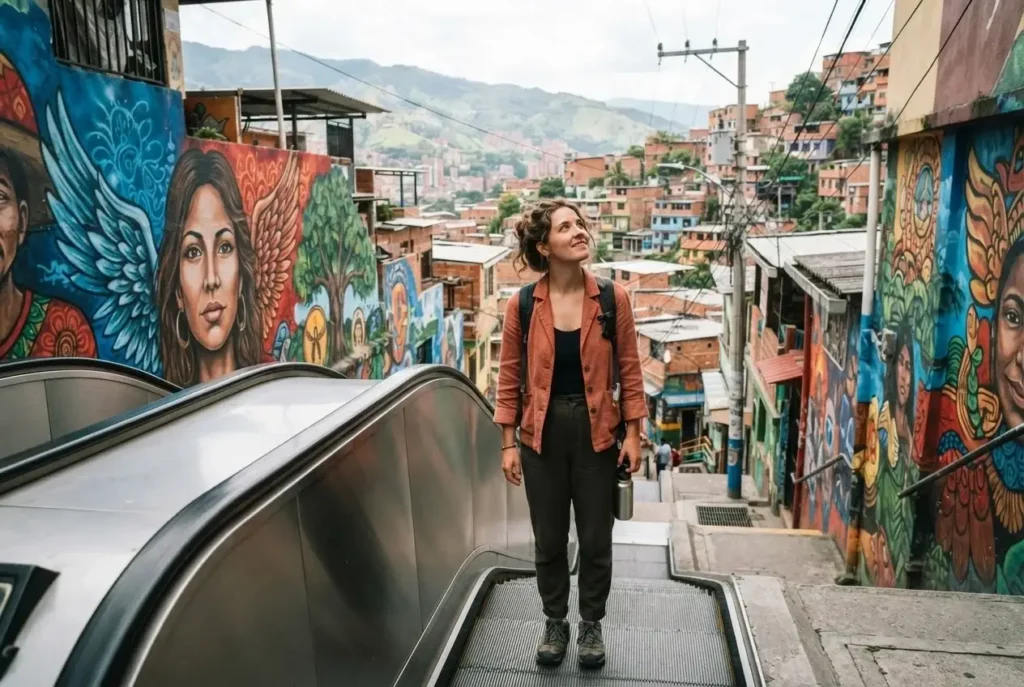
The best version of that story plays out in Comuna 13. This hillside neighborhood was once one of the city’s most violent, controlled by armed groups and essentially cut off from the rest of the city. In 2011, the city installed a series of outdoor escalators connecting the steep slopes to the Metro network below. The neighborhood responded with art. Today, every surface in Comuna 13 is covered in murals, hip-hop culture is everywhere, and local guides who grew up there take visitors through the alleys explaining both the difficult history and the community’s own process of rebuilding. Colombia’s official tourism board describes the Graffiti Tour of Comuna 13 as one of Medellin’s defining cultural experiences, and it genuinely earns that description.
Get there via the Metro (one of the only metro systems in Colombia) to the San Javier station, then connect via the escalators. Go with a local guide rather than alone. The combination of context, street art, and live music performances you’ll encounter there is unlike anything I can think of in South America.
Medellin also has world-class museums. The Museo de Antioquia on Plaza Botero houses the largest collection of Fernando Botero’s work (he donated it himself) and sits beside an open plaza filled with his iconic rotund bronze sculptures. Entry is affordable, and the plaza itself is free.
Bogota: The Capital That Earns Its Reputation
Bogota tends to divide travelers. It is cold (sitting at 2,600 meters above sea level), sprawling, and chaotic in parts. But if you give it two or three days instead of the one-night stopover most people give it, it repays you enormously.
The single most important cultural stop in the country may be the Museo del Oro, the Gold Museum in the La Candelaria district. It houses the largest collection of pre-Hispanic gold artifacts in the world, more than 34,000 gold pieces, and was recognized by National Geographic in 2018 as one of the best history museums globally, alongside the Louvre and the Auschwitz Museum. Admission is just COP 5,000 (roughly $1.25 USD) Tuesday through Saturday, and completely free on Sundays. Hours are Tuesday to Saturday 9 AM to 7 PM, and Sunday 10 AM to 5 PM. Go on a Sunday if you can plan it.
Walk from the Gold Museum into La Candelaria, Bogota’s historic colonial center. The streets here are narrow and lined with old churches, colorful facades, and universities. It is also the best area in the city for street food: empanadas, ajiaco (a hearty Bogota potato and chicken soup), and hot chocolate with cheese (yes, cheese in the hot chocolate, and yes, it works). Street food here runs about 2,000 to 5,000 COP per item, which is less than $2 USD.
Take the cable car up Monserrate Hill on the city’s eastern edge. The view across Bogota’s endless expanse is genuinely humbling, and the sanctuary at the top gives you a sense of how deeply Catholic identity is woven through Colombian culture.
The Coffee Cultural Landscape: Salento and the Eje Cafetero
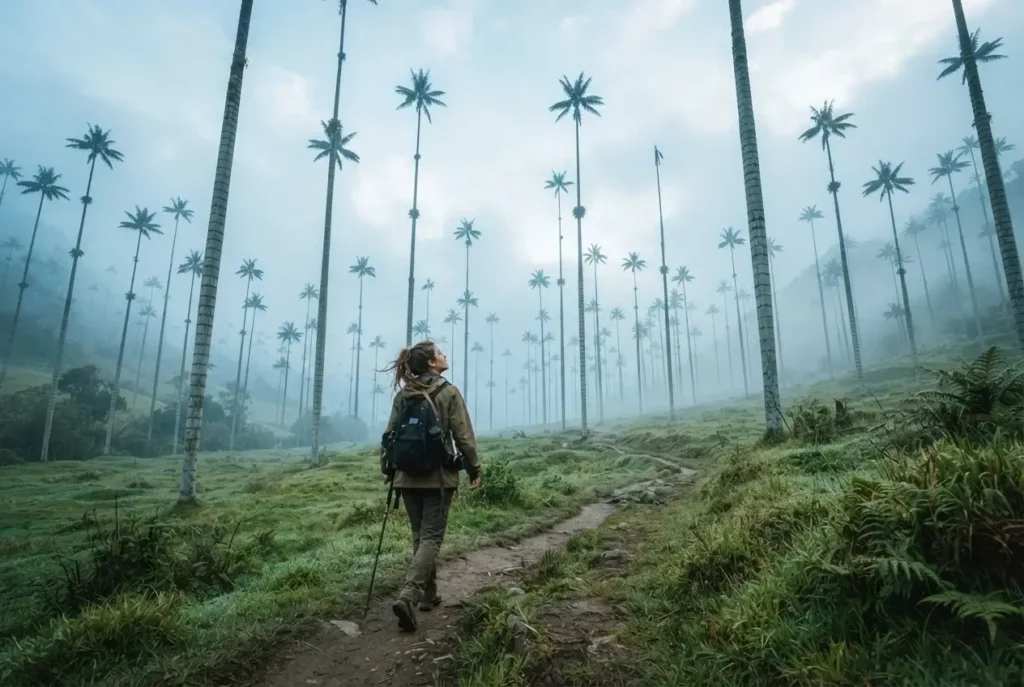
Colombia produces some of the world’s finest coffee, and the region that grows most of it, the Eje Cafetero or Coffee Axis, is also one of the most beautiful landscapes in South America. Rolling green hills, bamboo groves, colorful colonial towns, and the impossibly tall wax palms (Colombia’s national tree) in the Cocora Valley all make this region feel like a storybook illustration of what a coffee-growing country should look like.
Salento is the most accessible entry point. It is a small colonial town with brightly painted buildings and a street market that sells everything from local leather goods to fresh fruit. From Salento, you can hike into the Cocora Valley and walk among the wax palms, many of them 50 to 60 meters tall.
The coffee farm tours in and around Salento are a genuine highlight. A visit to a working finca (farm) takes you through the full process: planting, picking, pulping, fermenting, drying, and roasting. You learn quickly that the coffee Colombia exports is largely its good stuff, and that the local preference for tinto (a thin, sweetened black coffee) is a separate tradition entirely. Farm tour prices are typically around 30,000 COP per person (roughly $7 USD) and often include tastings.
What solo travelers consistently report is that these tours feel personal and unhurried in a way that larger-scale coffee experiences elsewhere do not.
To reach Salento from Medellin, there are direct buses that take roughly four hours. From Bogota it is about six to seven hours by bus through some spectacular mountain scenery.
The Festivals: Two UNESCO-Recognized Celebrations Worth Planning Your Trip Around
If your travel dates are flexible, Colombia’s festival calendar is one of the best reasons to choose one month over another.
Carnaval de Barranquilla takes place in the four days before Lent each February. The UNESCO Intangible Cultural Heritage listing describes it as one of the richest and most complex carnival traditions in the Americas, blending European, African, and Indigenous Colombian musical and dance traditions. Cumbia, congo, puya, and mapalé all appear on the streets alongside elaborate costumes, floats, and percussion ensembles. It is larger and more locally rooted than many tourists expect, and considerably less international than Rio’s carnival, which means you are more likely to be the only foreigner in a given block party than surrounded by tour groups. Pre-carnival events begin in January.
Feria de las Flores in Medellin runs from August 1 to 10, 2026. This is Medellin’s most iconic celebration, built around the Silleteros Parade on August 10, in which flower farmers from the surrounding mountains carry enormous flower arrangements on their backs through the city streets. The arrangements, called silletas, take months to build and can weigh up to 80 kilograms. The official Colombia Travel Flower Festival page has the full event schedule. The city transforms during these ten days: concerts, horse parades, and classic car shows fill the streets, and Medellin locals treat it with the energy of a major national holiday.
Both festivals require booking accommodation far in advance. Prices increase significantly during festival weeks.
Food as Cultural Experience: What to Eat and Why It Matters
Colombian food culture is regional, generous, and deeply tied to identity. Rushing through it would be a mistake.
In Medellin and the Paisa region, order a bandeja paisa at least once. It is a monumental platter of red beans, white rice, minced beef, chicharron (crispy pork belly), a fried egg, chorizo, blood sausage, an arepa, plantain, and avocado. It is not a light meal. It is the Paisa identity on a plate, and the pride with which it is served tells you everything about how this region sees itself.
In Bogota, try ajiaco, the city’s beloved chicken and potato soup made with three different types of potato, corn, and guasca (a local herb). It is warming and earthy and exactly right for a cold capital city afternoon.
On the coast, look for seafood everywhere. Whole fried fish with coconut rice and patacones (twice-fried plantain) is the coastal staple, and it is extraordinary. In Cartagena’s Getsemani neighborhood, the simplest restaurants serve the best versions.
Across the whole country, the arepa is the constant. Every region makes them differently: thicker or thinner, plain or stuffed, grilled or boiled. Learning to order them and knowing which regional version you prefer is one of those quietly satisfying cultural micro-skills that accumulates over a trip.
For budget travelers, the almuerzo corriente (set lunch) is how Colombians eat on weekdays: a soup, a main plate, a drink, and sometimes dessert, usually between 8,000 and 15,000 COP (roughly $2 to $4 USD). Eating lunch the way locals do is both the cheapest and most authentic food experience you can have.
Practical Advice for Solo Travelers
Colombia rewards careful, aware travel. Here is what solo travelers consistently find useful.
Use Uber or InDrive for transport in cities. In Cartagena, registered taxis (negotiate the price before getting in) are fine for short distances. Avoid hailing unmarked cars.
Spanish is the key that unlocks everything. You do not need fluency. Even basic phrases like “me puede recomendar?” (can you recommend something?) or “que rico” (how delicious) will shift interactions meaningfully. Colombians are genuinely warm toward travelers who try.
Keep your phone in your pocket in busy tourist areas, particularly in La Candelaria in Bogota and around the Cartagena walls at night. These precautions are the same ones I applied when backpacking solo across Europe, and they are just common sense rather than fear.
Plan your mornings. The heat in coastal cities like Cartagena is serious by midday, and most cultural sites are far more enjoyable in the cooler hours before noon.
Where to Start If You Have Limited Time
If you have ten days, the core triangle of Bogota, Medellin, and Cartagena covers three deeply different Colombian worlds. Spend three days in each and use the remaining day for a day trip: Salento from Medellin, or San Basilio de Palenque from Cartagena.
If you have more time, push south to Armenia and deeper into the coffee region. Or spend a week only in Medellin, using it as a base to explore Guatape (the lake and rock formations an hour outside the city) and the surrounding Antioquia countryside. Slow travel in Colombia works brilliantly.
The Real Takeaway
Every big solo trip I have taken has taught me that the country I thought I was going to is rarely the country I find. Colombia, from everything solo travelers and culturally curious visitors consistently describe, is a place that dismantles assumptions. The culture is layered, complex, and alive in the streets. The people are genuinely hospitable, not in the performed-for-tourists way, but in the way of a place that has historically valued human connection.
The best cultural experiences in Colombia are not behind velvet ropes. They are in the plazas at dusk, in the festival floats, in a coffee farmer explaining fermentation time with real pride, in a muralist in Comuna 13 pointing to a painted wall and saying this is how we fought back.
You do not need a perfect plan. You need a flexible one and the willingness to slow down long enough to actually receive what Colombia is offering.