How to Plan a Slow Travel Experience in Europe (Beginner Guide)

The first time I traveled through Europe, I did it all wrong, and I mean that in the best possible way. I was young, broke, and backpacking solo with a route that changed every three days. I saw a lot of train stations and not a lot of anything else. It took me years, a boring office job I eventually walked away from, and a stretch of teaching English in Thailand to understand what I actually wanted from travel. It wasn’t more countries. It was more depth.
That’s what slow travel gives you. Instead of racing through ten cities in two weeks, you settle into a place long enough to learn the walk to your favorite bakery, recognize the person at the market, and feel the rhythm of a neighborhood instead of just photographing it. If you’ve been quietly dreaming about doing this in Europe but the planning feels like a wall, this guide is for you. I’m going to walk you through it the way I wish someone had walked me through it, one calm step at a time.
What Slow Travel Actually Means (and Why Europe Is Perfect for It)
Slow travel is less about speed and more about attention. You stay in fewer places for longer. You cook a few meals instead of eating out constantly. You take the local bus even when it takes an hour, because that hour teaches you something. The goal isn’t to see everything. It’s to actually experience the few things you do see.
Europe is almost custom-built for this. The countries are small and close together, the train network is dense and reliable, and the cultures shift dramatically over short distances. You can spend a month in one region and never run out of day trips. You also get the quiet luxury of returning to the same coffee shop enough times that they stop handing you a menu.
Here’s the mindset shift I want you to make before anything else: you are not on vacation, you are temporarily living somewhere. That single reframe changes every decision you make from here on out, from where you stay to what you pack to how you spend a Tuesday.
How Long to Stay in One Place
This is the question I get most, and the honest answer is that it depends on your temperament. From what slow travelers consistently report, and from my own experience, one week is the bare minimum to feel a place at all, two weeks is where the magic starts, and a month is where a city genuinely begins to feel like home.
If you’re new to this, I’d suggest picking two or three bases for a longer trip rather than trying to be everywhere. A common and very livable shape is a month in one city, then two to three weeks in the next, then a final stretch somewhere slower to rest. Resist the urge to over-plan the in-between. Some of my favorite days were the ones with nothing scheduled.
One thing nobody tells you: around day four or five in a new place, you may feel a strange flatness, like the excitement wore off and nothing has replaced it yet. That’s normal. Push through it. Day seven onward is usually when a place starts giving back.
The Rule That Shapes Everything: Schengen 90/180
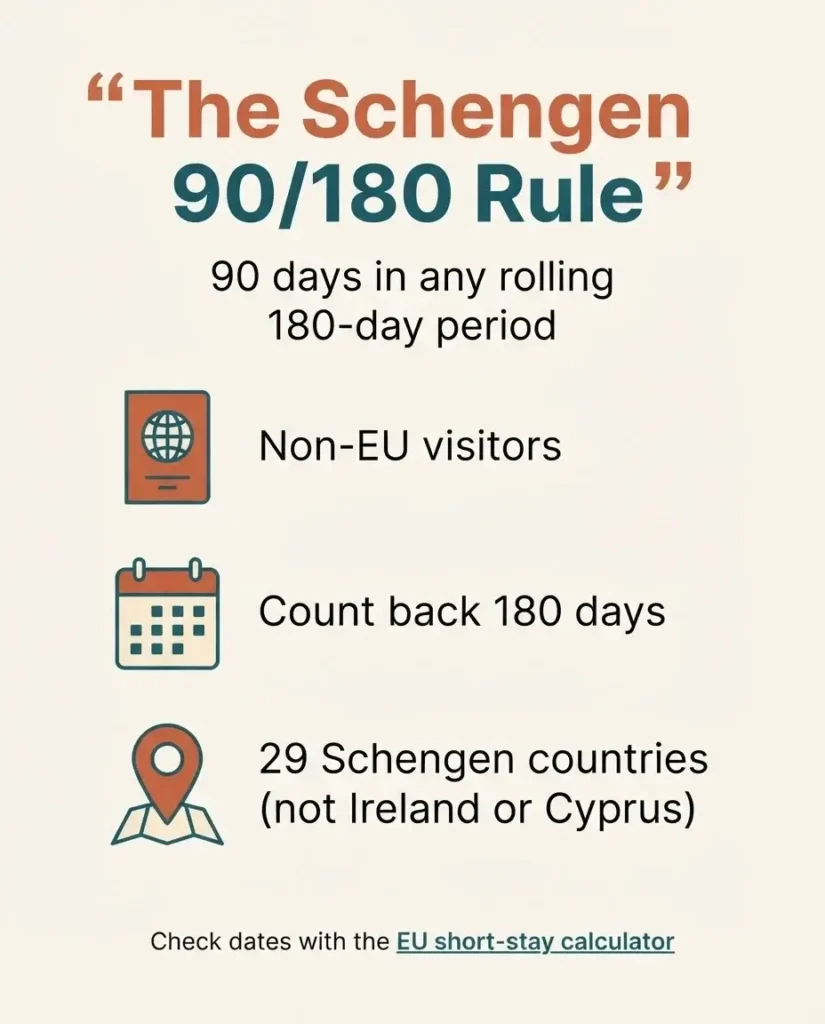
Before you fall in love with a three-month itinerary, you need to understand the one rule that quietly governs every long European trip for non-EU travelers. If you hold a US, UK, Canadian, Australian, or similar passport, you can stay in the Schengen Area for a maximum of 90 days within any rolling 180-day period. The Schengen Area covers 29 countries, and importantly, Ireland and Cyprus are not part of it, which becomes a useful loophole later.
The word “rolling” trips people up. It isn’t a clean calendar reset. Every single day, you count back 180 days and make sure your total time inside doesn’t exceed 90. It sounds fiddly, but you don’t have to do the math in your head. When I’m mapping out a longer trip, I run my exact dates through the EU’s own official Schengen short-stay calculator, which tells you instantly whether your plan is legal and how many days you have left. Do this before you book anything.
There’s also a newer wrinkle worth knowing. As of October 2025, Schengen countries began using a biometric Entry/Exit System that scans your fingerprints and takes a facial image at the border, replacing the old passport stamp. It’s free and requires no advance action, but it does mean your entries and exits are now tracked digitally, so overstaying is much easier to catch. The US State Department keeps a clear, current rundown of these entry requirements on its Europe travel guidance page, including the rule that your passport must stay valid for at least three months beyond your departure date. And if the UK is on your list, note that Americans and many other visitors now need a UK Electronic Travel Authorisation, which you apply for through the official UK government ETA service.
Looking ahead, the EU is also rolling out a pre-travel authorization called ETIAS, expected in the last quarter of 2026, which will require a quick online application and a small fee before you travel. It isn’t active yet, but you can track the timeline on the EU’s official ETIAS site so you’re not caught off guard.
How to Legally Slow Travel Longer Than 90 Days
If three months isn’t enough, you have real options. You can spend part of your trip in non-Schengen countries, which don’t count against your 90 days. Ireland, the UK, Croatia’s neighbors in the Balkans, and several others give you room to breathe. Alternatively, some countries offer long-stay national visas or digital nomad visas that let you settle in one place for months, which is a beautiful fit for slow travel if you can qualify.
Choosing Where to Go: Base Towns Over Bucket Lists
Instead of chasing famous cities, I want you to choose a base. A good slow-travel base has three things: it’s affordable enough to stay a while, it has everyday life happening around you, and it has good transport links for day trips.
Some of the bases full-time travelers rave about include Seville and Granada in Spain, Split in Croatia, Bologna in Italy, Porto in Portugal, and Ljubljana in Slovenia. What they share is walkability, real neighborhoods, and a lower price tag than the marquee capitals. You get more life for your money and fewer crowds pressing in on you.
When you’re deciding, I find it helps to anchor your choice around what you actually love. If it’s history and architecture, browse the UNESCO World Heritage List and notice which regions are dense with sites you’d want to keep returning to, then base yourself nearby rather than trying to tick them off in a day. A base an hour from three heritage towns beats a hotel inside the most crowded one.
Getting Around: Is a Rail Pass Actually Worth It?
Trains are the soul of European travel, and they’re genuinely one of the joys of slow travel. But here’s where I’ll gently push back on a lot of advice online: for true slow travel, a rail pass is often not the money-saver people assume.
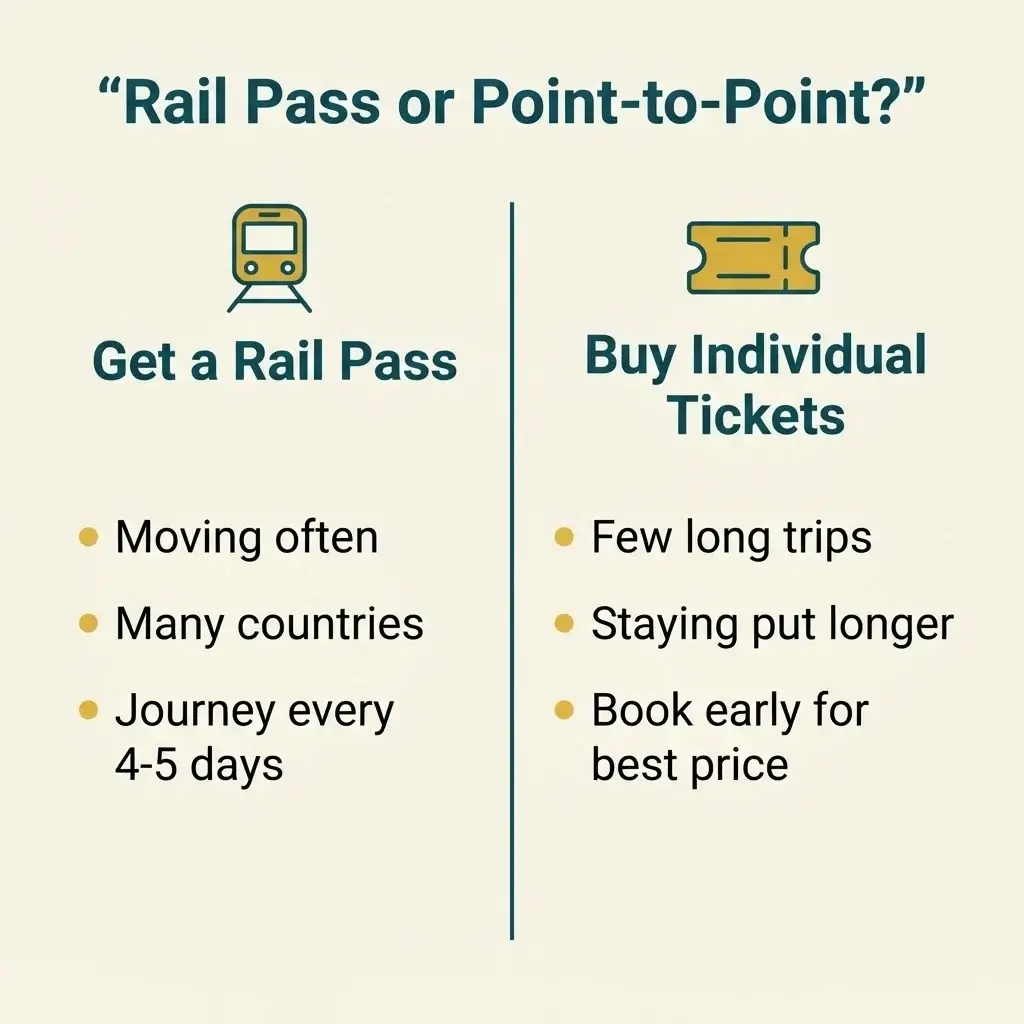
A rail pass earns its keep when you’re moving frequently across many countries. The Interrail and Eurail Global Pass works on travel days, so a 7-travel-day flexi pass costs around 286 euros and a 10-day pass around 335 euros, with high-speed and night trains needing a paid seat reservation on top. That’s fantastic value if you’re hopping constantly. But if your whole plan is a month here and three weeks there, you might take only four or five long trains the entire trip. In that case, booking individual advance tickets directly with the national rail companies is usually cheaper. Remember: Interrail is for European residents and Eurail is the equivalent for everyone else.
My rule of thumb is simple. Count your genuine long-distance journeys. If it’s more than roughly one every four or five days, price out a pass. If it’s less, buy point-to-point tickets early, when prices are lowest.
There’s also a reason beyond money to favor the train. Traveling by rail instead of flying on European routes cuts your carbon emissions dramatically, by around 85 percent according to the data compiled by Our World in Data. Slow travel and low-impact travel tend to walk hand in hand, and I’ve come to love that the calmer choice is usually the kinder one too.
Budgeting a Slow Trip (This Is Where Slow Wins Big)
Here’s a truth that surprises people: slow travel is often cheaper per day than a fast trip. When you stay put, you unlock monthly apartment rates that are far lower than nightly hotel prices, you cook instead of eating every meal out, and you stop spending on constant transport between cities.
For accommodation, look at monthly rentals rather than hotels. Furnished apartments booked for a month at a time frequently come with steep discounts, and you get a kitchen, which quietly saves a fortune. In mid-range European cities outside the priciest capitals, a comfortable monthly rental plus groceries and local life can be genuinely affordable, often less than what a two-week hotel-and-restaurant vacation would cost you.
I built my own travel life not on a big salary but by leaving a job that didn’t fit and working flexible gigs to fund the trips that did. So I’ll say this plainly: you probably don’t need as much money as you think. You need a lower burn rate, which slow travel gives you, and a little runway. Save a cushion, sort out your income situation honestly before you go, and start smaller than your dream if you have to. A confident month somewhere real beats a stressed-out week everywhere.
Packing for a Long, Flexible Trip
The longer the trip, the less you should bring. I learned this the hard way on my first backpacking run through Europe, hauling things I never touched. Pack for one week, add a few layers, and trust that laundromats exist everywhere. A carry-on plus a daypack is plenty, and it makes every train transfer and cobblestone street immeasurably easier.
Prioritize versatile, layerable clothing in colors that mix, one genuinely good pair of walking shoes, and a universal adapter. Everything else you can buy locally, which is half the fun.
Staying Connected Without the Hassle
You’ll want data for maps, translation, and finding your way home after wandering too far. The easiest solution now is an eSIM, which you install on your phone before you even land, so you have a connection the moment you arrive. Regional Europe eSIM plans are cheap and cover most of the continent on one plan, which is ideal when you’re crossing borders. If your stay in one country is long, a local physical SIM can be even cheaper. Either way, don’t rely on cafe wifi alone; a little data buys a lot of confidence when you’re solo in a new place.
Living Like a Local, Not a Tourist
This is the whole point, so let’s get practical. Learn ten words of the local language before you arrive: hello, please, thank you, excuse me, and the numbers one through five will carry you further than you’d believe. People soften instantly when you try, even when you butcher it.
Build a small routine. Pick a regular cafe. Shop at the same market. Take the same morning walk. Routine is what transforms a place from a backdrop into a home, and it’s also what quietly builds your confidence, because familiarity is the antidote to feeling lost.
Eat Where and What the Locals Eat
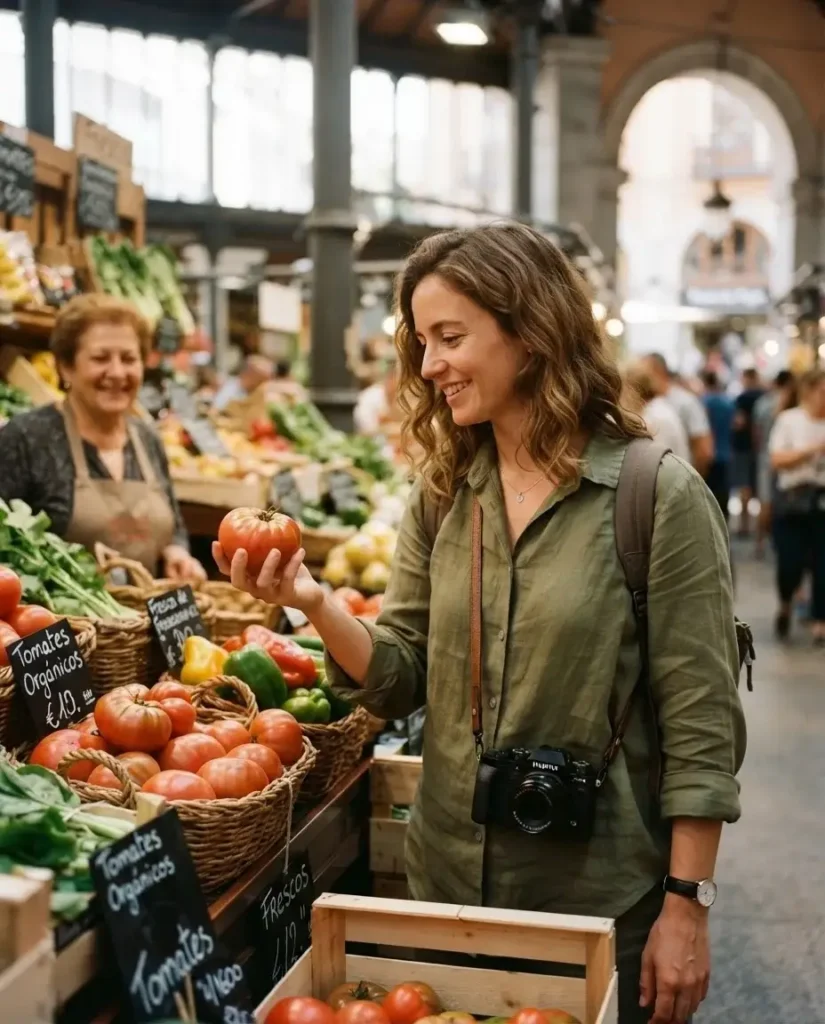
Food is the fastest route into a culture. Skip the restaurants with photo menus and hosts waving you in near the big sights. Walk ten minutes past them and eat where the tables are full of locals. Shop the neighborhood market and cook a simple regional dish in your rental. In Spain, that might be a menu del dia lunch, the incredible-value set meal locals eat midday. In Italy, seek out the humble trattoria and whatever pasta is regional to where you are, because it changes every hundred miles. In Portugal, the tiny tascas serve grilled fish and vinho verde for a song. Ask your apartment host where they eat. That single question has led me to more good meals than any guidebook.
Solo Slow Travel: Confidence and the Loneliness Question
Most of my travel has been solo, and I believe deeply that it’s one of the most powerful ways to build confidence and self-trust. There’s a specific pride that comes from figuring out a foreign bus system alone, or navigating a problem in a language you don’t speak, and coming out the other side. You learn you can handle far more than you assumed.
But I won’t pretend it’s always easy, because the honesty is the point. Longer solo stays can get lonely in a way short trips don’t. The fix is intention. Join a local class, whether it’s cooking, language, or pottery. Become a regular somewhere. Say yes to the small invitation. Loneliness on the road is almost never permanent; it’s usually a signal to reach out, and reaching out is a skill that gets easier every time you use it.
For safety, the fundamentals travel with you everywhere: share your itinerary with someone at home, trust the instinct that says leave, keep copies of your documents, and don’t broadcast that you’re alone to strangers. Slow travel actually helps here, because the longer you stay, the more you understand which streets and situations feel right, and the more you build a small web of people who know your face.
When to Go: The Case for Shoulder Season
If you have any flexibility, travel in the shoulder seasons, roughly April to early June and September to October. The weather is lovely, the crowds thin out, prices on rentals drop, and locals aren’t burned out from peak tourism, so they’re warmer and more open. Summer in the famous cities can be brutally hot and crowded, and everything costs more. Slow travel and shoulder season are natural partners, because you’re not tied to school holidays or a rigid two-week window.
Use that freedom.
Your Simple Starting Plan
If all of this still feels like a lot, here’s the smallest version that works. Pick one base city you’re drawn to. Choose a length that fits inside your 90 Schengen days. Book a monthly apartment. Sort out your connectivity and a light bag. Then let the rest unfold once you’re there. You do not need the whole trip mapped before you go. You need the first step booked and the courage to take it.
The perfect moment to do this will never announce itself. It didn’t for me. I left a comfortable, expected path because the version of my life I actually wanted was on the other side of some fear and a lot of small, practical decisions exactly like the ones in this guide. You’re closer than you think. Start with the base city. The rest is just details, and details are learnable.