Yoga Retreats in Central & South America: Where to Go First

There’s a moment in most people’s planning process where the tab count climbs past twenty and none of them are actually helping. You know you want a yoga retreat somewhere in Latin America. You’ve seen the photos of open-air shalas over lakes, sunrise sessions with volcanoes behind them, that specific kind of light that makes every outdoor yoga class look like a spiritual awakening. But you’re staring at a dozen aggregator sites, each one listing 300 retreats sorted by price and star rating, and you’re no closer to knowing where you actually belong.
I know that feeling. It’s the same kind of decision paralysis I felt before my first solo backpacking trip across Europe. So many options that the choosing felt harder than the going. What finally helped wasn’t another list. It was someone breaking down the real character of each place and being honest about what kind of traveler belongs there.
That’s what this guide is. Not a ranking of every yoga retreat from Panama to Patagonia. A real, honest breakdown of the destinations that have built genuine reputations, what it’s actually like to show up there as a first-timer or solo traveler, and what you need to know before you book.
Why Central & South America in Particular?
Because the region offers something genuinely rare: the combination of deep indigenous spiritual tradition, extraordinary natural environments, affordability relative to European or Balinese retreat circuits, and a culture that moves at a pace slow enough to let you actually decompress. Whether it’s the Mayan cosmology that surrounds Lake Atitlan in Guatemala or the Andean earth-based spirituality woven through every corner of Peru’s Sacred Valley, these aren’t just pretty backdrops. The land itself carries history and meaning, and the best retreat centers know how to honor that without turning it into a theme park.
You don’t need to be an experienced yogi to go. You don’t need to be wealthy. And you don’t need a partner or a group. Solo travelers make up a significant portion of retreat attendees across this region, and many of the places I’ll describe specifically welcome people who are arriving alone, starting fresh, and figuring things out on the mat as much as off it.
Let’s go through the destinations that consistently deliver.
Nosara, Costa Rica: Yoga in a Blue Zone
If I were designing a place from scratch that would make a first yoga retreat as welcoming as possible, it would look a lot like Nosara. This small beach town on Costa Rica’s Nicoya Peninsula sits inside one of the planet’s five certified Blue Zones, a designation given to regions where people statistically live the longest and healthiest lives on earth. The Costa Rica Tourism Board’s Blue Zone page documents how over 900 residents in the Nicoya region are aged 90 or above, with life expectancy approaching 80 years, the highest in Central America. This isn’t marketing fluff. It reflects a genuine local culture of whole-food eating, physical movement, community bonds, and purposeful daily rhythm. That ethos infuses the entire Nosara wellness scene.
The town itself is small, spread across jungle-covered hills that slope down to Playa Guiones, a long, consistent surf break.
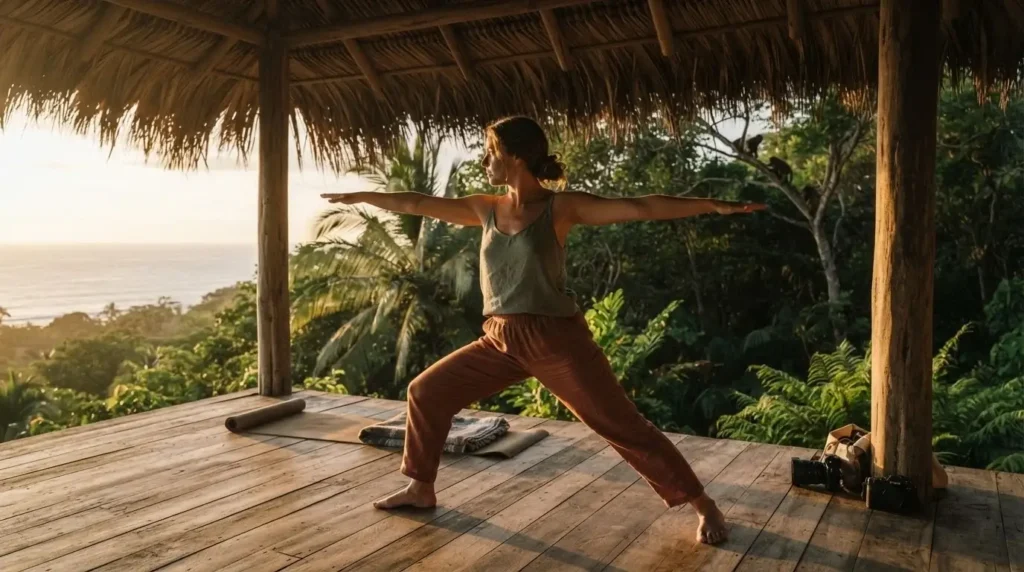
It doesn’t feel like a resort destination. There are no big resort chains. The roads are mostly unpaved. Howler monkeys wake you up at sunrise. This combination of wildness and wellness infrastructure is exactly what makes it work so well for retreat travel.
The most well-established retreat center here is Blue Spirit Costa Rica, a world-class facility perched on a hilltop overlooking the Pacific Ocean. The three-mile white sand beach below is protected as a sea turtle refuge. Blue Spirit hosts programmed retreats year-round, meaning you arrive to a structured schedule of yoga, meditation, workshops, and meals rather than figuring it out yourself. For solo travelers who want community without planning every detail, this model is deeply practical.
Bodhi Tree Yoga Resort is another strong option, sitting on eight acres with two yoga shalas, a saltwater pool, spa facilities, and jungle hiking trails. Week-long retreats with accommodation and meals generally run $700 to $1,500 depending on the program and room type. Budget-conscious travelers can find shorter weekend programs starting around $300 to $500.
Getting there from the US: fly into Liberia (LIR) or San José (SJO), then take a shuttle or rental car south. San José to Nosara is about a five-hour drive. Nosara is not a place you stumble upon, and that remoteness is part of what keeps it feeling genuine. US citizens need no visa and can stay up to 180 days. The dry season runs roughly from December through April, which brings the most sunshine and easiest road conditions, but the green season (May through November) keeps prices lower and the jungle at its most lush.
Eat: grab breakfast at a juice bar near Playa Guiones before morning practice. The town has excellent plant-forward cafes and several spots serving traditional Costa Rican gallo pinto (rice and beans with eggs) for a grounded, affordable start to the day.
Lake Atitlan, Guatemala: The Deep-End Retreat Experience
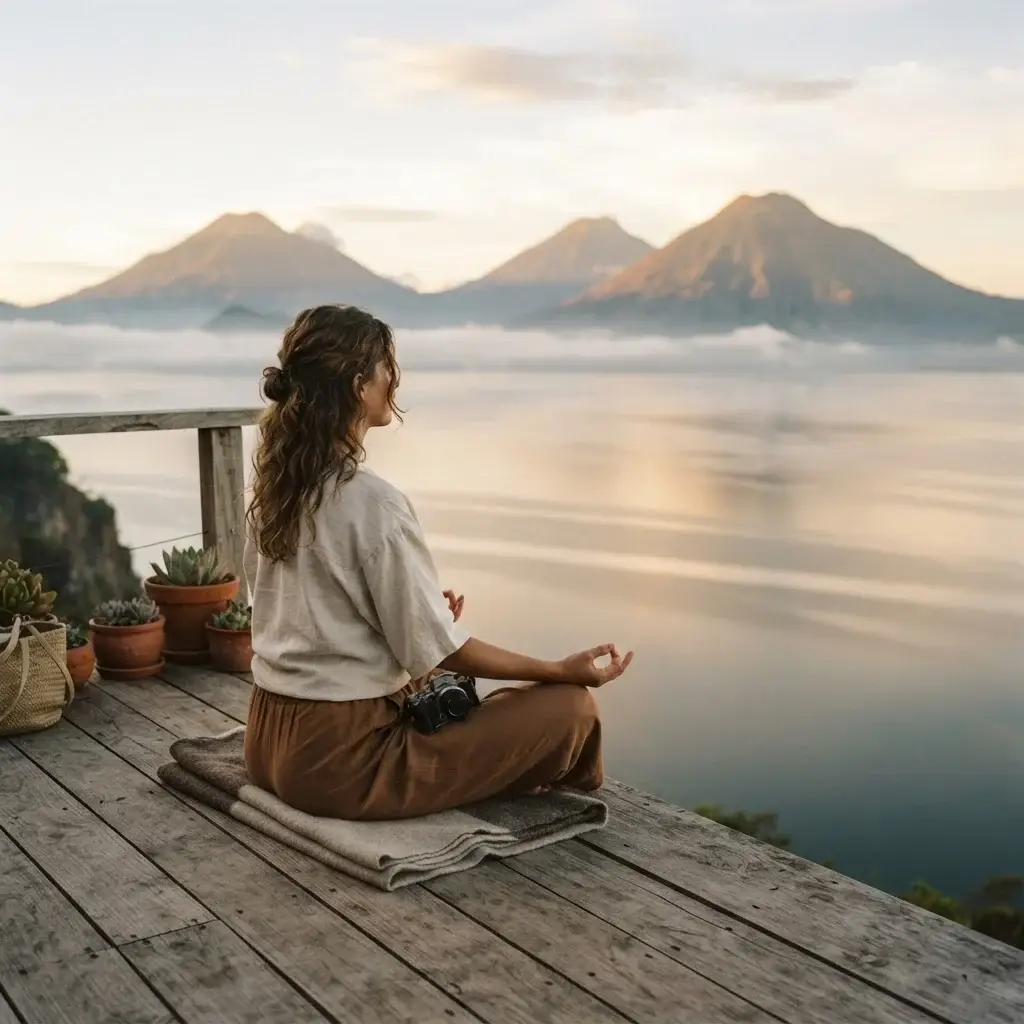
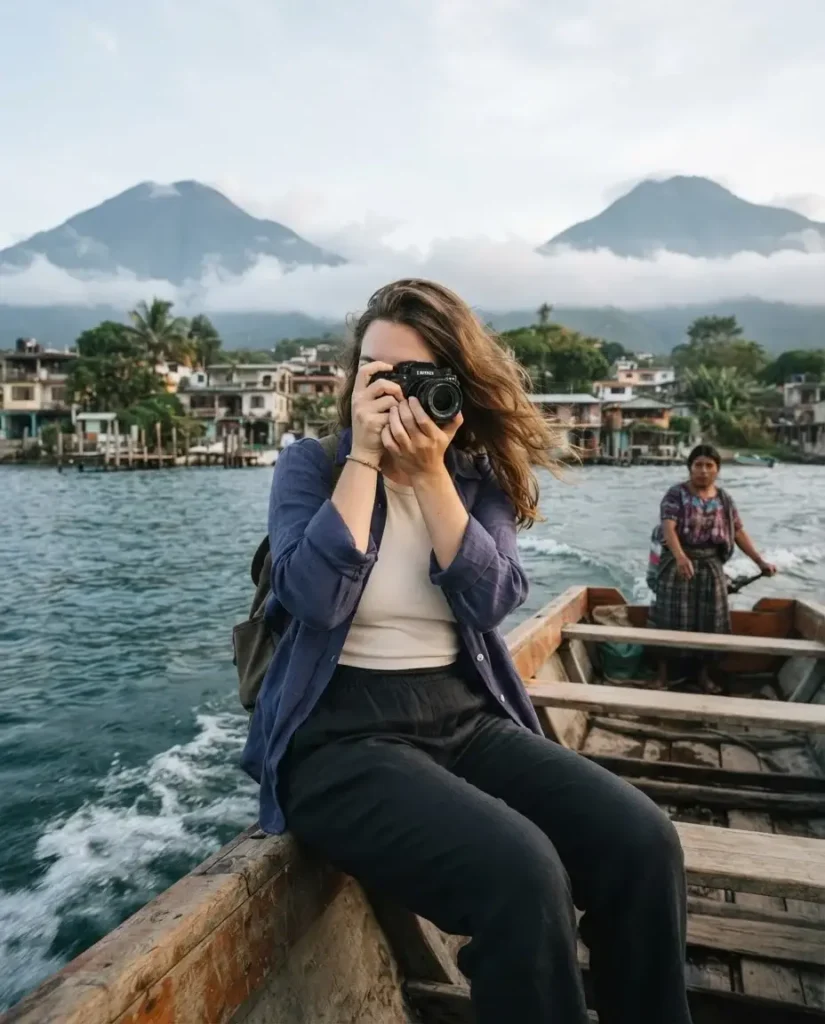
Lake Atitlan is, without question, one of the most dramatic natural settings on earth. Ringed by three volcanoes, sitting at 5,100 feet above sea level in the Guatemalan highlands, and surrounded by a dozen small villages where indigenous Tz’utujil and Kaqchikel Maya communities continue to live largely as they have for centuries, the lake creates an atmosphere that’s genuinely unlike anywhere else in the region. Guatemala submitted it to UNESCO as a World Heritage Site, and its UNESCO World Heritage Tentative List entry recognizes its significance as a protected natural area of multiple cultural and ecological value.
For yoga retreats specifically, the village of San Marcos La Laguna is the hub. It has developed an international wellness reputation over several decades and now hosts a dense cluster of retreat centers, holistic health practitioners, herbalists, sound healers, and meditation teachers. You can take a single drop-in yoga class for $15, attend a week-long residential retreat, or pursue a 200-hour teacher training.
The range is extraordinary.
Eagle’s Nest Atitlan is one of the most reviewed and respected centers on the lake. Featured in National Geographic Traveller’s Spa & Wellness Collection and rated 4.6 out of 5 across more than 1,400 combined reviews on TripAdvisor and Google, it offers all-inclusive stays where your room rate covers three home-cooked, locally sourced vegetarian meals daily, unlimited yoga classes (Hatha, Vinyasa, Yin, sound healing, breathwork, and more), a sauna, spa access, and meditation spaces. Rates start from $189 per person per night for yoga retreats. Solo travelers are specifically welcomed, and the community format means you’re very unlikely to spend your evenings alone.
Getting to San Marcos from Guatemala City: fly into Guatemala City (GUA), take a shuttle or public bus to Panajachel (about 3 hours), then hop on a lancha, the small motorized boats that connect all the lake villages. The ride to San Marcos takes about 20 to 30 minutes and costs a few dollars. It’s a genuinely fun arrival. US citizens need no visa and can stay up to 90 days.
A practical note: San Marcos La Laguna has limited ATMs, so bring enough quetzales from Panajachel before heading to the lake. The village runs almost entirely on shared meals, morning practices, and early nights. If you’re looking for nightlife, this isn’t your destination. If you’re looking to genuinely slow down and reset, it’s hard to beat.
What to eat: the retreat centers here typically serve vegetarian and vegan cuisine, and it’s genuinely good. When you venture into town, look for pupusas from local street vendors, fresh avocado and black bean plates, and locally grown fruit that shows up on every breakfast table. The market in Panajachel sells spices, textiles, and produce, and a morning there is a beautiful way to spend an off-day.
The Sacred Valley, Peru: Yoga at the Edge of the Inca World
This is the one for people who want their retreat to feel transformative in ways that are difficult to explain to the people back home. The Sacred Valley of the Incas, the broad Andean valley running between Pisac and Ollantaytambo northwest of Cusco, is one of those places that seems to affect people on a level below conscious thought. The altitude, the landscape, the presence of Inca ruins in every direction, and the living indigenous Quechua culture that still fills the valley’s markets and agricultural terraces combine into something that hits differently than any other retreat environment in the Americas.
From what solo travelers and retreat participants consistently report, the experience of practicing yoga at this altitude, typically between 9,000 and 9,800 feet above sea level, changes the quality of breath awareness in ways that studio practice back home simply doesn’t. You feel your breath because you have to. Pranayama (breathwork) isn’t abstract here.
One highly regarded center is Samadhi Sacred Valley, located in Huycho near Urubamba, with seven bungalows each designed around one of the chakra energy centers. They serve organic vegetarian and vegan cuisine, offer yoga, meditation, art therapy, and cultural immersion as integrated elements of the retreat experience, and run specific programs for solo travelers. The yoga deck has direct views of the surrounding Andes.
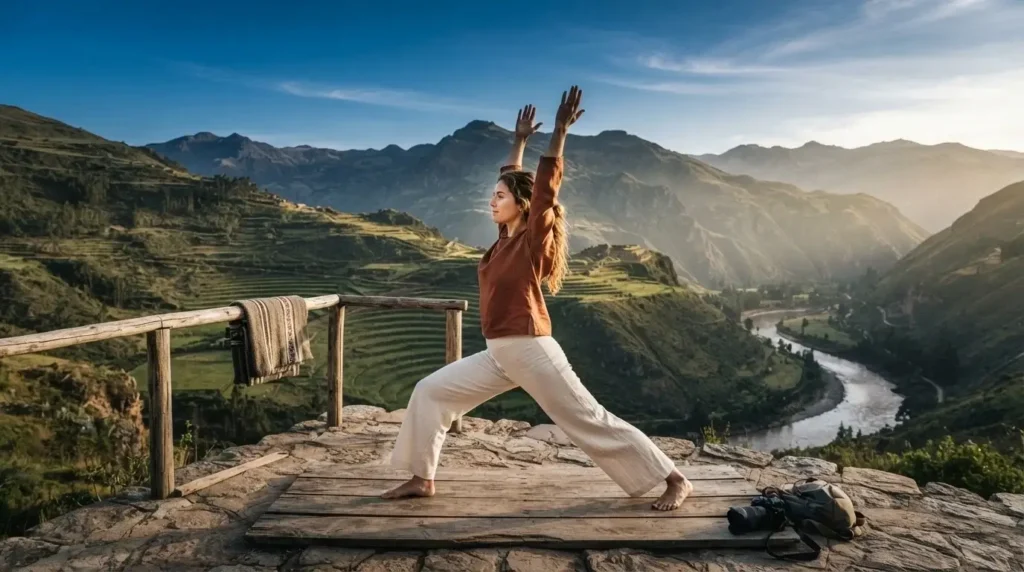
The center also facilitates visits to nearby Inca sites, markets in Pisac and Ollantaytambo, and the Maras salt pans. It’s an experience that layers cultural understanding onto physical practice in a way that genuinely enriches both.
Seven-day Sacred Valley retreat packages generally run from around $650 on the lower end for more basic accommodations to $2,900 or more for fully programmed, higher-end all-inclusive programs. Most include two yoga classes daily, all meals, and guided cultural excursions.
A real and important logistics note: altitude sickness is a genuine consideration here, not something to dismiss. The Salkantay Trekking guide on acclimatizing in Cusco strongly recommends arriving in Cusco at least two days before heading to any strenuous activity. Walk slowly, drink coca tea (freely available in the region and completely legal locally), eat light on your first day, avoid alcohol, and don’t push your yoga practice hard on day one. The Sacred Valley sits about 1,500 feet lower than Cusco, which makes it a smarter acclimatization base for many retreat-goers than Cusco city itself.
For entry: according to the US Department of State’s Peru travel page, US citizens do not need a tourist visa for stays under 90 days, but your passport must be valid for at least six months from your date of entry. Flying into Cusco (CUZ) is the most direct route; Lima (LIM) is the main international hub with connecting flights.
What to eat: the Sacred Valley has excellent local food. Look for sopa de quinoa (quinoa soup) which is warming, nutritious, and practically designed for altitude. Roasted corn, stuffed peppers called rocoto relleno, and trout from the Urubamba River are worth seeking out. Cusco city has a vibrant restaurant scene if you’re spending a day or two there, with everything from hole-in-the-wall markets to well-regarded contemporary Peruvian restaurants.
A Quick Look at Two More Worth Knowing
Ecuador’s Mindo Cloud Forest is a destination that doesn’t show up often in yoga retreat roundups, which is exactly why it’s worth mentioning. Mindo sits about two hours northwest of Quito at roughly 4,100 feet, nestled in dense cloud forest with extraordinary birdwatching, waterfalls, and a misty, cool-jungle atmosphere completely unlike coastal or highland Peru. Casa Verde, a small boutique lodge run by Wendy Green, offers year-round personalized retreats combining raw food principles, Ashtanga yoga, hiking, and sauna. It’s intimate, customized, and genuinely off the mainstream path.
Colombia’s Caribbean Coast and Coffee Region are emerging for yoga retreats, particularly around Cartagena and the coffee country around Salento and Medellin. The infrastructure is newer and less established than the four major destinations above, but the growth is real. Solo female travelers particularly report feeling more comfortable in Medellin and the Coffee Region than many other South American cities, thanks to improved safety conditions in recent years and a strong local culture of outdoor activity and wellness. Worth monitoring if you want to be ahead of the curve.
What to Actually Expect When You Arrive
Here’s something nobody tells you before your first retreat: the first day usually feels slightly awkward.
You arrive, you don’t know anyone, everyone else seems to already be part of a tribe, and you’re wondering if you made a mistake. This is completely normal and it passes quickly.
Retreat formats across this region tend to follow a similar daily rhythm. Morning practice typically runs from about 7:00 to 9:00 a.m., then breakfast, then free time or workshops through the afternoon, an evening practice or meditation, and a communal dinner. By day two, you’ll know people’s names. By day three, you’ll wonder how you’re going to leave.
You do not need an advanced yoga practice to attend any of the retreats described in this guide. Hatha and Yin classes, which appear at virtually every center, are genuinely accessible for beginners. Tell the teacher it’s your first retreat or that you’re still building your practice. A good teacher will offer modifications and you won’t be judged for needing them.
Budget Reality: What This Actually Costs
Here’s a rough breakdown to help you plan honestly:
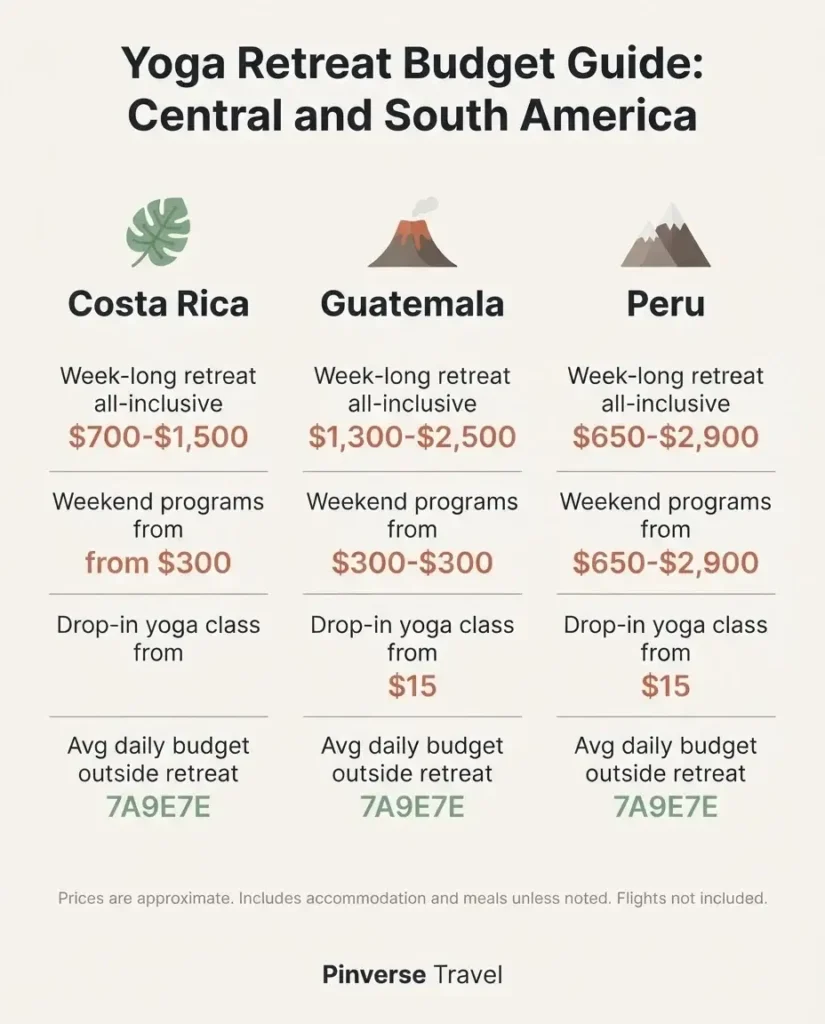
A week-long retreat in Guatemala’s Lake Atitlan area is the most accessible price point in this guide, with all-inclusive stays running roughly $1,300 to $2,500 total including accommodation, meals, and unlimited yoga. You can supplement with drop-in classes for as little as $15 if you prefer a more flexible stay.
Costa Rica tends to be the mid-to-upper range, with week-long programs at established centers like Blue Spirit or Bodhi Tree typically running $1,000 to $2,500 all-inclusive, with premium rooms pushing higher.
Peru’s Sacred Valley retreats can vary the most. Budget-oriented week programs exist around $650, while high-end fully programmed experiences climb to $2,900 or above. Factor in a couple of extra days in Cusco for acclimatization, adding roughly $50 to $100 a day for a simple guesthouse and meals.
Don’t forget to budget for flights, airport transfers (often $20 to $80 depending on the country and distance), travel insurance, and any visa-related costs. Most of this region requires no tourist visa for US, Canadian, UK, and Australian passport holders, which cuts down on pre-trip bureaucracy significantly.
Five Things to Look For Before You Book Any Retreat
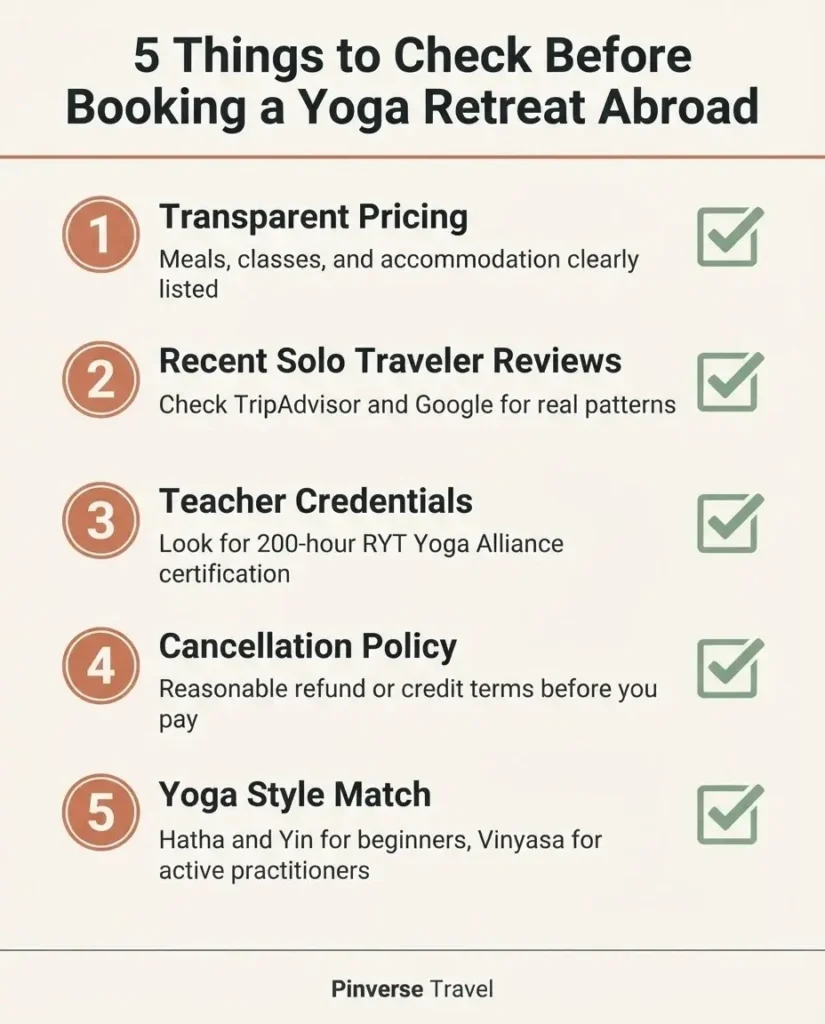
First, look for transparent pricing. A good retreat center tells you clearly what’s included (meals, classes, accommodation) and what costs extra (excursions, massages, airport pickup). Vague pricing is a red flag.
Second, read recent reviews, specifically from solo travelers if that’s your situation. Aggregator sites like TripAdvisor and Google have enough reviews at established centers that patterns are easy to spot. Look for comments on the community feel, food quality, and whether solo travelers felt welcome.
Third, check the teacher backgrounds. A legitimate yoga retreat will list the teachers and their training credentials. 200-hour RYT (Registered Yoga Teacher) from a Yoga Alliance-accredited program is the baseline standard. More hours and more experience is better, but the minimum matters.
Fourth, pay attention to the cancellation policy before you put any money down. Life happens. A center with a reasonable refund or credit policy respects your situation.
Fifth, consider the style of yoga being offered and whether it suits your body right now. If you have injuries or limited mobility, a restorative or Yin-focused retreat will serve you better than a power vinyasa intensive. Ask the center about modifications before you book, and notice how they respond.
A Note on Solo Travel and Safety
All four of the primary destinations in this guide have significant track records with solo travelers, including solo women. The retreat center environment itself adds a layer of built-in community and safety, because you’re arriving into a structured setting with other guests, staff, and a fixed schedule rather than navigating a city alone.
Costa Rica and Peru are among the most established tourist infrastructures in the region. Guatemala requires a bit more awareness; stay in the lake villages and Panajachel, use the recommended lakeside boats rather than walking unfamiliar paths after dark, and keep your retreat center’s contact information accessible.
The experience-of-travel reality is this: anywhere in the world, including New York City, being a solo traveler requires common sense and situational awareness. You carry that with you. These destinations, in the retreat context specifically, are among the safest and most welcoming environments in the region.
One Last Thing Before You Start Searching
I left a traditional career path because I wanted a life that felt meaningful instead of just manageable. Traveling alone, building experience through doing rather than planning, taught me that the conditions for transformation don’t arrive on a silver platter. You create them by choosing to show up.
A yoga retreat in Central or South America won’t fix your life. But it might give you three things that are genuinely hard to find at home: space to breathe, time to be still, and the strange and useful experience of being a stranger somewhere beautiful, figuring out who you are when no one around you knows your history.
That’s worth booking a flight for. Pick one destination from this guide, find a retreat that fits your budget and timeline, and go.