Local Cultural Festivals to Experience Around the World

There is a certain kind of travel moment that stays with you longer than any scenic viewpoint or famous landmark ever will. It happens when you stumble into something you were not supposed to see, a narrow alleyway filling with drumbeats, a crowd of thousands facing the same direction in total silence, strangers handing you food you cannot name. These are festival moments. Not the kind sold in a tour package brochure. The kind that happen because you showed up at the right time, in the right city, curious enough to ask a local what was going on.
I have been in that position. When I was teaching English in Thailand, I was not planning to experience Songkran. I just happened to be there in April, standing in the street when the whole city turned into a water fight that somehow also felt sacred. That experience changed how I travel. From that point on, I started building trips around festivals before I built them around sights.
This is not a list of the world’s biggest parties. You already know about Carnival in Rio and Oktoberfest in Munich. What I want to share are the festivals that actually feel local, the ones where you are not surrounded by other tourists taking the same photo, but surrounded by people celebrating something that genuinely matters to them. These are celebrations worth getting on a plane for.
Why Festival Travel Is Different:
Most travel is about seeing. You see a cathedral, you see a coastline, you see a museum. Festival travel is about witnessing. You are watching something alive, something that exists for the community first and for you second. That shift in priority changes everything about how you experience a place.
86% of travelers are now prioritizing immersive experiences over traditional tourism, according to 2025 research from Skift. That number does not surprise me at all. After years of following itineraries built around sights, people are hungry for connection, for the feeling that they were present for something real. Local festivals deliver that in ways that nothing else quite matches.
The other reason festival travel matters, especially for solo travelers, is what it does for your confidence. Walking into a crowd of strangers who all share a cultural bond you do not yet understand is uncomfortable at first. But that discomfort is exactly where growth lives. I have been in that feeling more times than I can count, from my first solo days backpacking across Europe to living with a family in Ghana, where celebration was never a spectacle but always a participation. The moments I pushed through the awkwardness were always the ones I talked about for years afterward.
How to Find Local Festivals Before (and During) Your Trip:
Before we get into specific festivals, here is the most practical thing I can share. Most travelers miss local festivals because they do not know how to look for them.
The best tools are simple. Google “[country] + festival calendar + [month you’re traveling]” is a good start, but it surfaces the same big names. Dig deeper by searching for regional tourism board websites, which often list province and city-level events the major travel sites ignore. Facebook event pages in the local language are surprisingly powerful if you can translate them. Apps like Couchsurfing and Meetup occasionally surface community celebrations. And honestly, the best source is always a guesthouse owner or a local you meet in the first day or two. When I was backpacking through Europe alone, asking “what do people here celebrate in this season?” opened more interesting conversations than any guidebook.
Also check UNESCO’s Intangible Cultural Heritage Lists. The UNESCO ICH program documents traditions, festivals, and rituals that communities have nominated as living heritage, and the list covers hundreds of celebrations across every continent that most travelers have never heard of.
Now, let’s get into the actual festivals.
Timkat, Ethiopia: When an Entire Nation Takes to the Water
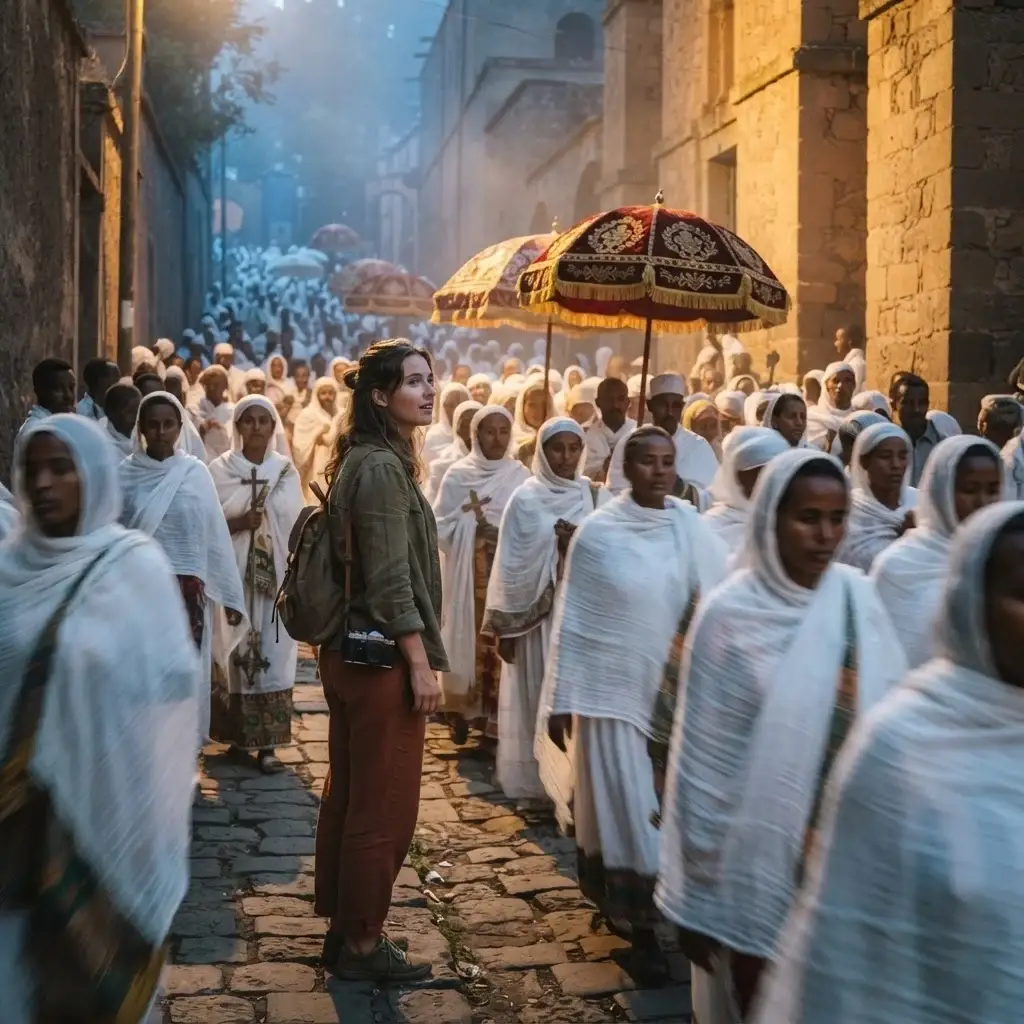
If you travel during January and you want to witness something you will genuinely not see anywhere else on earth, get yourself to Lalibela or Gondar in Ethiopia for Timkat.
Timkat is the Ethiopian Orthodox Christian celebration of Epiphany, marking the baptism of Jesus in the River Jordan. But calling it a religious holiday barely scratches the surface of what it actually looks like. The celebration begins on the eve of January 18, known as Ketera, when each parish church carries its tabot (a replica of the Ark of the Covenant) in procession to a nearby pool, river, or reservoir. Priests lead the procession, clergy sing ancient hymns, and tens of thousands of white-robed worshippers follow, many carrying candles. The procession continues through the night. At sunrise on January 19, the priest blesses the water and sprinkles it on the gathered crowd, and the tabots make their colorful procession back to their churches.
Gondar is particularly spectacular because the celebration takes place around the Fasilides Bath, a stone pool built in the 17th century that is filled with water just for Timkat. Watching thousands of white-clad celebrants gathered around this ancient pool as dawn breaks over the mountains is one of those images that travel writers reach for superlatives to describe, but honestly, no description fully does it justice.

You just have to be there.
UNESCO recognized Timkat as Intangible Cultural Heritage of Humanity in 2019, which reflects just how globally significant this living tradition is. That recognition also means it has been documented in detail, so you can research it deeply before you go.
What to eat: Timkat falls during a fasting period for Orthodox Christians, so street food during the celebration leans heavily on injera served with lentil stews, vegetable tibs, and chickpea dishes. This is actually a great time to explore Ethiopian food as a non-meat-eater.
Practical note: Lalibela requires a domestic flight from Addis Ababa; Ethiopian Airlines runs regular routes. Accommodation books out months in advance for Timkat, so plan early. Dress modestly, cover your shoulders and legs, and ask before photographing anyone in prayer.
Bisket Jatra, Bhaktapur, Nepal: A Tug-of-War at the New Year
Mid-April in Nepal means one thing in Bhaktapur: Bisket Jatra, a nine-day festival that marks the Nepali New Year with one of the most physically dramatic celebrations in South Asia.
The centerpiece is a tug-of-war that is nothing like any tug-of-war you have seen before. Two massive wooden chariots, each carrying sacred deities, are pulled by rival neighborhoods through the narrow lanes of Bhaktapur’s old city. The chariot that reaches a designated point first is considered to have brought good fortune for its side of town. Crowds are enormous, energy is feverish, and if you find yourself in the middle of a rope-pulling team without quite planning it, that is perfectly normal. Locals often pull outsiders in.
After the chariot races, the festival moves to its most visually striking moment: the raising of a massive wooden pole (called the Lingo) at the Khalna Tole open space. The pole can stand as tall as 25 meters, and raising it takes teams of men pulling on ropes while crowds hold their breath. On the final day, the pole is brought down, marking the official start of the New Year.
Bisket Jatra is one of the most culturally rich celebrations in the Kathmandu Valley, and Bhaktapur is the best base because the festival is most concentrated in that ancient city, which is far less crowded than Kathmandu and has preserved its medieval character beautifully. Entry to Bhaktapur itself requires paying a heritage conservation fee (approximately $15 USD for international visitors), which is worth every cent.
What to eat: Juju Dhau, a thick, creamy curd made in Bhaktapur that is considered the finest yogurt in Nepal. It comes in small clay pots and costs almost nothing. Also look for bara, a savory lentil pancake sold at roadside stalls throughout the festival.
Practical note: Kathmandu is the nearest airport. A taxi from Kathmandu to Bhaktapur takes about 30-40 minutes. Book accommodation in Bhaktapur itself rather than commuting, because the chariot processions often block roads at unpredictable times.
Surva (Kukeri Festival), Pernik, Bulgaria: When the Demons Come Out
This one is genuinely unlike anything else. Every January in the city of Pernik, about 30 kilometers southwest of Sofia, thousands of participants from across the Balkans and beyond gather for Surva, Bulgaria’s ancient masked festival.
The tradition is rooted in pre-Christian Bulgarian folklore. Men and women dress in costumes that are part scarecrow, part monster, part ancient forest spirit, covered in animal pelts, colored ribbons, and enormous bells that can weigh 30 kilograms or more. These are the Kukeri, and the noise and spectacle they create as they stomp and leap through the streets is meant to scare away evil spirits and bring fertility and good fortune for the year ahead. The sound of the bells is thunderous. The masks are genuinely unsettling in the best possible way.

The 2026 festival ran from January 16 to 25, with the main parade days on January 17, 18, 24, and 25. According to the Surva Pernik 2026 visitor guide, the outdoor parades are completely free, making it one of the most accessible major folk festivals in Europe. Budget travelers staying in Sofia can do the whole trip as a day trip; trains run regularly between Sofia and Pernik. Daily costs in Pernik run roughly €40-80 depending on food and any guided options.
What to eat: Banitsa, a warm flaky pastry filled with white cheese, sold at every corner stall during the festival. Also look for shopska salad (tomatoes, cucumbers, peppers, onion, and crumbled white cheese), one of Bulgaria’s most beloved dishes.
Practical note: Wear your warmest layers. January in Pernik is cold, and you will be standing outside for hours. Waterproof boots are essential. The masks can startle young children, so if you are traveling with kids, arrive early and position yourself on a wider street rather than in the dense crowd.
Inti Raymi, Cusco, Peru: The Festival of the Sun
Every June 24, the ancient Inca capital of Cusco, Peru fills with the sound of quenas and drums, and tens of thousands of people gather to watch one of the most visually spectacular cultural events in the Americas.
Inti Raymi, which translates from Quechua as “Festival of the Sun,” honors Inti, the sun god of the Inca Empire. The celebration had been banned during the Spanish colonial period, but was revived in 1944 as a theatrical reenactment based on Inca chronicles and has grown into an event that draws 100,000 to 150,000 attendees each year. In 2001, it was declared Cultural Heritage of the Nation of Peru.
The ceremony follows a three-part route through the city. It begins at the Qoricancha temple (the original Temple of the Sun) at 9:00 a.m., continues to the Plaza de Armas at approximately 10:30 a.m., and culminates at the esplanade of Sacsayhuaman from 1:00 p.m., ending around 3:30 p.m. The ceremonies at Qoricancha and the Plaza de Armas are free and open to anyone who arrives early enough. The full ceremonial schedule, ticket options for the Sacsayhuaman grandstands, and practical tips are available directly from CuscoPeru.com, which is the most comprehensive official resource for planning your visit.
Grandstand tickets for the Sacsayhuaman ceremony sell out weeks in advance, so book early if you want a seated view. If you prefer to experience it free of charge, positioning yourself along the Plaza de Armas route in the morning provides a genuinely memorable view.
What to eat: Cusco during Inti Raymi is the time to try chicha morada (a sweet, non-alcoholic purple corn drink), anticuchos (grilled beef heart skewers sold by street vendors), and cuy (roasted guinea pig, a traditional Andean delicacy that takes some courage but is genuinely delicious if you can get past the presentation). The streets around the Plaza de Armas are lined with food stalls for the full week surrounding June 24.

Practical note: Altitude is real in Cusco, which sits at 3,400 meters above sea level. Arrive at least two days before the festival to acclimatize. Drink coca tea, stay hydrated, avoid alcohol in the first 48 hours, and walk slowly. Most visitors feel fine after the first day or two.
Pchum Ben, Cambodia: Fifteen Days of Honoring the Dead
In late September or early October each year, Cambodia essentially pauses. Pchum Ben, the Festival of the Ancestors, is one of the most important dates in the Khmer calendar, a 15-day period during which families return to their home pagodas to make offerings to the spirits of deceased relatives.
The belief behind Pchum Ben is profound. According to Buddhist and folk traditions, during these 15 days the gates of the spirit world open and ancestors return to the living world, hungry and searching for their families. Each morning before dawn, Cambodians gather at temples to offer sticky rice balls wrapped in banana leaves, as well as other foods, to monks who recite prayers on behalf of the deceased. The atmosphere is simultaneously solemn and deeply communal.
For travelers, visiting Cambodia during Pchum Ben means experiencing the country in its most honest, unrehearsed state. Siem Reap and Phnom Penh are quieter because locals have traveled home. The tourist infrastructure slows. What you gain is access to a more local reality: morning temple offerings, family gatherings spilling onto street corners, and the feeling of being a respectful observer at something that has nothing to do with your presence. In 2026, the culminating day falls on October 10.
Traveling to Cambodia during Pchum Ben offers a window into Khmer spiritual life that no museum or tour can replicate. The article linked there gives a firsthand account of attending temple ceremonies and explains the cultural context in detail, which I recommend reading before you go.
What to eat: Nom ansom chek (banana sticky rice wrapped in banana leaf), which is specifically associated with Pchum Ben offerings. You will find it at temple stalls and markets throughout the festival. Also look for bai sach chrouk, a simple breakfast of grilled pork over rice that is sold early in the morning near every pagoda.
Practical note: Some restaurants and services close during the peak days, so stock up on snacks and check that your accommodation will remain open. Dress modestly when visiting temples: covered shoulders and knees are required, and silence and stillness during prayers are expected. Ask before photographing ceremonies.
Festa Junina, Northeast Brazil: The Party That Lasts All Month
If you picture Brazil, you probably picture Carnival. But ask anyone in the Northeast and they will tell you that Festa Junina, the June festival, is the celebration they actually wait all year for.
Rooted in the Portuguese Catholic tradition of honoring Saints Anthony, John, and Peter in June, Festa Junina has evolved into something distinctly Brazilian and specifically Northeastern. It is a harvest celebration and a folk party rolled into one, centered on forró music (a fast, accordion-driven rhythm that makes standing still almost impossible), quadrilha dancing (a synchronized group dance with elaborate costumes), bonfires, colorful flags strung between buildings, and more food than any reasonable person can eat.
The spiritual home of Festa Junina is Caruaru in the state of Pernambuco, which holds a Guinness World Record for the largest celebration (approximately 1.5 million attendees recorded in 2011), and whose traditions have received UNESCO recognition as an Intangible Cultural Heritage of Humanity. The state of Maranhão, particularly its capital São Luís, also hosts extraordinary celebrations throughout June that run across arraiás (festival spaces) for the whole month.
What to eat: This is one of the genuinely great food festivals of the world. Canjica (a sweet white corn pudding cooked in milk and coconut), pamonha (a corn cake cooked in banana leaf), caldo de milho (hot corn soup), pé-de-moleque (a peanut brittle made with rapadura sugar), and quentão (a warm spiced cachaça drink served when evenings cool down). Eating your way through Festa Junina is, genuinely, a full-time activity.
Practical note: Recife and Caruaru are connected by a two-hour bus ride. June is winter in Brazil’s South but warm in the Northeast, so you need light layers for evenings. Go mid-week if you can to avoid the heaviest weekend crowds. Learning even a few words of Portuguese before you go makes an enormous difference in how people respond to you.
Songkran, Thailand: More Than Just a Water Fight
I have to include Songkran here, though I want to be honest about what it actually is versus what most travel content makes it out to be.
I was living and teaching in Thailand when Songkran happened around me, and the version that most Western travelers experience, a massive street party where everyone sprays each other with water guns, is real and genuinely fun. But the more meaningful version happens at the same time: people returning to their families, visiting temples, washing Buddha images with scented water, and carefully pouring water over the hands of elders as a gesture of respect and blessing for the new year. Both versions coexist, and the best experience of Songkran involves finding both.
UNESCO officially recognized Songkran as an Intangible Cultural Heritage of Humanity in December 2023, formally acknowledging the deeper cultural significance behind the celebration that many tourists miss entirely. If you are in Thailand for Songkran (mid-April), visit a temple in the morning before the street celebrations begin. Watch families go through the ritual water-pouring with their elders. Then, absolutely, join the water fight in the afternoon.
What to eat: Khao chae, a royal Thai dish eaten specifically during Songkran in some regions, consisting of rice soaked in chilled jasmine-scented water and served with small savory side dishes. It is cooling, delicate, and unlike anything you eat the rest of the year in Thailand. Also: mango sticky rice, which is at peak season in April.
Practical note: Protect your phone and camera. Waterproof bags or cases are sold everywhere. ATM cards in pockets are a bad idea. Wear clothes you do not mind soaking completely. And if you are on a scooter: be careful, because the roads are genuinely wild during Songkran’s main days.
How to Be a Good Guest at Someone Else’s Festival:
This matters and it does not get discussed enough in festival travel content.
Every festival I have described above exists for a community, not for you. Your presence can be welcome, enriching, even beautiful for both parties. Or it can be intrusive, disrespectful, and extractive. The difference comes down to a few simple things.
Ask before photographing anyone, especially during prayers, rituals, or moments of visible emotion. Dress appropriately, which usually means modestly, covering shoulders and knees in religious contexts. Follow the lead of the people around you: if everyone is quiet, be quiet; if everyone is sitting, sit. Spend money locally, at food stalls run by families rather than tourist restaurants, at small guesthouses rather than international chains. Learn two or three words in the local language: hello, thank you, and “may I take a photo?” These small gestures are remembered.
The festivals that survive for centuries do so because they remain meaningful to the communities that hold them.

The best thing you can do as a traveler is show up with genuine curiosity, spend your money thoughtfully, stay humble, and leave the place slightly better for your having been there.
Finding Your Own Festival: A Few Honest Tips:
The festivals I have described here are a starting point, not a complete list. The world is full of local celebrations that no English-language website has ever covered, and finding them is one of the great quiet pleasures of slow travel.
Talk to your guesthouse host within the first day of arriving somewhere new. Ask: “Is there anything being celebrated here in the next week or two?” You will be surprised how often the answer is yes. Follow local city Facebook groups and Instagram accounts in the places you plan to visit. Check the regional tourism ministry website for the country, which often has province-level event calendars that aggregate beyond the famous national festivals.
And give yourself permission to change your plans when you discover something unexpected is happening. The trip that pivots to follow a festival is almost always more memorable than the one that sticks rigidly to the itinerary.
One of the biggest travel mistakes I see people make is planning every hour so tightly that there is no room for the unexpected. Leave space. That space is where the real stories happen.