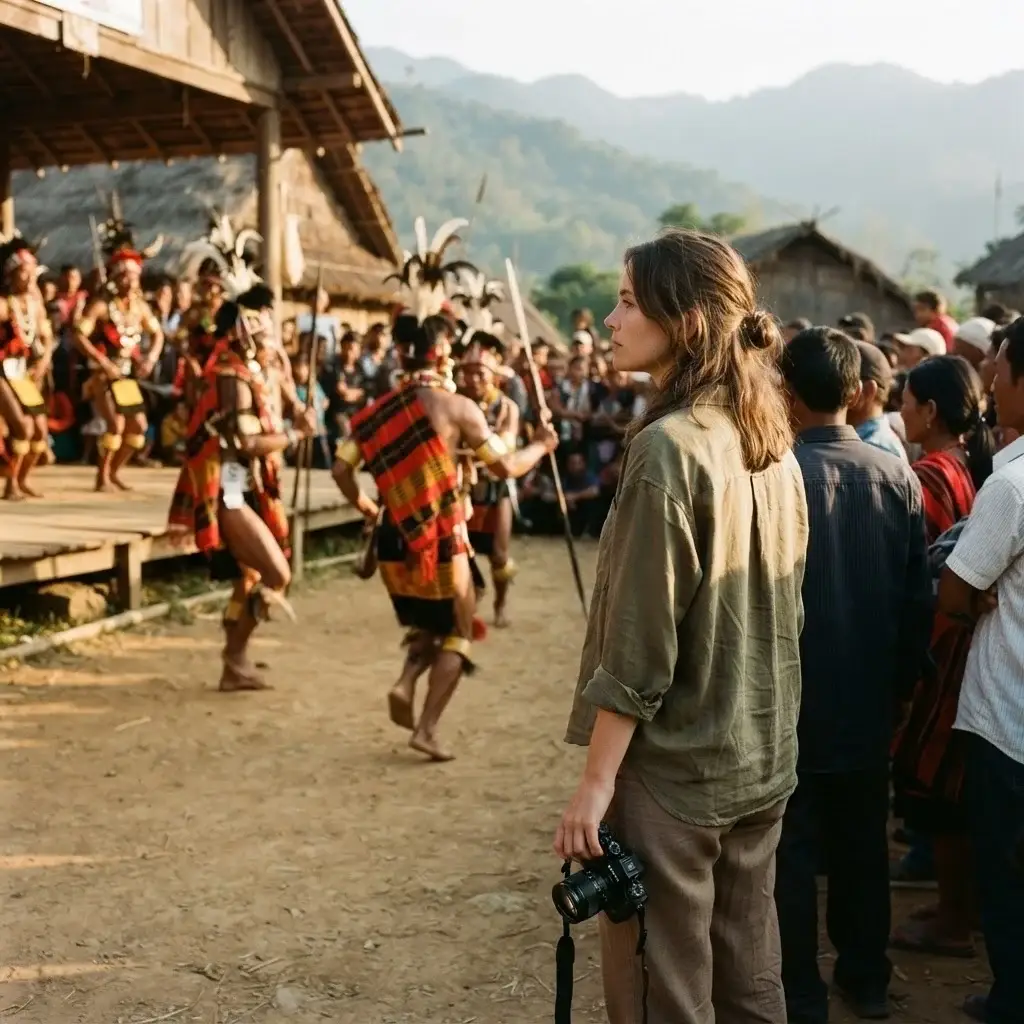
Beyond the Tourist Trail: Real Cultural Traditions Worth Seeking

There is a particular kind of travel memory that never fades. Not the photo in front of the famous landmark, not the airport lounge coffee, not even the Instagram-worthy sunset. The ones that stick are the ones where you witnessed something so deeply human, so rooted in a place and its people, that you felt the weight of it long after you came home.
I know this not from reading about it, but from doing it. When I lived with a family in Ghana, I didn’t experience a “cultural highlight.” I experienced life, at its pace, on its terms. When I taught English in Thailand, I watched how community shaped every single meal, every decision, every celebration. Those weren’t moments I planned for with a guidebook. They were the result of showing up, paying attention, and being willing to go somewhere that wasn’t on the obvious list.
Most travelers never get there. Not because they can’t, but because the travel industry is very good at directing everyone toward the same crowded highlights. This article is about the other option.
Here is a practical, honest guide to finding and experiencing unique cultural traditions in regions most travelers overlook completely.
Why “Lesser-Known” Often Means More Meaningful:
Before we get into specific destinations, it’s worth addressing why these places offer something different. When a tradition is performed for millions of tourists a year, it changes. Sometimes gradually, sometimes not. The people involved become performers rather than participants. The ritual becomes a product. That is not a criticism of popular culture, it is simply what scale does to intimacy.
In smaller, less-trafficked regions, traditions are still practiced for the community first. You are a witness, not a consumer. That shift in dynamic changes everything about how you feel when you’re standing there. The UNESCO Intangible Cultural Heritage list is actually a genuinely useful research tool here. It is a publicly browsable database of hundreds of living traditions across the world, and it includes many attached to places you would never find by scrolling a mainstream travel feed. If you want a starting point for research beyond the obvious, spend an hour there before you plan your next trip.
Now, four regions that solo travelers consistently report as the most genuinely transformative cultural experiences they have ever had.
Nagaland, Northeast India: The Hornbill Festival and the 16 Tribes
Most people who haven’t been to Northeast India couldn’t place Nagaland on a map. That is exactly why this matters. Nagaland is a small mountainous state bordered by Myanmar to the east, and it is home to 16 distinct Naga tribes, each with its own language, traditions, warrior history, and visual identity. For the remaining eleven months of the year, outsiders rarely make it here. But every December, that changes.
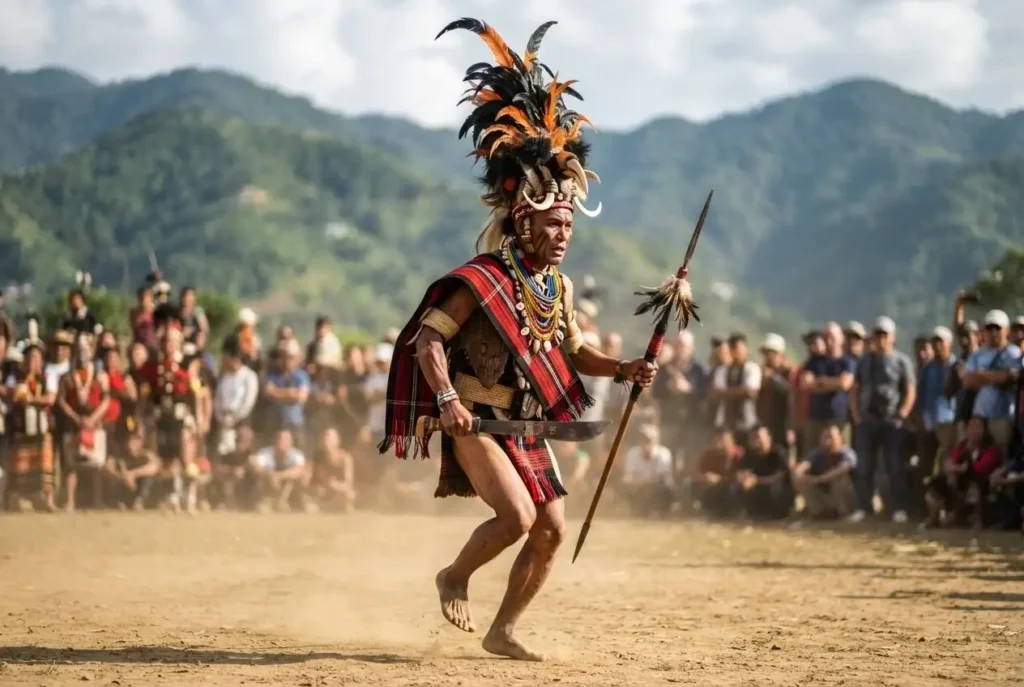
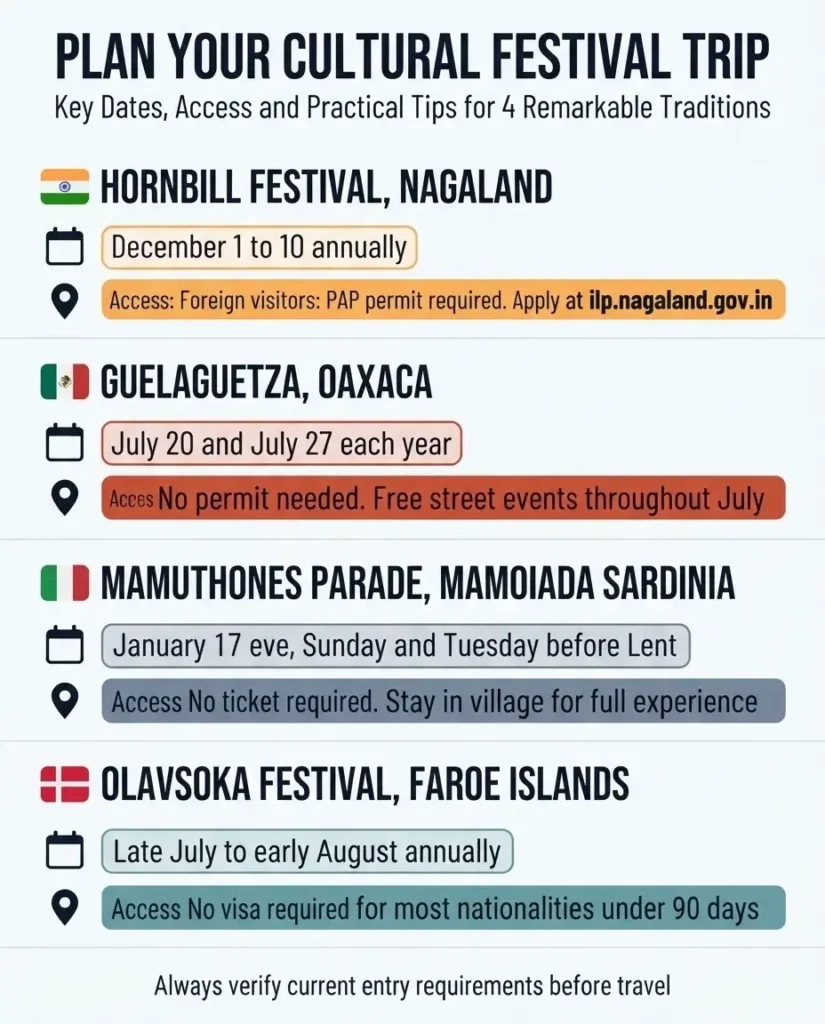
The Hornbill Festival, organized by the Government of Nagaland, runs from December 1 to December 10 each year at Kisama Heritage Village, just outside the state capital Kohima. It was created specifically to celebrate and preserve Naga tribal culture in one place. What that means in practice is ten days of traditional dance, warrior ceremonies, indigenous sports like log-drum beating and stone-pulling competitions, handwoven textiles for sale directly from artisans, and food from across all 16 tribes served at the open-air cultural village.
Here is what solo travelers who make it here consistently describe: the scale is manageable, the crowds are curious rather than overwhelming, and the tribal representatives are not performing at you, they are sharing with you. There is a difference you feel immediately.
Practical note: entry to the cultural grounds costs approximately Rs 50-100 per person per day, which is negligible, but the permit situation requires advance attention. Foreign nationals need both an Indian visa and a Protected Area Permit (PAP) specifically for Nagaland. Indian nationals from outside the region need an Inner Line Permit (ILP). Both can now be applied for online through the Nagaland ILP portal ahead of your visit. Do not leave this to the last minute. The closest major city is Dimapur, which has an airport with connections to Kolkata and Guwahati.
On the food front, don’t miss smoked pork with bamboo shoot, fermented soybean chutney, and rice beer, all found at the festival grounds. These are not tourist-menu approximations. They are what people eat at home.
The morning hours at Kisama are the best time to move around. By mid-morning the main performance areas fill up, but the village lanes are quieter and that is where you will find artisans at work, elders sitting in the shade, and the kind of conversation that happens when no one is rushing to a show.
The Faroe Islands: Chain Dancing, Ballads, and a Culture Hiding in Plain Sight
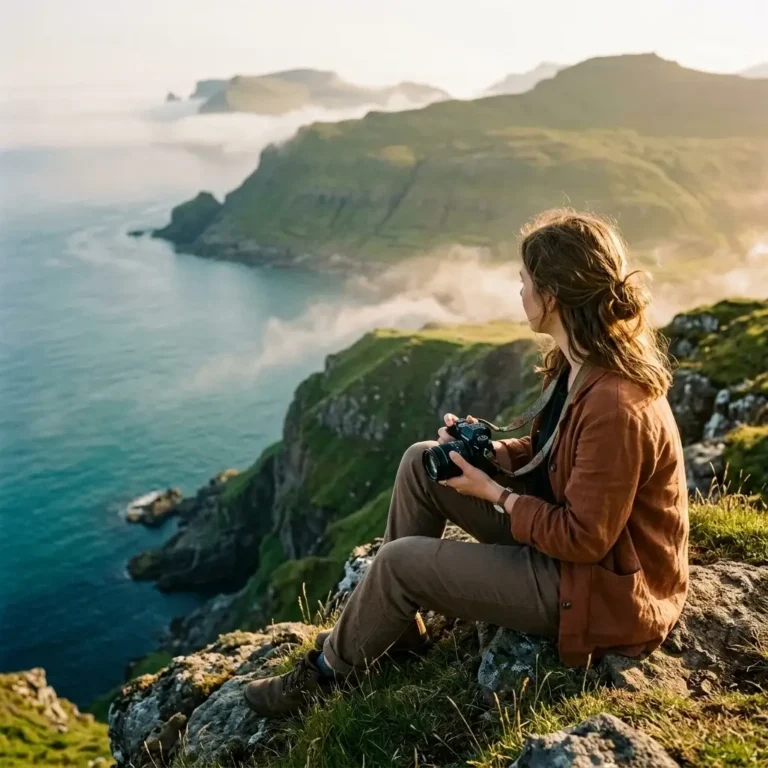
The Faroe Islands sit in the North Atlantic between Norway and Iceland, and they receive a fraction of the tourism that either of those neighbors attract. They are not undiscovered exactly, but they remain deeply, stubbornly themselves in a way that is increasingly rare in the modern world.
What solo travelers consistently report about the Faroes is that the culture here is not presented as entertainment. It is just how people live. The most striking example of this is the chain dance, known locally as the Faroese dansur. This is a medieval circle dance that has been performed continuously since the Middle Ages, passed down orally through generation after generation because for much of their history, the Faroese had no written language. The dance is performed to ballads called kvæði, unaccompanied by any instruments, and these ballads tell stories from Norse mythology, Viking history, and island folklore. The chain dance is not a museum piece. It is danced at weddings, festivals, and celebrations throughout the year.
The official Faroe Islands tourism board, Visit Faroe Islands, runs a program called “Heim” experiences, which connects visitors directly with locals for authentic cultural encounters: sheep farming on a hillside farm, traditional Faroese cooking in someone’s home kitchen, or listening to kvæði in a small village hall. You can browse these through the Visit Faroe Islands cultural experiences page. This is the kind of infrastructure that makes cultural access as a solo traveler genuinely possible, rather than theoretical.
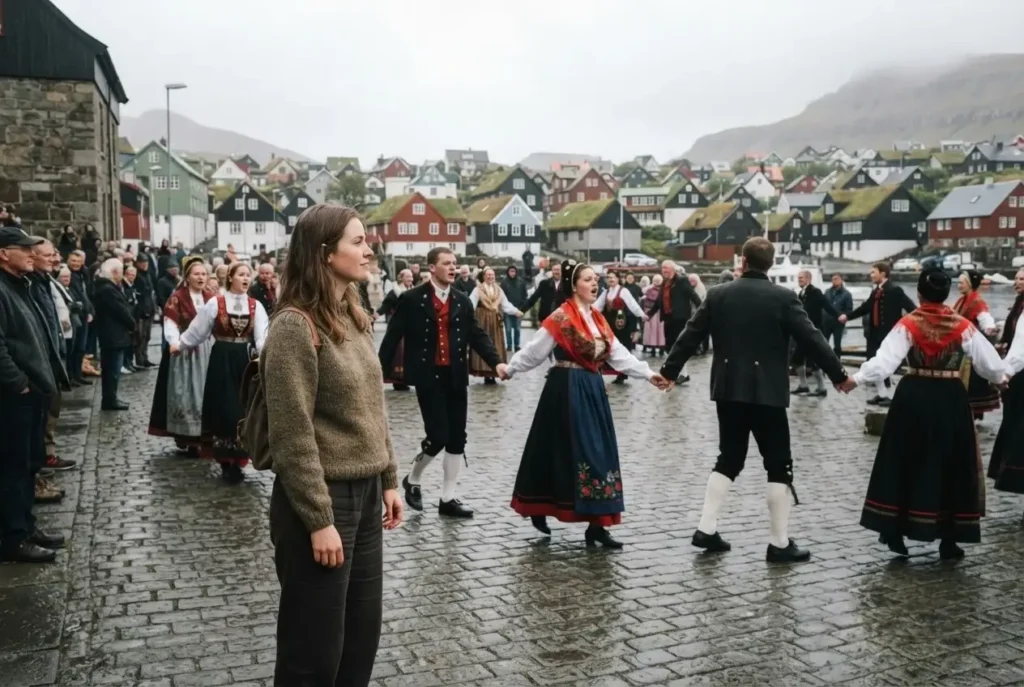
The Ólavsøka Festival in late July and early August, celebrated in the capital Tórshavn, is the largest national celebration of the year and the best single opportunity to see chain dancing in a fully communal context. The Faroes are a self-governing territory of Denmark. No visa is required for most nationalities for stays under 90 days, and the main entry point is Vágar Airport, with direct flights from Copenhagen, Edinburgh, and several other European cities.
What to eat while you are there: skerpikjøt, which is wind-dried mutton aged for up to eighteen months, is the defining food of the islands and not remotely like anything you have tried. It is served thinly sliced, intensely flavored, and usually accompanied by rye bread. It is challenging and wonderful in equal measure.
Oaxaca, Mexico: Sixteen Indigenous Cultures in One State
Most travelers who visit Mexico go to the beach. A smaller group makes it to Oaxaca City. Almost none go deep enough into the region to understand what is actually here: a state so linguistically and culturally complex that, as researchers at IndigenousMexico.org note, the linguistic diversity of Oaxaca is comparable to the entire continent of Europe, with sixteen formally recognized indigenous groups maintaining their own languages, cosmologies, food traditions, and ceremonial practices.
The Zapotecs and Mixtecs are the most widely known of these groups, but even for most visitors, they remain abstract names rather than living cultures. That gap closes quickly when you spend time in the villages rather than the city.
The single best event for a first-time visitor to Oaxaca who wants to experience this cultural depth in a concentrated way is the Guelaguetza, the annual indigenous dance and cultural festival held at the Cerro del Fortín amphitheater above Oaxaca City. The official Guelaguetza festival site lists the 2026 dates as July 20 and July 27, with community events, street parades, and village celebrations happening throughout the entire month. This is often described as the largest indigenous cultural celebration in Latin America. Each of the eight regions of Oaxaca sends delegations dressed in full traditional regalia to perform their distinct dances, and the visual variety alone is extraordinary.
But the Guelaguetza is the introduction, not the destination. The real depth comes from the surrounding villages. Teotitlán del Valle, about thirty minutes from Oaxaca City, is a Zapotec weaving community where families have been producing hand-dyed, hand-loomed wool rugs using techniques that predate the Spanish conquest. San Bartolo Coyotepec is home to the distinctive black clay pottery known as barro negro. Visiting a workshop in either village is not a craft demonstration for tourists. It is a peek into an economy and an identity that have remained intact against significant historical pressure.
For food, Oaxacan cuisine is one of the most distinctive in all of Mexico. The seven moles of Oaxaca are famous, but don’t overlook tlayudas (large flat tortillas topped with black beans, Oaxacan string cheese, and your choice of meat), chapulines (toasted grasshoppers seasoned with lime and chile, sold by the bag in the central market), and mezcal from small-batch producers in nearby Santiago Matatlán, which calls itself the mezcal capital of the world. Eating these things in the right context, at a family-run comedor in a village market, is an act of cultural participation.
Mamoiada, Sardinia: An Ancient Carnival That Belongs to No One Else
Sardinia is an Italian island, but Sardinians will tell you plainly and with some pride that they are not quite Italian. The island has its own language, its own architecture, its own food culture, and some of its oldest villages contain traditions that predate the Roman Empire. Mamoiada is one of those villages.
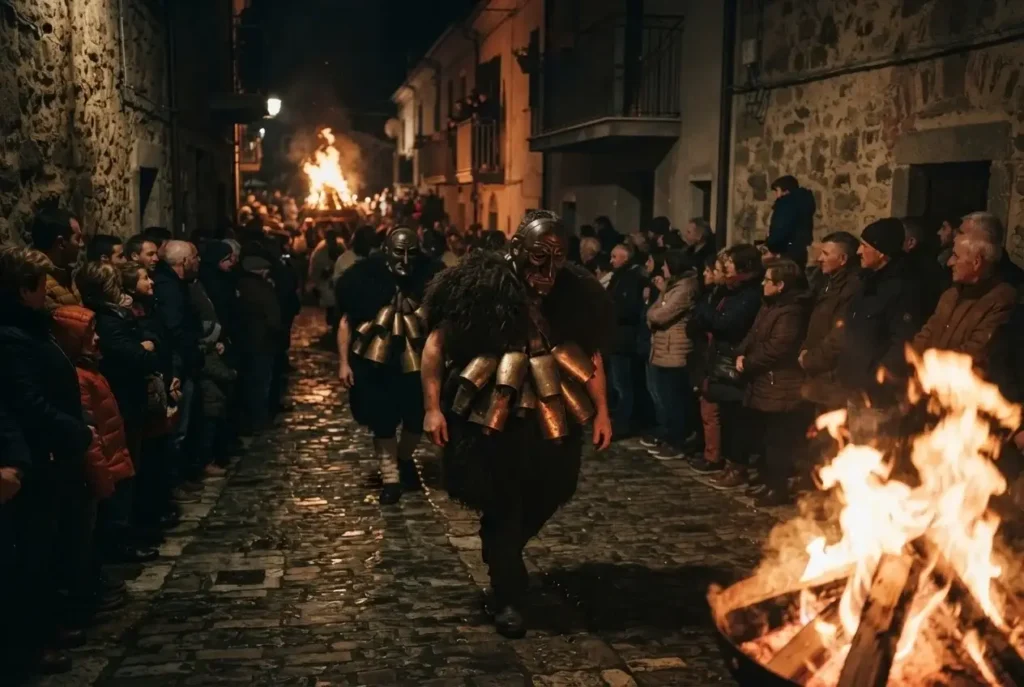
Each winter, the village of approximately 2,300 people in Sardinia’s central Barbagia region performs one of the most ancient and enigmatic winter rituals in all of Europe. As Smithsonian Magazine documented in depth, the parade of Mamuthones may have its roots in the Nuragic civilization, which began almost 4,000 years ago. The Mamuthones are twelve men dressed in dark sheepskin cloaks, severe carved wooden masks, and carrying over 60 pounds of cowbells strapped across their backs. They parade through the streets in two parallel lines, moving in a slow synchronized shuffle that makes the bells ring in a controlled, hypnotic rhythm. Accompanying them are the Issohadores, who wear white masks and carry lassos, darting through the crowd.
The parade happens three times each winter: the eve of January 17 (the feast of St. Anthony the Abbot), and on the Sunday and Tuesday before Lent. The January 17 event is the most intimate of the three. It happens at night, through the whole village, circling dozens of bonfires that residents have spent weeks collecting wood for. This is not a performance designed for outsiders. It is a community ritual about collective survival and the turning of the season, and you are welcome to witness it.
Getting to Mamoiada requires a flight to Cagliari or Olbia, then a bus or rental car inland. It is not difficult, just uncommonly traveled. Stay in one of the village’s small guesthouses if you can, because the informal conversations at breakfast or over a glass of Cannonau red wine in the evening will tell you more than any organized tour.
Speaking of Cannonau: this robust, deeply flavored Sardinian red grape variety is grown in the Barbagia region surrounding Mamoiada and is one of the reasons the area is studied as a Blue Zone, one of the few places on earth where people consistently live past 100 years old. Pour a glass with a plate of roast suckling pig (porceddu), the defining dish of the Sardinian interior, and you will understand something about why these people have no particular desire to be anywhere else.
How to Show Up Right: A Solo Traveler’s Approach to Cultural Traditions
This section matters as much as any destination detail. Showing up at a cultural tradition as a solo traveler in a community that doesn’t know you requires a specific kind of presence. Here is what consistently works, drawn from solo travelers and cultural guides across these regions and from my own experience with deep cultural immersion in Ghana and Thailand.
First, go with a genuine question rather than a camera goal. The moment your primary objective is the photograph, you have already stepped out of the experience. Bring the camera, of course. But let the experience come first.
Second, learn a few words in the local language. Not for fluency. Just for respect. “Hello,” “thank you,” and “this is delicious” in the language of the community you are visiting opens more doors than a month of careful preparation in English. When I was teaching in Thailand and even during my time in Ghana, the moments of warmest connection always came through the simplest linguistic efforts.
Third, hire a local guide wherever possible, and specifically a local rather than a tour company based in the nearest major city. In Nagaland, this means a Naga guide from within the festival community. In Oaxaca, it means someone from the village rather than a guide from Oaxaca City. The difference in depth is enormous, and the money goes directly where it matters.
Fourth, understand that some parts of a tradition are not meant for outsiders. Not every ceremony at the Hornbill Festival is open to visitors. Not every stage of the Mamuthones procession is accessible to anyone outside Mamoiada’s community. Respecting those boundaries is not a loss. It is an acknowledgment that these are living traditions belonging to real people, not content created for your timeline.
Finally, give yourself more time than you think you need. The most meaningful cultural moments are almost never on the official schedule. They are in the village lane at 7am, or the roadside food stall after the ceremony ends, or the conversation with the artisan who decides, for reasons you will never fully understand, that today she wants to tell you the whole history of how the pattern on that rug connects to her grandmother’s mountain village.
Starting Your Search: How to Find Traditions No One Else Is Visiting
Beyond the four destinations above, here is a simple process for finding cultural traditions in lesser-known regions on your own. Start with the UNESCO Intangible Cultural Heritage database. Browse by country or region. When a tradition catches your attention, search for it specifically. Look for the local or regional government page associated with it rather than a travel blog. Check whether there is a festival or public event tied to it, and when that event occurs. Then build your trip around the timing.
The Faroe Islands’ chain dance led me here because I followed a single thread of curiosity about medieval oral traditions in the North Atlantic. That thread will take you somewhere genuinely unexpected if you follow it without needing the destination to be famous first.
That is the mindset shift that separates a trip you forget from one you carry with you for years.