I still remember standing in the middle of JFK Airport back in 2018, staring down at a massive, bursting rolling suitcase that weighed nearly fifty pounds. I was about to board a flight to Europe for my very first major solo backpacking trip, and I was terrified. I had packed for every single hypothetical disaster. I had heavy boots I would never wear, four different jackets, and enough casual t-shirts to clothe a small village. Ten days later, dragging that monstrous bag up five flights of narrow, winding stairs in a tiny flat in Paris, I broke down crying. My shoulders ached, my palms were blistered, and I realized that my giant bag wasn’t keeping me safe—it was keeping me miserable.
Before I became a full-time traveler, I worked long hours as a certified sightseeing guide on the double-decker buses in New York City. I spent all day on my feet, shouting over traffic, and talking to tourists from every corner of the planet. Later, I waitressed late nights in a greasy diner just to save every extra dollar for plane tickets. Working those grind-heavy jobs taught me a lot about survival, efficiency, and comfort. If your shoes hurt or your clothes restrict your movement, your day is ruined.
When I finally quit my 9-to-5 office job to travel the world full-time, I vowed to never carry a heavy bag again. I learned the hard way that true travel freedom means fitting everything you need into a single carry-on backpack. To do that, you have to master a specific skill: learning how to pack versatile outfits for any trip.
Packing light is not about deprivation. It is not about wearing the exact same smelly shirt for a month or looking boring in your travel photos. It is about choosing smart, high-functioning pieces that blend together perfectly. When you pack light, you build confidence. You can hop off a train, skip the crowded taxi lines, and walk directly into a local market without hauling a giant trunk behind you. Here is my complete, battle-tested blueprint to help you pack a versatile, minimalist wardrobe for your next big adventure.
The Psychology of Overpacking: Why We Bring Too Much
We do not overpack because we are stupid. We overpack because we are anxious. When you are preparing to step out of your comfort zone and fly to a brand-new country where you do not speak the language, your brain looks for control. You start asking yourself frantic “what if” questions. What if I get invited to a fancy gala? What if it snows in July? What if I spill soup on my favorite pants on day two?
To soothe that anxiety, you throw more clothes into your bag. Your suitcase becomes a security blanket. But when you land, you quickly realize that the local people in Tokyo, Lima, or Rome live normal lives. They do laundry, they walk through the rain, and they wear practical clothes.
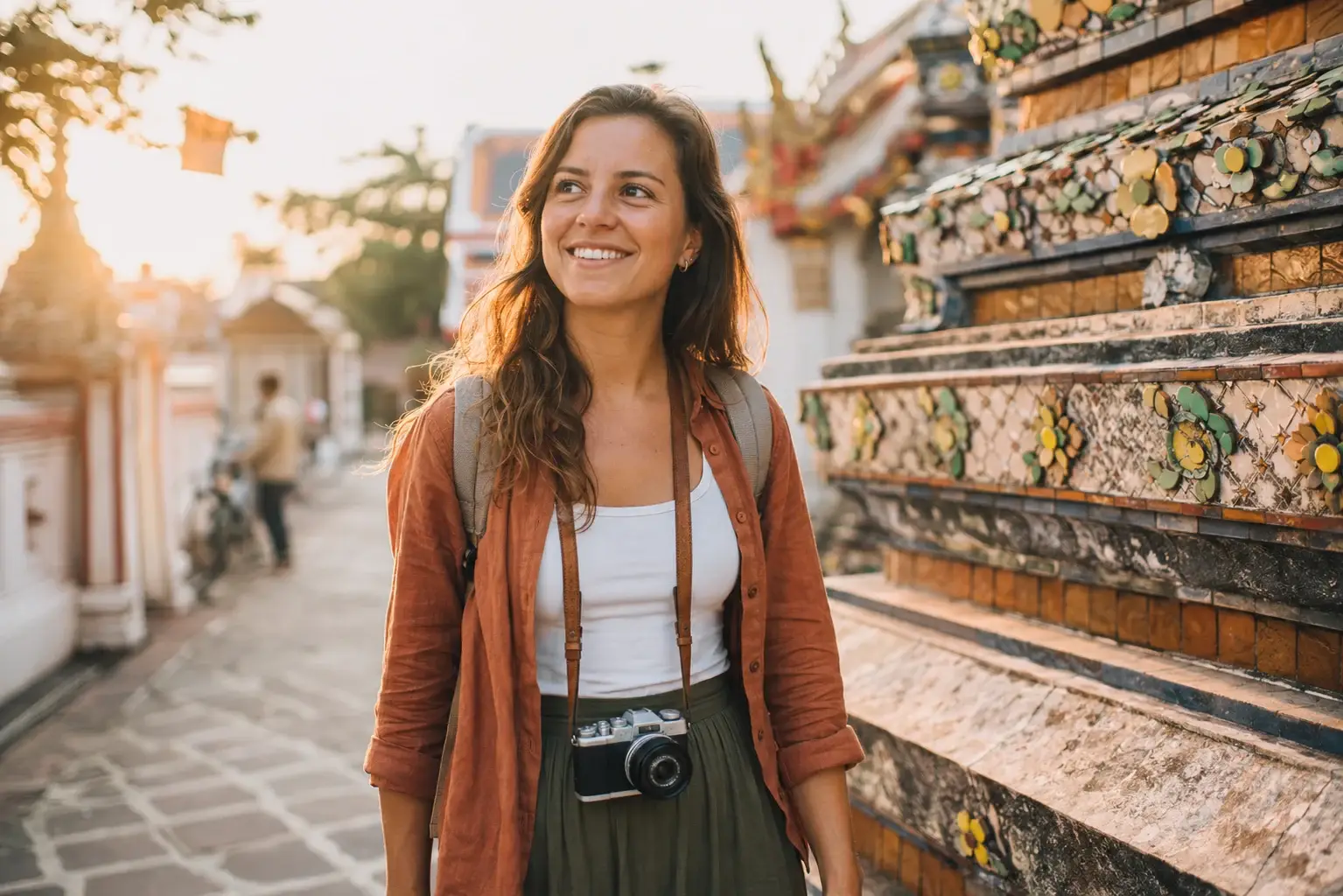
If you do run into a sudden weather change, you can easily buy a cheap umbrella or a cozy sweater from a neighborhood shop. Some of my absolute favorite travel souvenirs are simple, practical clothing items I bought out of pure necessity on the road, like a lightweight linen shirt from a market stall in Bangkok. Shift your mindset from packing for “worst-case scenarios” to packing for the 80% daily reality of your trip.
The Core Concept of the Travel Capsule Wardrobe
The secret weapon of every seasoned solo traveler is the capsule wardrobe. This is a small, curated collection of clothes where every single top matches every single bottom. If you pack four tops and four bottoms that all look good together, you do not just have four outfits—you have sixteen different combinations.
To make this work, you need to follow a strict color palette. I always suggest picking one or two neutral base colors, like black, navy blue, charcoal gray, or deep olive green.
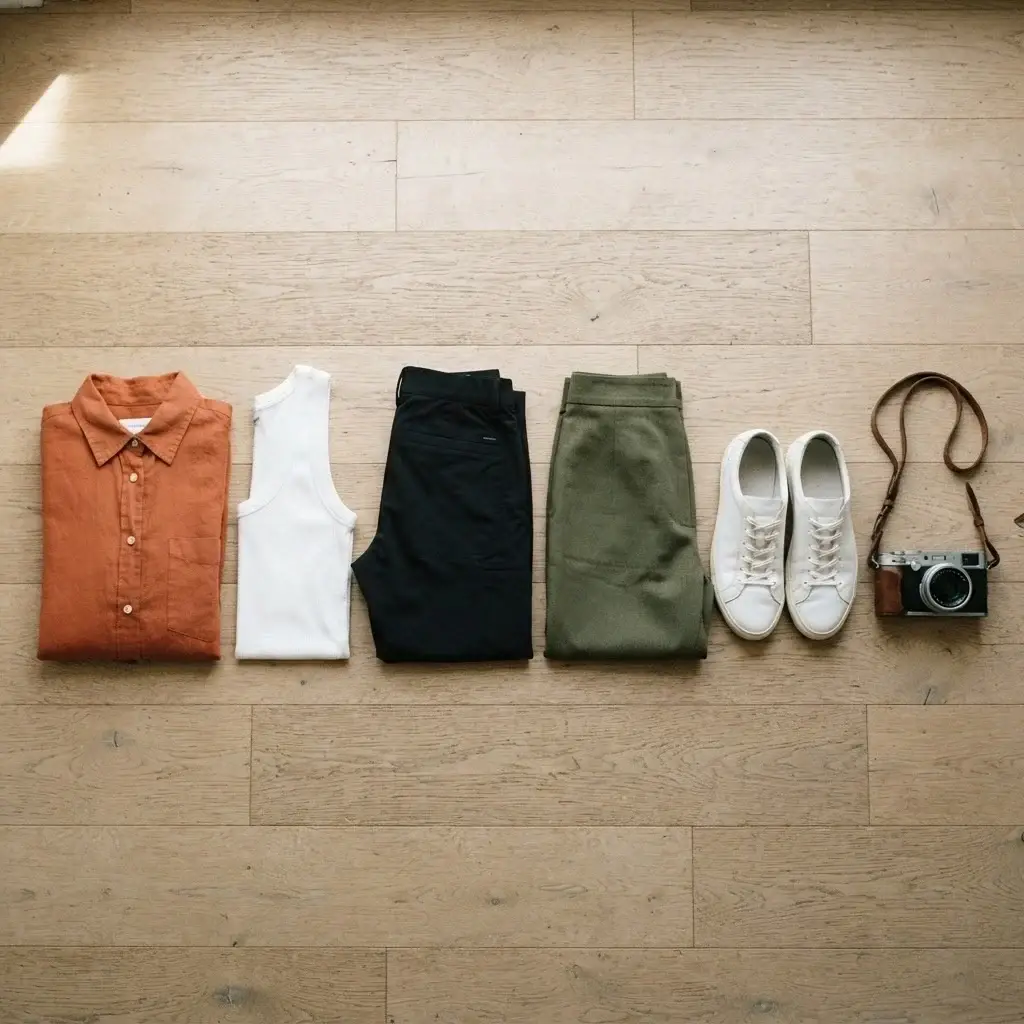
Your base colors should form the foundation of your pants, shorts, skirts, and jackets. Then, you can choose two or three accent colors that bring some personality and life to your tops or scarves. For my personal wardrobe, I love using black and olive green as my base, with pops of warm terracotta and mustard yellow in my shirts.
When you stick to a cohesive color palette, getting dressed in a dim hostel room or a small hotel becomes completely effortless. You can grab any top and any bottom blindly from your bag, put them on, and look instantly put-together.
Choosing the Right Fabrics: The Good, the Bad, and the Heavy
When you are learning how to pack versatile outfits for any trip, the fabric tag on your clothes matters far more than the brand name. The wrong fabrics will trap sweat, wrinkle instantly, take three days to dry on a clothing line, and take up massive amounts of physical space in your bag.
The Miracle Fabrics to Hunt For
- Merino Wool: This is the holy grail of travel clothing. Merino wool fibers are incredibly fine, soft, and naturally resistant to odor-causing bacteria. You can wear a high-quality merino wool t-shirt through a sweaty, high-humidity day of exploring temples, hang it up to air out at night, and wear it again the next day without it smelling bad at all. It also regulates temperature beautifully, keeping you cool in the sun and warm in the evening breeze.
- Linen-Cotton Blends: Pure linen wrinkles if you even look at it wrong, but a good linen-cotton blend gives you all the breathable, lightweight benefits of linen with the structure and wrinkle-resistance of cotton. It is perfect for hot, tropical climates where you need to keep your skin covered from the sun or respect local dress codes.
- Synthetic Performance Blends: Look for lightweight nylon, polyester, and spandex mixes that feature moisture-wicking technology. These fabrics are durable, stretch comfortably when you are sitting on long bus rides, and can be washed in a hotel sink and dried completely in a couple of hours.
The Heavy Fabrics to Leave at Home
- Heavy Denim: I love a good pair of thick jeans when I am hanging out at home in New York, but they are an absolute nightmare for travel. Thick denim is heavy, bulky, traps heat, and takes an eternity to dry if you get caught in a sudden rainstorm. If you absolutely must bring jeans, wear your single heaviest pair on the airplane so it does not take up room in your suitcase.
- Thick Sweatshirt Fleece: Giant, bulky hoodies are massive space hogs. A single thick fleece hoodie can take up a third of a standard carry-on backpack. Instead, swap it out for a sleek, lightweight sweater or a packable micro-fleece jacket that offers the exact same warmth for a fraction of the physical size.
The 5-4-3-2-1 Packing Rule That Never Fails
If you struggle with narrowing down your clothing list, you need a concrete, numerical rule to keep you honest. My absolute favorite formula for a week-long trip—which can be easily adapted for a month or a year of travel through regular laundry—is the classic 5-4-3-2-1 rule.
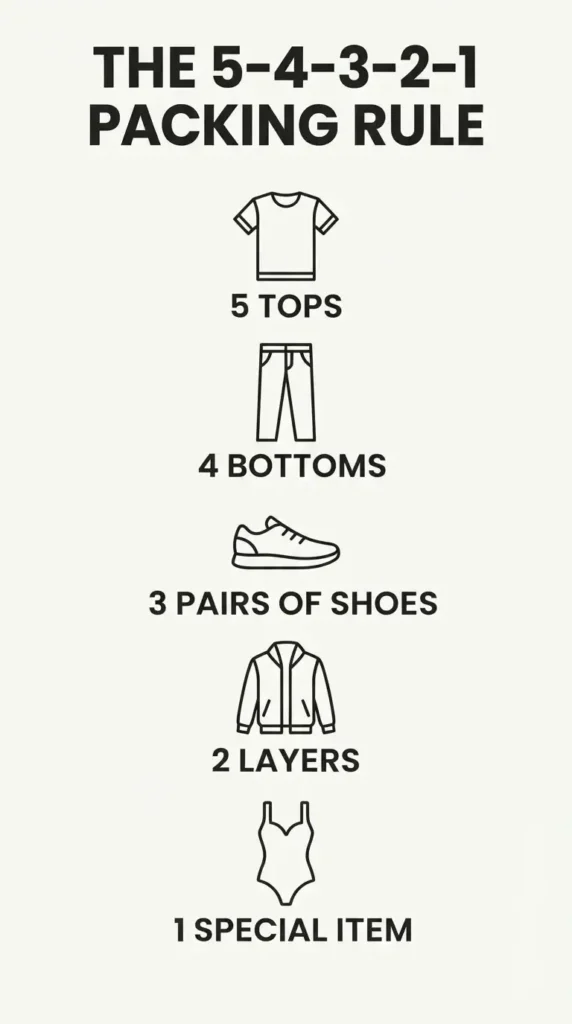
Let’s break down exactly how to select these items so they maximize your style options while keeping your physical footprint incredibly small.
5 Versatile Tops
Your tops should be lightweight and easy to layer. I recommend packing two basic crew-neck t-shirts (one neutral, one accent color), one breathable tank top or camisole, one lightweight long-sleeve shirt for sun and bug protection, and one classic, button-down linen or chambray shirt. A good button-down shirt is a true chameleon. You can wear it buttoned up and tucked into long pants for a nice dinner, leave it completely open over a tank top as a light jacket during a daytime walk, or tie it around your waist if the afternoon gets hot.
4 Adaptable Bottoms
For your bottoms, focus on items that can handle miles of walking but still look presentable if you stop at a nice cafe. Bring one pair of stretchy, durable technical travel pants (brands like Athleta, Prana, or Lululemon make great options that look like real trousers but perform like workout gear), one pair of tailored shorts, one casual skirt or dressier midi-skirt, and one pair of comfortable leggings. Leggings are great because they serve double duty: you can wear them as comfortable pants on long travel days, use them for an early morning hike, or layer them underneath your skirt if the temperature drops unexpectedly.
3 Pairs of Functional Shoes
Shoes are always the biggest obstacle to packing light. They are bulky, dirty, and heavy. To keep your bag manageable, you must cap your footwear at three pairs maximum, and wear your bulkiest pair onto the plane.
First, you need a stellar pair of supportive, broken-in walking sneakers. You will be walking thousands of steps on hard concrete, rough dirt paths, and ancient stone streets, so do not sacrifice comfort for fashion here. Find a clean, minimalist leather or canvas sneaker that pairs well with both pants and skirts. Second, bring a pair of versatile, comfortable sandals with secure ankle straps for hot days. Finally, pack one pair of lightweight, packable slip-ons or flat ankle boots for dressier evenings.
2 Weather-Appropriate Layers
Even if you are traveling to a warm tropical destination, you will encounter aggressive air conditioning on planes, long-distance buses, and trains. Bring one lightweight, cozy cardigan or knit sweater that layers easily over your t-shirts. Pair that with one highly compressible, wind-resistant rain jacket or windbreaker. A good rain jacket protects you from unexpected storms without adding unnecessary bulk to your pack.
1 Multi-Use Special Item
This last spot belongs to an item tailored specifically to your destination. If you are heading to the beautiful beaches of Southern Thailand, this will be a quick-drying swimsuit. If you are planning an autumn trek through the misty valleys of Peru, this might be a warm, packable down vest. Choose one item that serves a specific, high-value purpose for your unique itinerary.
Adapting Your Wardrobe for Cultural Respect and Immersion
As a solo traveler, one of my deepest core values is cultural curiosity and respect. When you visit historical sites, religious temples, and traditional neighborhoods around the world, how you dress matters. It signals to the local community that you respect their heritage and traditions.
But dressing conservatively does not mean you have to pack a completely separate wardrobe or carry heavy, restrictive clothing. It simply means you need to be strategic about your layers and choices.
When I was traveling through Southeast Asia, I spent weeks exploring the breathtaking historic temples. To prepare for my journeys, I regularly reviewed the comprehensive safety updates and international entry requirements on the US Department of State Travel advisory pages to make sure I had all my documentation in perfect order before moving between borders.
But beyond the official paperwork, I had to ensure my wardrobe met local standards. Many sacred sites require your shoulders and knees to be completely covered before you are allowed to enter.
TEMPLE DRESS CODE VISUAL GUIDE:
[YES] Covered Shoulders –> Wear a light tee or throw a scarf over a tank.
[YES] Below-Knee Bottoms –> Maxi skirts, midi dresses, or linen trousers.
[NO] Short Shorts/Tanks –> Will be denied entry at sacred cultural sites.
Instead of packing heavy long-sleeve shirts that would leave me melting in the intense tropical heat, I packed two incredibly versatile items: a lightweight, flowy midi-skirt and a large, breathable rayon scarf.

During hot daytime walks through the city streets, I could wear a comfortable tank top and shorts.
When I approached a sacred temple site, I simply pulled the midi-skirt over my shorts and draped the rayon scarf over my shoulders like a shawl. Instantly, I was appropriately covered, respectful, and perfectly comfortable in the heat.
This approach works beautifully in any culturally conservative region. A large, high-quality scarf or sarong is arguably the most versatile item any traveler can own. It can be a shoulder cover in a temple, a makeshift beach blanket, a light towel, an emergency head cover in a rain shower, or an extra layer of warmth around your neck on a freezing, air-conditioned bus ride.
Navigating Local Transit with a Lightweight Bag
One of the greatest rewards of learning how to pack versatile outfits for any trip is the sheer ease of navigation it offers. When your clothing choices are streamlined, your entire transit experience transforms from a stressful chore into a seamless adventure. You become nimble, independent, and fast.
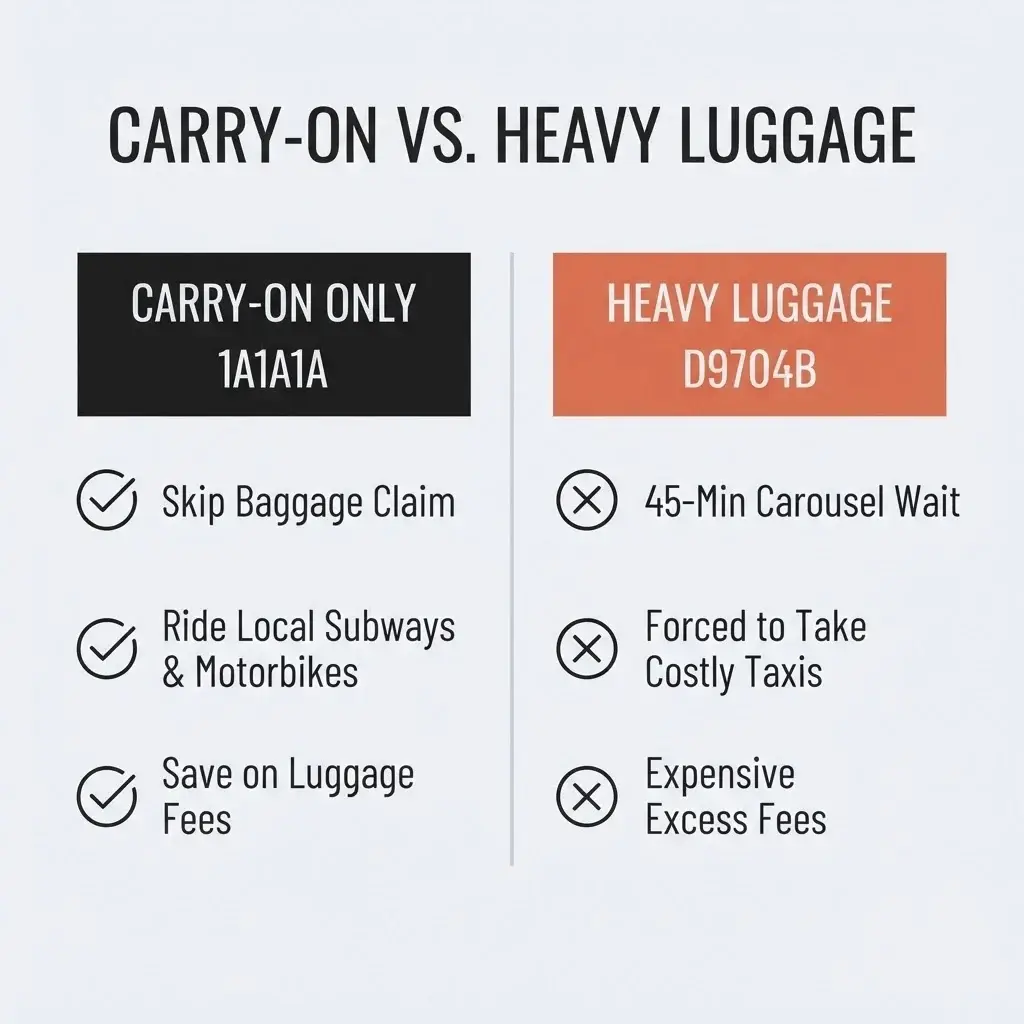
Imagine landing at an airport after a long, exhausting flight. Instead of standing anxiously around a crowded baggage carousel for forty-five minutes, praying that the airline didn’t lose your suitcase, you simply walk right past the crowds with your lightweight backpack. You breeze through customs and step out into the fresh air, ready to explore immediately.
If you are traveling through bustling cities across Southeast Asia, you can download a local rideshare app to get around safely and efficiently. I always check the official Grab app overview for international travelers before I land in a new city so I can easily book a quick, affordable motorbike or car ride directly from my phone without having to haggle with unregulated taxi drivers at the curb.
TRANSIT SCENARIO COMPARISON:
If you are carrying a massive, heavy rolling suitcase, trying to squeeze into a crowded local subway car or hopping onto the back of a motorbike taxi is practically impossible. You are forced to pay expensive rates for large private cars, and you become an easy target for scams because you look visibly weighed down and overwhelmed.
With a small, versatile carry-on bag, you can easily slide into a crowded train car, throw your bag onto an overhead rack, or walk down a vibrant cobblestone street to find your guesthouse without breaking a sweat. You save massive amounts of money on transportation, protect your physical energy, and keep your attention focused outward on the gorgeous sights around you rather than downward on your luggage.
Smart Packing Techniques: Roll, Compress, and Conquer
Once you have selected your versatile clothing items, how you place them inside your bag makes a massive difference in maximizing your available space and preventing wrinkles.
The Ranger Roll Method
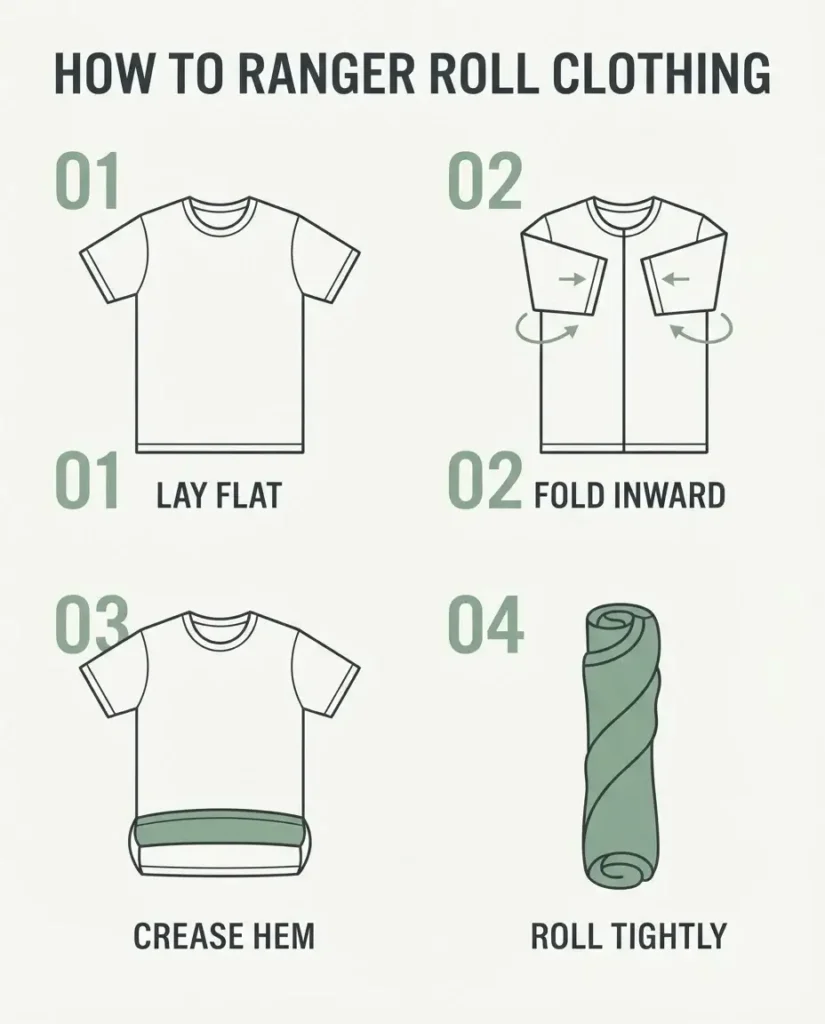
Do not fold your clothes flat like you do in your dresser drawers at home. Flat folding creates hard creases and wastes an immense amount of space because air gets trapped between the layers. Instead, use the military or “ranger roll” method. Lay your shirt or pants completely flat, fold the sleeves or waistband inward to create a straight rectangle, and then roll the fabric down tightly from the top to the bottom like a tight sleeping bag. This compresses the fabric down to its absolute minimum size and prevents items from shifting around and wrinkling during transit.
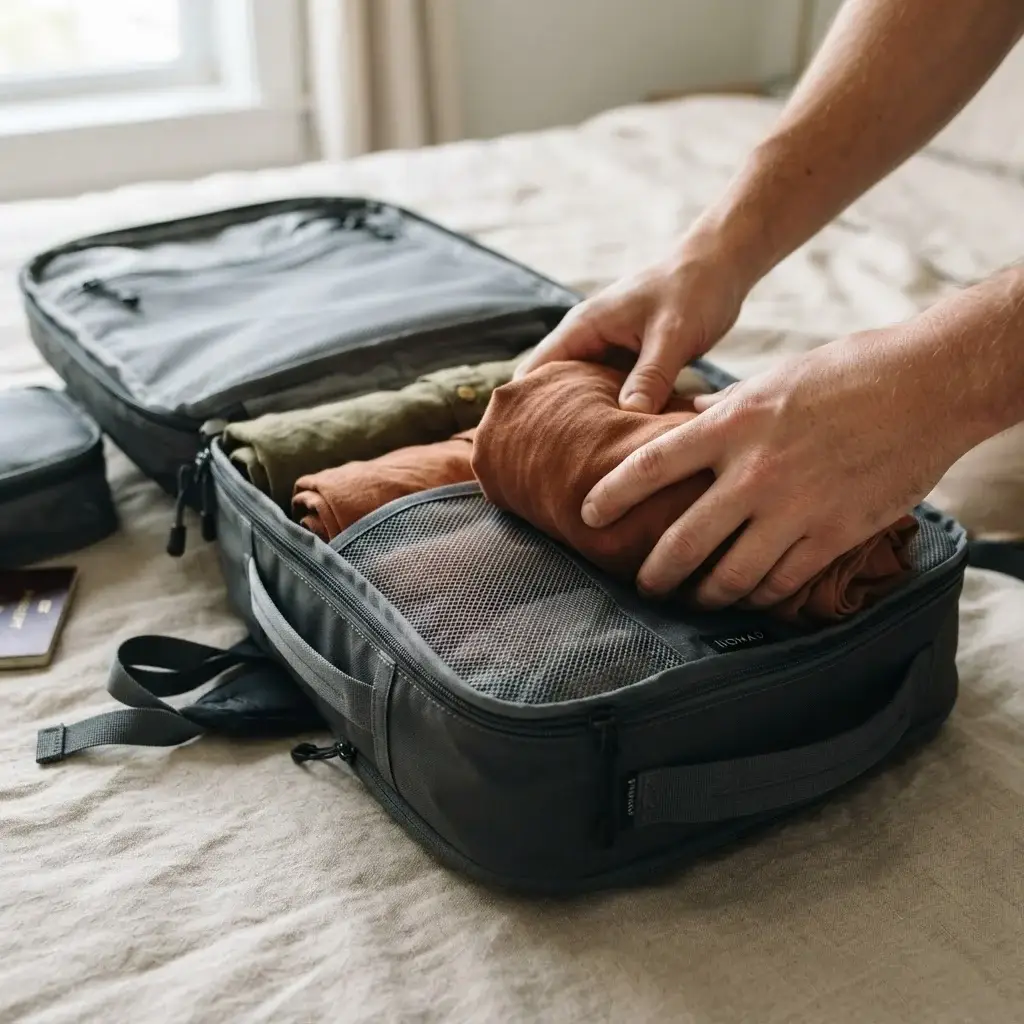
Utilizing Packing Cubes
If you are not using packing cubes yet, they will completely change your travel life. Packing cubes are lightweight, zippered fabric containers that act like portable dresser drawers for your backpack or suitcase.
I use one medium cube for all my rolled bottoms, one small cube for my rolled tops, and one separate cube for undergarments and socks. Packing cubes keep your bag incredibly organized. When you arrive at a hostel or guesthouse, you do not have to dump your entire bag out onto the bed just to find one specific clean shirt. You simply pull out the specific cube you need, unzip it, grab your item, and slide the cube back in. It keeps your gear compact and stress-free.
Maintaining Health, Safety, and Fabric Longevity on the Road
When you travel with fewer clothes, you will be wearing and washing your garments far more frequently than you do at home. This means you need to take proactive steps to care for your health and protect your hard-working fabrics so they last throughout your entire journey.
Keeping your clothes clean is not just about looking good—it is a vital part of staying healthy and comfortable on the road. Dirty, damp clothing can quickly harbor bacteria, lead to painful skin chafing, or attract unwanted pests.
To ensure you stay completely healthy while exploring diverse regions, it is incredibly helpful to read through the official CDC Travelers’ Health destination guidelines to stay updated on essential vaccine recommendations, local water safety standards, and regional health advisories before you pack your bags. Knowing the local conditions helps you prepare precisely what you need to protect your body.
LAUNDRY SINK METHOD:
[STEP 1] Fill sink with lukewarm water + add a few drops of travel soap.
[STEP 2] Submerge clothes, agitate gently, and let soak for 10 minutes.
[STEP 3] Rinse thoroughly with clean water until all soap bubbles are gone.
[STEP 4] Roll tightly inside a dry hotel towel to wring out excess moisture.
[STEP 5] Hang up overnight near a window or an open air breeze to dry.
When it comes to laundry on a minimalist trip, you do not need to find a professional laundromat every few days. I pack a tiny, concentrated bottle of biodegradable travel soap and a sink stopper in my toiletry kit. Every two or three days, before I go to bed, I spend ten minutes washing my worn tops and undergarments directly in my room’s sink.
After rinsing the clothes thoroughly, I lay them flat on a dry towel, roll the towel up tightly like a burrito, and stomp on it to wring out the excess moisture. Then, I hang the clothes up on a travel clothesline near an open window or fan. Because I selectively packed quick-drying performance synthetics and lightweight merino wool, my clothes are bone dry, fresh, and ready to wear again by the time I wake up in the morning.
Embracing the Freedom of the Light Load
Learning how to pack versatile outfits for any trip is ultimately an exercise in self-trust. It is a declaration that you do not need a mountain of material possessions to feel safe, confident, and beautiful out in the world.
When you strip away the heavy layers of unnecessary luggage, you open yourself up completely to the magic of travel. You stop worrying about your things, and you start focusing entirely on the people you meet, the rich histories you encounter, the vibrant local foods you taste, and the incredible personal growth that happens when you step boldly into the unknown.
Pack with courage, choose your pieces with intention, and leave the extra baggage behind. The world is waiting for you, and trust me—you can carry everything you truly need to find it right on your own back.